Does AI Save You Time? What a Study of 9,000 Workers Found
Verdict: Hype
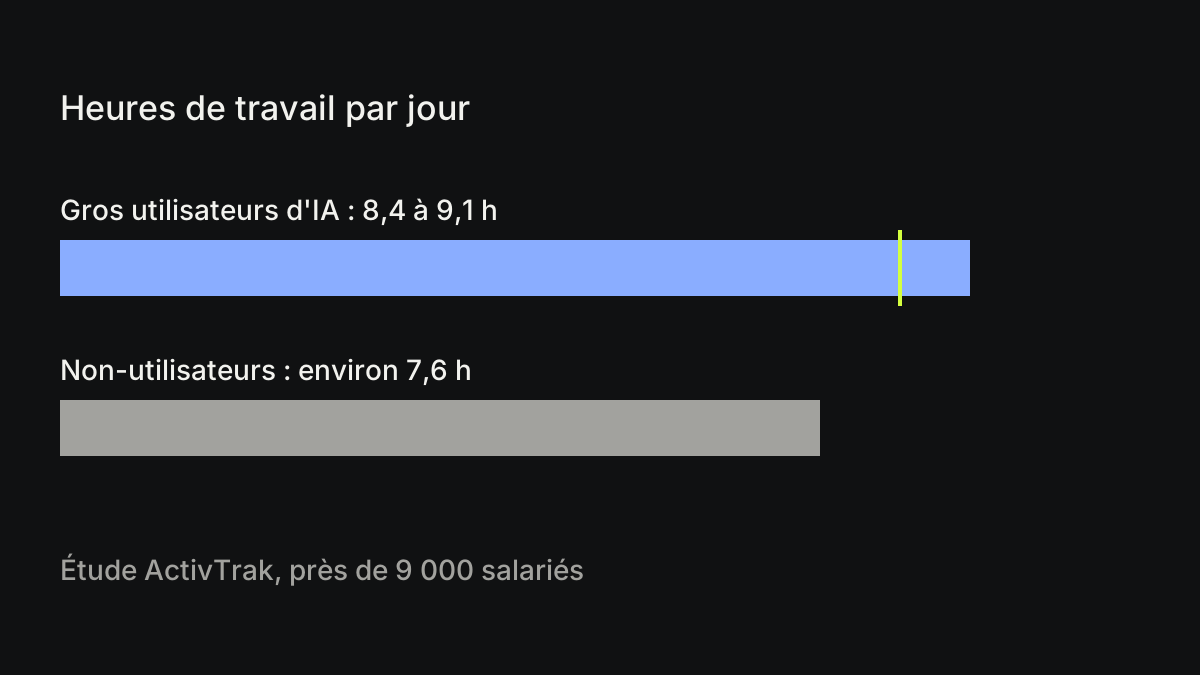
According to a study by ActivTrak, an American software company, heavy AI users work longer hours than everyone else. The study covers nearly 9,000 employees over six months. The gap ranges from 48 minutes to 1 hour 30 minutes a day.
The numbers, side by side
| Metric | Heavy AI users | Comparison |
|---|---|---|
| Length of the workday | 8.4 to 9.1 h | about 7.6 h for non-users |
| Uninterrupted work session | 37.8 min | 48.2 min for occasional users |
| Meetings | 3% of the day | 5% for non-users |
| After-hours activity | 32.3% on average | not given |
So heavy users string together longer days, with shorter stretches of focus. They also switch between apps more often. According to Siècle Digital, the French tech news site that covered the study, after-hours activity adds up to about 18 extra minutes a day for this group.
The time saved doesn't show up anywhere
The usual argument from AI's supporters goes like this: a task done faster frees up time. ActivTrak acknowledges that AI can speed up some tasks. Its study doesn't measure productivity, though, meaning what actually gets produced in the time spent. The data shows longer days, not shorter ones.
So you can't conclude that AI saves time. If anything, the numbers point the other way, without proving a cause.
A company study, with no peer review
The study wasn't published in a peer-reviewed scientific journal, and the article doesn't describe how the data was collected. We don't know whether AI makes workdays longer, or whether people who already have packed days use AI more. Both explanations produce the same numbers, and the study can't tell them apart.
For another study on AI at work, read the study of 133 patent attorneys and their skills.
A simple test you can run at home
If you want to know whether AI saves you time, time a specific task you do often, like writing a standard email or summarizing a document. Do it once without AI, then once with it, keeping the same level of quality. The number you get applies to your situation, not to all workers.
Key takeaways
- The study covers nearly 9,000 employees, over six months, at 467 companies.
- Heavy AI users work 8.4 to 9.1 hours a day, compared with about 7.6 hours for non-users.
- The study doesn't measure productivity, and it doesn't prove cause and effect.
- Nothing in these numbers shows that AI saves time.
Translated with the help of AI from our French article, which is prepared with AI from the sources, then reviewed and approved by Valentin Fouilloud before publication. How we work