48 AI agents found a Maya site archaeologists already knew
Verdict: Hype
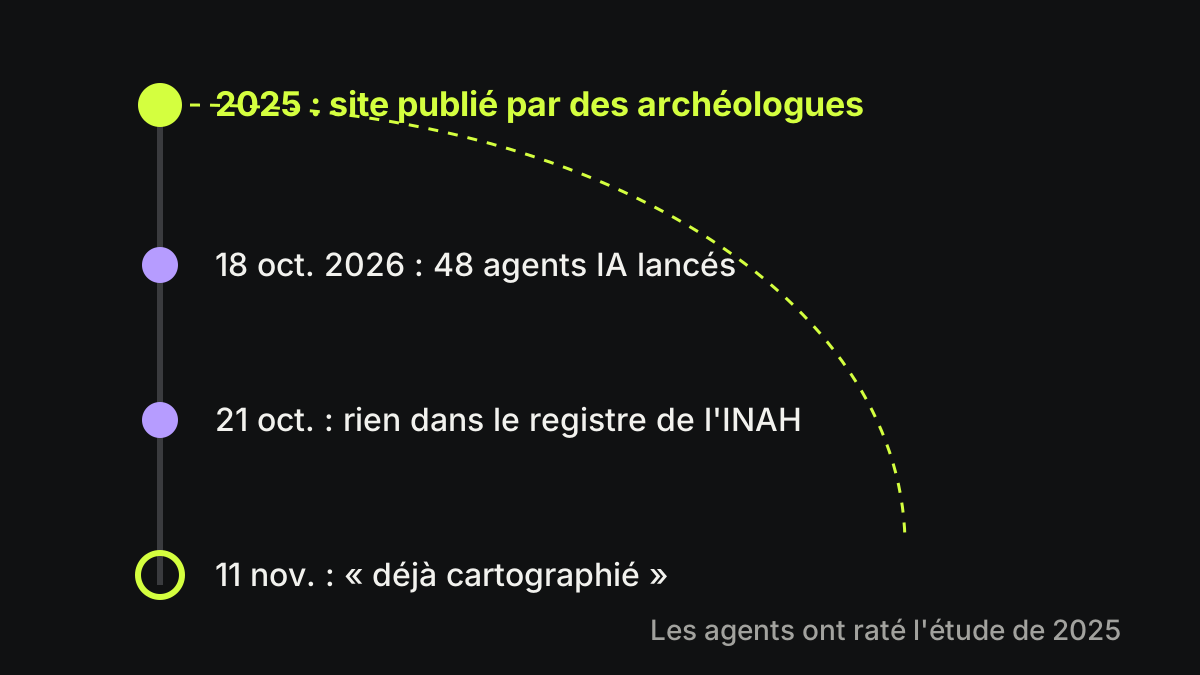
Did an AI discover an unknown Maya site in Mexico? In early November, Pietro Miotti, described by The Verge as a Google researcher, described on his blog how 48 AI agents he launched during his vacation had spotted a pyramid hidden under the jungle. On November 11, he added a correction at the top of his post: the site had already been mapped in a scientific study published in 2025.
Key takeaways
- The agents combed through about 1,200 km² of forest in lidar images, in less than 72 hours.
- They spotted real structures, including an oval pyramid at least 8 to 12 meters tall.
- A team led by Tulane University archaeologist Francisco Estrada-Belli had published this site a year earlier.
- The agents failed at the most basic step: checking what had already been published.
What is lidar?
It's a laser mounted under a plane that sends pulses toward the ground and measures how long they take to come back. Some of the beams slip between the leaves, so you can map the terrain hidden under the trees, as if you shaved off the forest on screen. This is the tool that has helped archaeologists uncover many Maya cities buried under vegetation in recent years. Some of these surveys, made by NASA, are freely available.
48 agents, 1,200 km² and an email to INAH
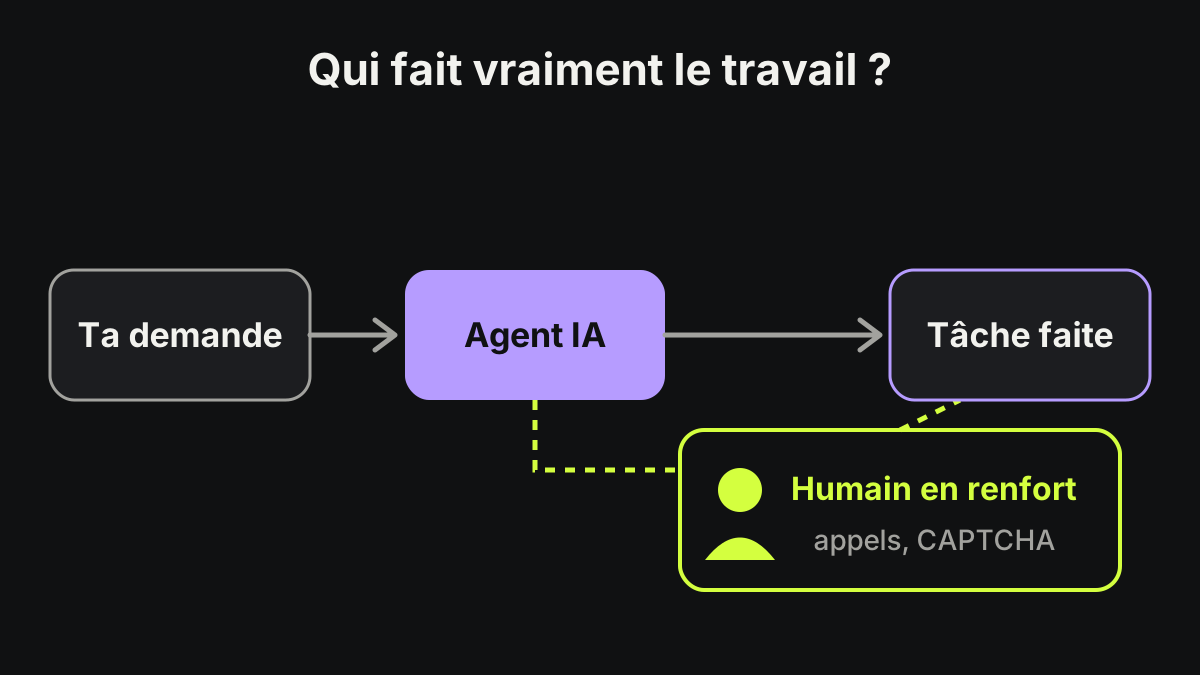
On October 18, while traveling in Peru, Pietro Miotti wonders whether an AI could find ruins. He brainstorms with Gemini, ChatGPT, Claude and Grok, which suggest using lidar. The surveys are turned into images, and 48 agents examine them one by one with a sheet describing what a pyramid, a platform or a plaza looks like. A second pass checks the raw data.
The result: a hill on the edge of a cliff, with a leveled plaza, a raised courtyard and that oval pyramid, all under 10 to 17 meters of forest. The agents also figure out who to write to: INAH, the Mexican institute in charge of heritage. The report goes out in Spanish, with the exact coordinates in a confidential appendix. On October 21, INAH replies that no site is registered at that location.
Missing from the INAH registry, so unknown?
No. A country's official registry doesn't list everything researchers publish, and Miotti admits it in his correction: the site's absence from the Mexican government's database said nothing about what archaeologists already knew. It appeared in a 2025 paper by Estrada-Belli and colleagues, which studies Maya settlement in the lowlands, and the agents tasked with searching the scientific literature missed it.
According to The Verge, archaeologists criticize the project for spreading a false discovery and for erasing the work of researchers who have used these digital tools for decades. They also fear being flooded with announcements from amateurs armed with AI.
A pyramid on a lidar image, then what?
Spotting a shape on an image is only the start of the work. To call it a discovery, you need to check on the ground with a permit, date the structures and compare them with what has already been published. The agents were fast on the spectacular part and missed the tedious part. AIs that botch their sources cause the same problem elsewhere, like the chatbots that send people to fake shopping sites.
The claim "an AI discovered an unknown Maya site" is therefore false: the agents found a site already published by archaeologists. Still, the experiment shows that a non-specialist can sort through hundreds of square kilometers of images in three days, as long as people in the field review the result. Miotti updated his posts to cite the 2025 study, and the rest of his story is still online.
Translated with the help of AI from our French article, which is prepared with AI from the sources, then reviewed and approved by Valentin Fouilloud before publication. How we work