ChatGPT, Gemini, Perplexity: do AI chatbots link to fake stores?
Verdict: True
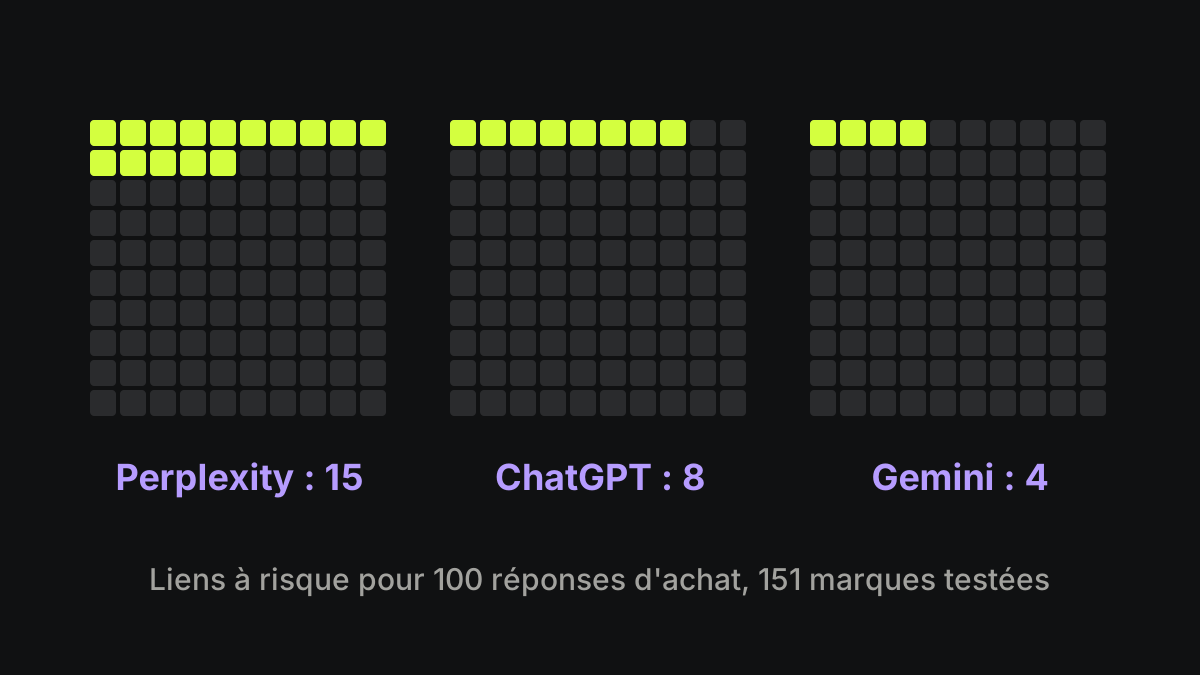
Asking a chatbot where to buy a pair of sneakers can land you on a fake website. A study by the company Podqi, published as an exclusive by The Verge on November 12, analyzed 6,795 answers from ChatGPT, Gemini and Perplexity about 151 brands: depending on the chatbot, 4 to 15% of the answers contained a risky link.
Key takeaways
- Perplexity offers a risky link in 15% of its answers, ChatGPT in 8%, Gemini in 4%.
- The bad links lead to fake stores, to old domains bought up by someone else, or to dead sites.
- Small brands and regional sites are hit the hardest.
- The study comes from a company that sells brand protection, and its method hasn't been published in detail.
Which chatbot links to the most fake sites?
Perplexity, by far. In its answers to shopping questions, 15% contained a risky address, almost twice as many as ChatGPT (8%) and nearly four times as many as Gemini (4%). Podqi ran its tests in two rounds, in September 2026.
Those rates look low. Scaled up to real-world use, they add up: if you ask Perplexity ten shopping questions during Black Friday, there's a good chance at least one answer will include a sketchy link.
The study also notes that ChatGPT is the one that most often warns that a site might be a problem. The link stays on screen, with a warning the other two give less often.
How does a bought-up old domain fool an AI?
A chatbot that searches online relies on what the web says about a brand. When a store changes its address or shuts down, its old domain name can be bought by someone else. The site then keeps years of links and mentions pointing to it, and the AI keeps believing it's the official one.
Fake stores play the same game: an almost identical address, a copied logo, slashed prices. For a big brand, the real site is cited everywhere and crushes the knockoffs. For a small one, reliable sources are rare, and a well-ranked copy can get ahead. Podqi actually found half as many risky links for big brands as for small ones. Questions about regional sites, like a store that only operates in one country, also produce more bad results.
This matters more and more, because a lot of people now search with a chatbot instead of Google. We looked at what the often-quoted figure on ChatGPT's share of searches compared with Google is really worth.
Podqi: a solid study?
The main result is credible, and it lines up with other tests published this year on chatbots and brand websites. Two caveats, though. Podqi sells brand protection services, so the company has an interest in showing that the risk is real. And the exact questions put to the chatbots aren't public, which makes it impossible to rerun the test.
Google, OpenAI and Perplexity told The Verge they were working to improve the accuracy and safeguards of their tools, without giving details.
We're calling it anyway: chatbots really do send people to fake shopping sites, and often enough that you should keep it in mind every time you order.
Before you pay on a site an AI found for you
- Don't pay through the chatbot's link. Use the answer to find the product, then go to the brand's site by typing its address yourself, or from its official Instagram or TikTok account.
- Read the address letter by letter. An extra hyphen, a ".shop" instead of a ".fr" (France's domain), a doubled letter: that's the classic signature of a copy.
- Be wary of prices that are too low, especially on a product that's sold out everywhere else.
- Pay by card, with approval in your bank's app, and never by bank transfer or in crypto to an unknown seller.
- If you run into a scam, the French government site cybermalveillance.gouv.fr explains the steps to take depending on your situation.
Black Friday falls on November 27 this year, the time of year when these fake sites are most common.
Translated with the help of AI from our French article, which is prepared with AI from the sources, then reviewed and approved by Valentin Fouilloud before publication. How we work