Mischief 1 AI video model: what “neuron-derived” really means
"A video model derived from living neurons": that line is enough to raise an eyebrow. On October 30, 2026, the American startup The Biological Computing Co. (TBC) launched Mischief 1, a video generator it presents as the first of its kind available to the public. No, your video won't be made by a brain in a jar. Here's what's really behind it.
Key takeaways
- Mischief 1 turns an image and a text prompt into a short 3- or 5-second video.
- It's built on Wan 2.2, an existing video model whose code is open.
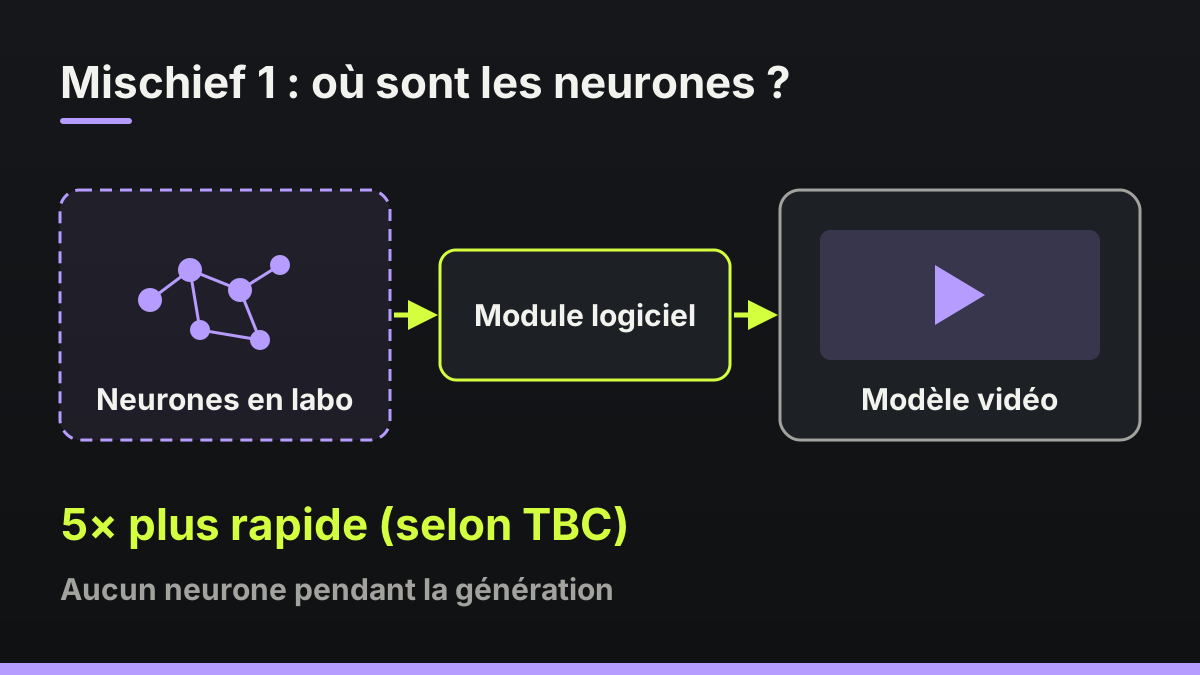
- The living neurons are only used in the lab, to design a small piece of software. They play no part in making the videos.
- TBC claims generation is 5 times faster than the base model, at the same quality. That figure comes from the company and hasn't been independently verified yet.
- Announced price: starting at half a US cent per second of video.
What Mischief 1 actually does
You give it a starting image and a description, and the model generates a short clip. According to the specialist site Tao Media, the videos are 3 or 5 seconds long, in 480p or 720p, at 16 frames per second. Don't expect a movie: it's more for animating an illustration or making a quick effect for social media.
Mischief 1 is available through fal and OpenRouter, two platforms that let developers use AI models and pay as they go. Pricing starts at $0.005 per second in 480p, or 2.5 cents for a 5-second clip, and $0.01 per second in 720p. TBC says it's the cheapest image-to-video model on those two platforms.
So what about the neurons?
This is the heart of the story. TBC was founded by two neurosurgeons, Alex Ksendzovsky and Jon Pomeraniec. In its lab, the company grows neurons on chips covered with 4,096 electrodes, according to the tech news site The Decoder. It stimulates them with images and videos, then watches how the electrical activity spreads and fades.
From these observations, the researchers draw ideas about how a real brain processes information. They turn them into a small software module, which they graft onto an existing AI model. This module is tiny: less than 0.1% of the size of the base model.
And that's it. When you generate a video, no neurons are plugged in. Everything runs on standard servers, with ordinary AI chips. TBC says so itself: the neurons stay in the lab.
Think of an engineer who studies how birds fly to design an airplane wing. There's no bird inside the plane. Same here: the model doesn't contain neurons, just an idea inspired by watching them.
What's proven, what isn't
What you can check: the model exists, it's online, and its price is posted. Any developer can try it.
What's still a company claim: the "5 times faster, at the same quality." TBC doesn't publish a detailed, controlled comparison. It gives one example from its own tests, 142 seconds for Wan 2.2 versus 12 for Mischief 1, but that's just one measurement under specific conditions, not a guarantee for every video.
The fuzziest part: the real role of the neurons. The Decoder points out that nothing proves, for now, that this method does better than the purely digital techniques that already speed up AI models. An external test, run in July by the hosting company Bluesky Compute, found costs about 4.4 times lower, but without comparing against those other techniques.
The "first neuron-derived model" label: that's the description TBC chose. No independent body has validated it.
Why it's still interesting
Behind the marketing, the starting idea is serious. Your brain uses roughly the energy of a light bulb to do things that AI needs entire data centers to pull off. Understanding how neurons manage it could help make AI less power-hungry. TBC raised $25 million in February 2026 on that promise, and in late September announced a collaboration with Amazon Web Services to offer its model to businesses.
If the approach lives up to its promises, it could be used beyond video. But that's exactly what will need to be shown, with public, comparable tests.
So, what changes?
For you, right now, Mischief 1 is mostly a very cheap clip generator, meant for people comfortable with developer platforms. No need to worry about an "artificial brain": there isn't one in the product.
The real test will come in the next few months, when researchers or specialist sites compare Mischief 1 with other speed-up methods. If the gains hold up, expect other companies to tout "brain-inspired" AI. If you see that phrase on TikTok, always ask yourself the same question: are the neurons used to run the AI, or only to inspire it? In this case, it's the second one.
Translated with the help of AI from our French article, which is prepared with AI from the sources, then reviewed and approved by Valentin Fouilloud before publication. How we work