Anthropic IPO: what its S-1 filing reveals, explained simply
Anthropic, the American company behind the Claude AI, wants to go public. On October 26, 2026, it released its "S-1," the big filing every company has to make public before selling its shares to the general public in the United States. For the first time, we get a look inside the books of one of the AI leaders. And the numbers are dizzying, in both directions.
Key takeaways
- Anthropic filed for its IPO on October 26, 2026, to be listed on the Nasdaq under the ticker "ANT."
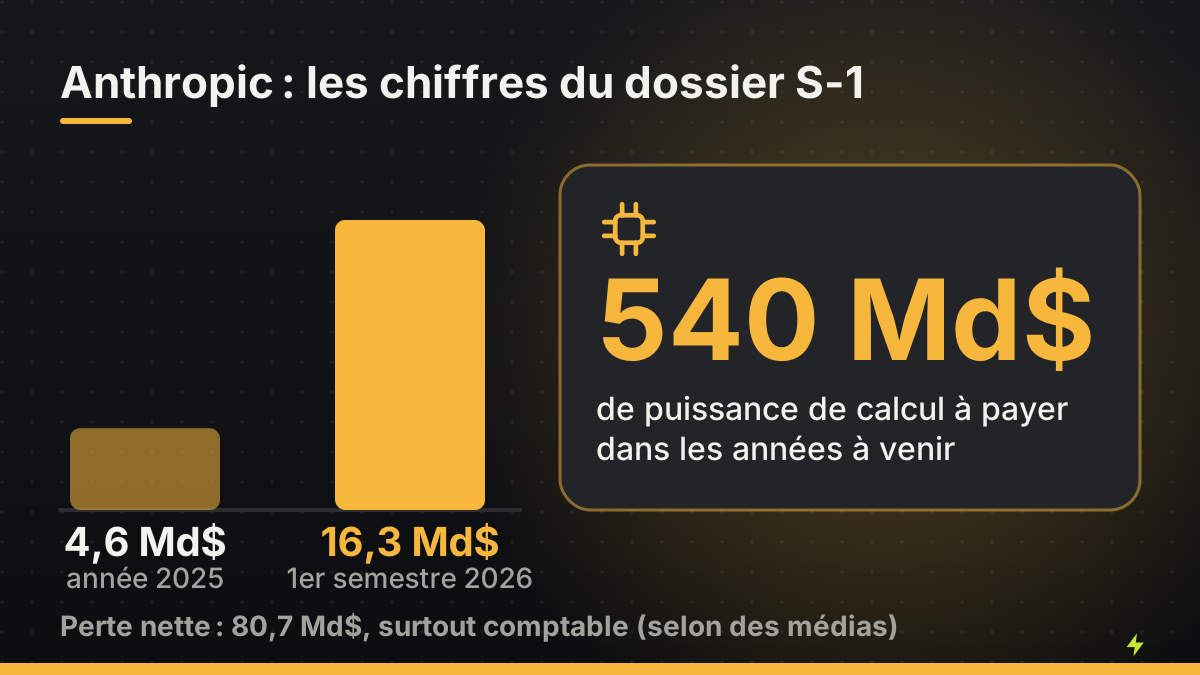
- Its revenue has exploded: $16.3 billion in the first half of 2026, compared with 4.6 billion for all of 2025.
- Its net loss reached $80.7 billion for the half-year, mainly because of an accounting entry, according to several media outlets.
- It has committed to spending more than $540 billion on computing power in the coming years.
- The exact date and the share price haven't been set yet.
What's an S-1?
When a company wants to sell its shares on the stock market, it first has to reveal everything: its revenue, its losses, its debts, its risks. In the United States, this document is called the S-1. It's a bit like a full report card, teachers' comments included, that you show before asking strangers to trust you with their money.
Until now, Anthropic's finances were only known through leaks and statements. Now they're official, legally binding numbers.
Revenue that's taking off
The number that jumps out first: $4.7 billion in revenue in the first quarter of 2026, then 11.6 billion in the second. In three months, revenue grew almost 2.5-fold. In a single half-year, Anthropic brought in more than three times what it made in all of 2025.
Where does that money come from? Mostly from businesses and developers paying to use Claude, especially for coding. Good news for the company: in the second quarter, it posted an operating profit of $974 million, after a loss of 1.7 billion in the first. In other words, its core business is starting to bring in more than it costs.
So why 80 billion in losses?
That's the paradox of the filing. The net loss for the half-year reached $80.7 billion. According to several analyses, most of it comes from an accounting charge tied to convertible notes (loans that can turn into shares). When the company's value goes up, these loans are "worth" more on paper, and accounting records that as a loss, even though no money actually leaves the bank.
Remember this: a huge accounting loss doesn't necessarily mean a company is burning that much cash. You always have to look at where it comes from.
The real issue: the cost of computing
Anthropic's biggest expense is the servers that run Claude. In the second quarter, computing power cost it $5.6 billion, nearly half its revenue.
And that's just the beginning. According to Fortune, the S-1 details commitments to spend between $542 and $567 billion on computing and infrastructure over the next few years. That's more than 30 times its first-half revenue. These contracts are with Amazon, Google, Microsoft, but also SpaceX (up to $120.5 billion through 2029). Anthropic is also launching its own data centers, built and run by partners.
The filing acknowledges risks: its computing suppliers are also its competitors, and connecting new data centers to the power grid can be delayed (permits, legal challenges, equipment shortages).
How much is Anthropic worth?
In May 2026, the company was valued at $965 billion during a funding round. According to the financial press, a valuation of $1,500 to $2,000 billion is reportedly being discussed for the IPO. Nothing is official: the share price doesn't appear in the filing yet.
For comparison, $2,000 billion is about half of Alphabet's (Google's) stock market value at the end of October 2026. For a company that made less than 5 billion in revenue in 2025.
What the filing doesn't say yet
- The number of shares sold, their price and the amount raised.
- Revenue for the third quarter of 2026.
- The exact date of the first trading day: the press is talking about a few weeks.
So, what changes?
If you use Claude, nothing right away: the app doesn't change because the company goes public. But a listed company has to publish its results every three months and answer to its shareholders. The pressure to be profitable will increase, which could eventually affect subscription prices or priorities.
For the industry, it's a real-world test: the stock market will show whether it believes generative AI can pay back hundreds of billions of dollars in servers. The filing shows real, spectacular growth, but also colossal spending.
Note: this article explains the news, it's not investment advice. An IPO is a risky bet, even for professionals.
Translated with the help of AI from our French article, which is prepared with AI from the sources, then reviewed and approved by Valentin Fouilloud before publication. How we work