RAM prices soar: AI data centers drain memory, and you pay
If you tried to build or upgrade a PC this year, the price of RAM probably came as a shock. The reason: AI data centers, which are buying memory in massive quantities. And OpenAI's CEO, Sam Altman, just explained that, in his view, RAM is put to better use at his company than in your computer. Here's who's winning what in this shortage.
Key takeaways
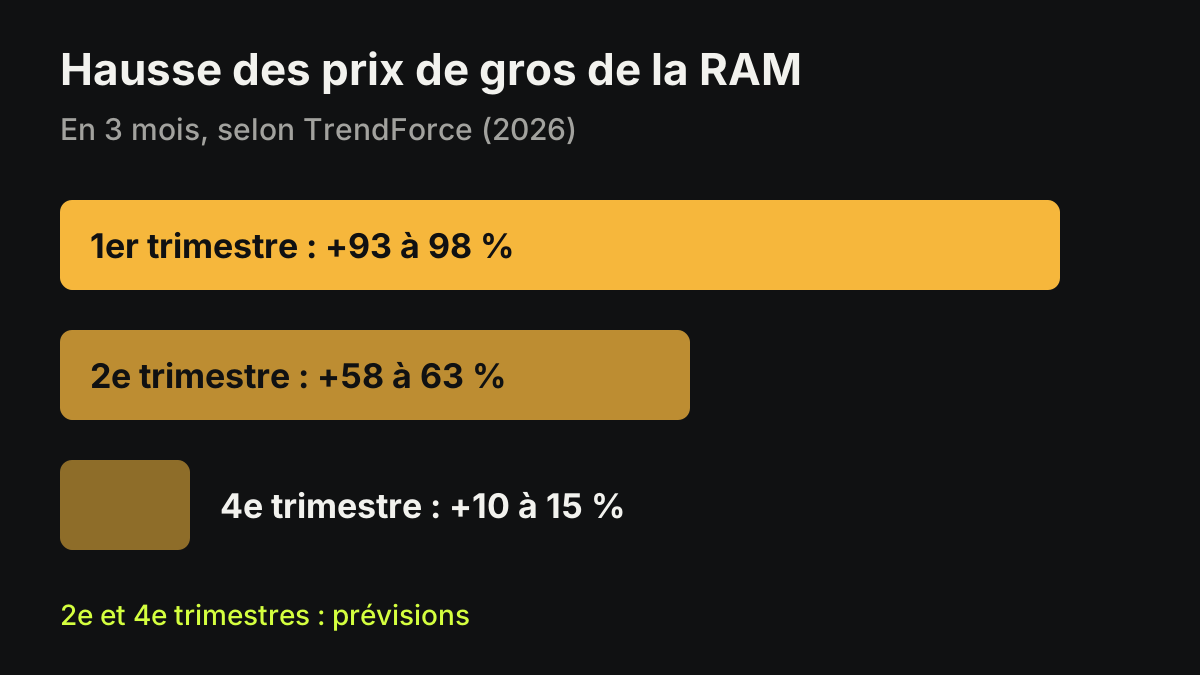
- Wholesale prices of DRAM memory (RAM) nearly doubled in a single quarter in early 2026, according to the research firm TrendForce, then kept climbing.
- In stores, the cheapest 32 GB DDR5 kit found cost $449.97 on October 14, compared with $400 in August.
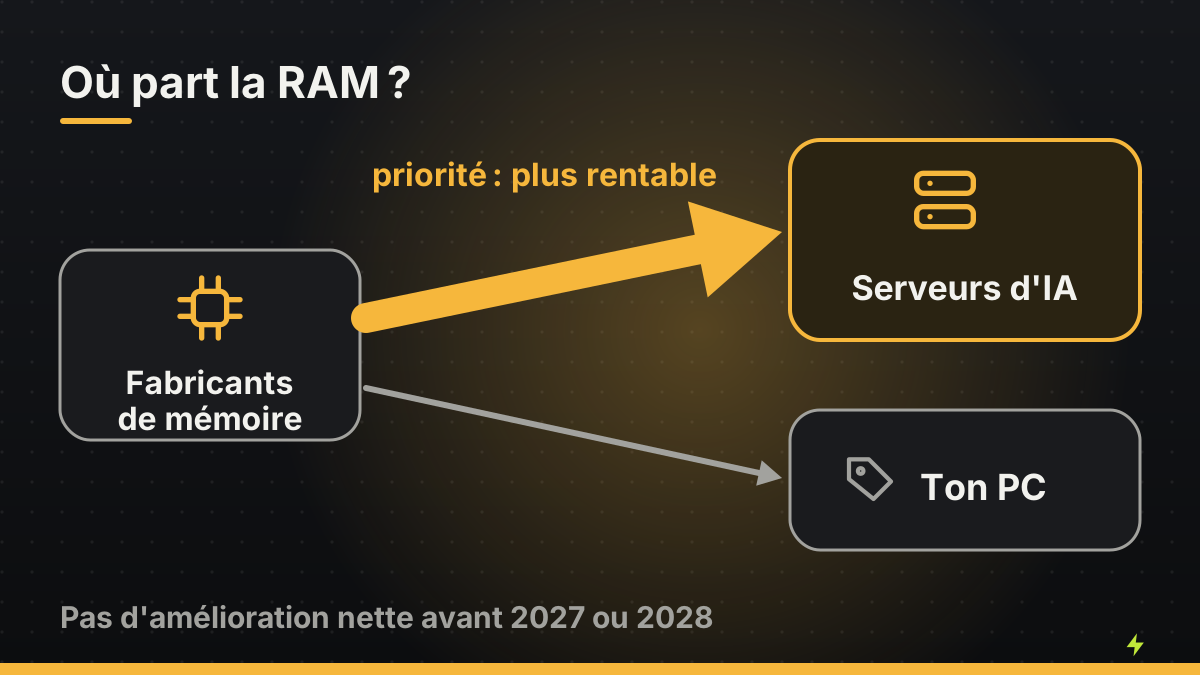
- The main cause: manufacturers are reserving their output for AI servers, which bring in more money.
- On October 29, Sam Altman called it "quite terrible" that RAM stays in our computers, where he says it's only used about 5% of the time. He didn't back up that number.
- The big winners are the three manufacturers that split the market: Samsung, SK hynix and Micron.
What Sam Altman said
The line comes from episode 39 of the Cheeky Pint podcast, hosted by Stripe cofounder John Collison and released on October 29, 2026. Sam Altman was responding to a popular idea: running open-source AI directly on our computers would reduce the need for data centers.
His argument, as reported by Back2Gaming: when memory is scarce, it's better used in servers that run nonstop than in PCs that use it about 5% of the time. He isn't proposing to limit RAM for regular people. But he didn't cite any study or measurement to support that 5% figure.
His comment made a lot of gamers and PC enthusiasts furious. Makes sense: OpenAI is one of the biggest memory buyers in the world.
Why RAM got so expensive
RAM is a device's working memory: it keeps close at hand whatever the processor needs right now. Your PC, your phone, your console and AI servers all need it.
The problem is that AI servers want a huge amount of it. According to TrendForce, manufacturers have very low inventories and are prioritizing high-capacity modules for AI servers. Cloud giants are willing to pay more, and other customers follow so they don't end up with nothing. PC and smartphone makers are further back in line.
TrendForce's figures on wholesale prices, the ones device makers pay: - First quarter of 2026: +93 to 98% in three months. Prices nearly doubled. - Second quarter: another increase of 58 to 63% was expected. - Fourth quarter: +10 to 15% expected, according to a September 30 forecast reported by Hardware Cooking, a French PC hardware site.
The increase is slowing down, but prices are still rising from levels that are already very high.
The OpenAI factor
In October 2025, Samsung and SK hynix signed letters of intent to supply memory to Stargate, OpenAI's big data center project. Planned demand could reach up to 900,000 silicon wafers (the discs that chips are etched onto) per month. Meanwhile, the research firm TechInsights estimates global DRAM production at about 2.25 million wafers per month in 2025.
If OpenAI went all the way, it could therefore absorb up to 40% of global production. Keep in mind: that's a ceiling calculated from those two numbers, not a quantity actually delivered.
Who's making money?
Three companies make most of the world's DRAM. In the first quarter of 2026, according to TrendForce: - Samsung (South Korea): 38.5% of the market, $37.3 billion in revenue for the quarter, +93% in three months; - SK hynix (South Korea): 28.8% of the market, about $28 billion, +62.5%; - Micron (United States): 22.4% of the market, about $21.8 billion, +82%.
In total, the industry's revenue jumped 81% in one quarter, to $97 billion. When supply is limited and demand explodes, whoever sells the scarce resource wins big. That's what's happening here. It says nothing about what these companies will do tomorrow: this market is known for its cycles, with shortages followed by periods when prices collapse.
The losers are PC, phone and console makers, who pay more for their components. And at the end of the chain, you.
What it means for you
- Building a PC costs more. RAM, which used to be one of the cheapest parts of a build, has become one of the biggest items on the bill.
- So do new devices. When memory costs more, manufacturers raise their prices, or put less memory in their products.
- Running AI at home gets harder. Local AI models need a lot of RAM. When it becomes a luxury item, everyone gets pushed toward online AI… like OpenAI's.
So, what changes?
What's proven: AI demand sent memory prices through the roof in 2026, and manufacturers are cashing in big.
What's debatable: Sam Altman's idea that RAM "sits idle" in our PCs. The 5% figure isn't backed by anything public. And having your own memory also means being able to work, play and run AI without depending on a server or a subscription.
How long will it last? Nobody knows. Manufacturers are building new factories, but it takes years for them to start producing. As long as the AI giants keep buying this much, don't expect a quick return to the old prices.
Translated with the help of AI from our French article, which is prepared with AI from the sources, then reviewed and approved by Valentin Fouilloud before publication. How we work