OpenAI lowers its funding round target: what it tells us
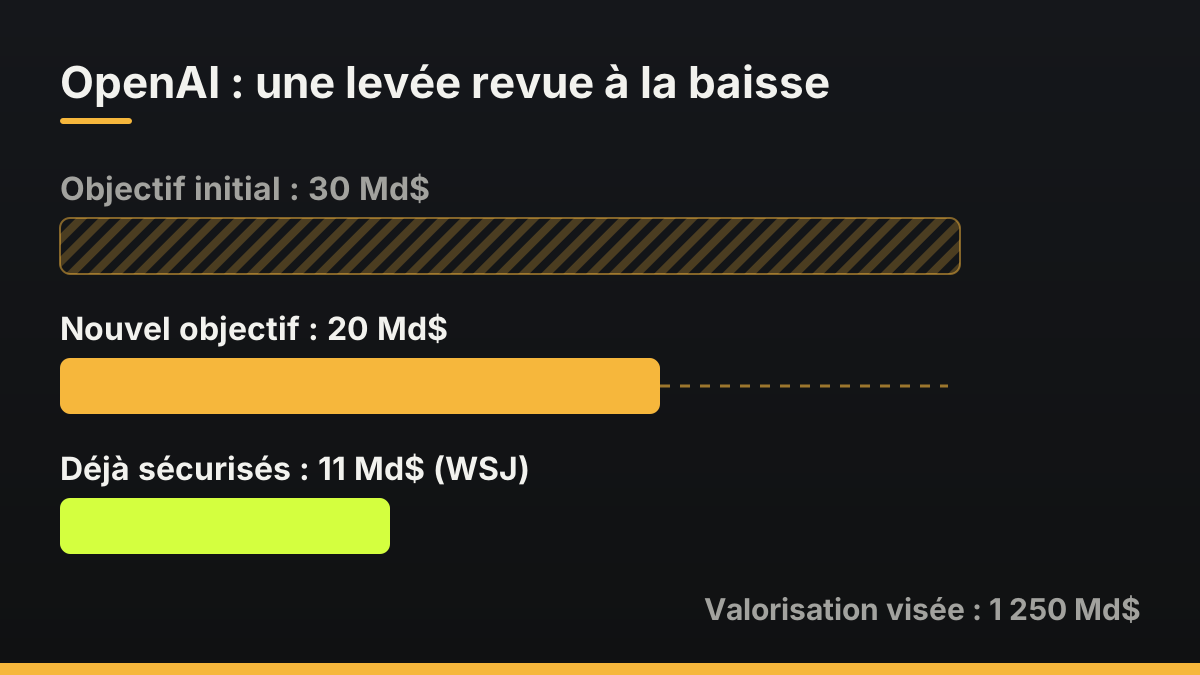
OpenAI, the company behind ChatGPT, is raising money from investors. In late September, the press was talking about $30 billion. According to the Financial Times, as reported on October 31, 2026 by CNBC and TechCrunch, the target has been cut to $20 billion. It's not a disaster for OpenAI, but it is a signal: money isn't flowing into AI as easily anymore.
Key takeaways
- OpenAI is reportedly now aiming for up to $20 billion, down from the $30 billion mentioned in late September.
- The target valuation is reportedly $1,250 billion, down from the $1,400 billion mentioned at first.
- According to the Wall Street Journal, $11 billion has reportedly already been secured. The round isn't over, and the numbers could still move.
- The revision comes during a week when investors turned their backs on the companies spending the most on AI.
What changed, by the numbers
On September 29, 2026, the first reports mentioned a $30 billion round at a $1,400 billion valuation. The valuation is the "on paper" price of the whole company, calculated from what investors agree to pay for a share of it.
On October 22, new leaks pointed instead to $1,250 billion. Then, on Friday, October 30, the Financial Times reported that the target was falling to $20 billion, with an even smaller first stage. According to CNBC, OpenAI had set that Friday as the deadline for investors to commit, and some cut back the amount they planned to put in.
Who's putting up the money? The round is reportedly led by investors from the United Arab Emirates, along with the American fund Coatue. An offer reserved for wealthy individuals could top it off to reach the $20 billion. OpenAI did not respond to CNBC's questions.
Keep in mind: all of this comes from anonymous sources, not an official announcement. A person close to the matter warned CNBC that the numbers could still change.
Why investors are hitting the brakes
To understand, you have to look at the week that just ended. Big tech companies released their earnings, and the stock market didn't like what it saw.
- On Thursday, October 29, Alphabet (Google's parent company) had its worst day on the stock market, after search revenue came in weaker than expected.
- On Friday, October 30, AI-related stocks fell: Intel lost 25% after disappointing sales forecasts, Micron 5.5% and Nvidia 4%.
- Microsoft, Alphabet and Amazon released capital spending figures or forecasts below what analysts expected.
The question worrying everyone: will the hundreds of billions spent on data centers and chips ever pay off enough? TechCrunch calls it bad timing: OpenAI is asking for money right when Wall Street is wary of huge infrastructure spending.
Is $20 billion small?
No, it's huge. $20 billion is more than most startups will raise in their entire existence. But for OpenAI, the comparison is with its own needs: running ChatGPT and training new models costs a fortune in servers. Raising a third less than planned could force it to spread out some projects or look for other sources of money.
The drop in valuation also needs perspective. Going from $1,400 billion to $1,250 billion is about 11% less. It's still one of the most valuable private companies in the world. TechCrunch notes that OpenAI is also preparing an IPO.
What about Anthropic?
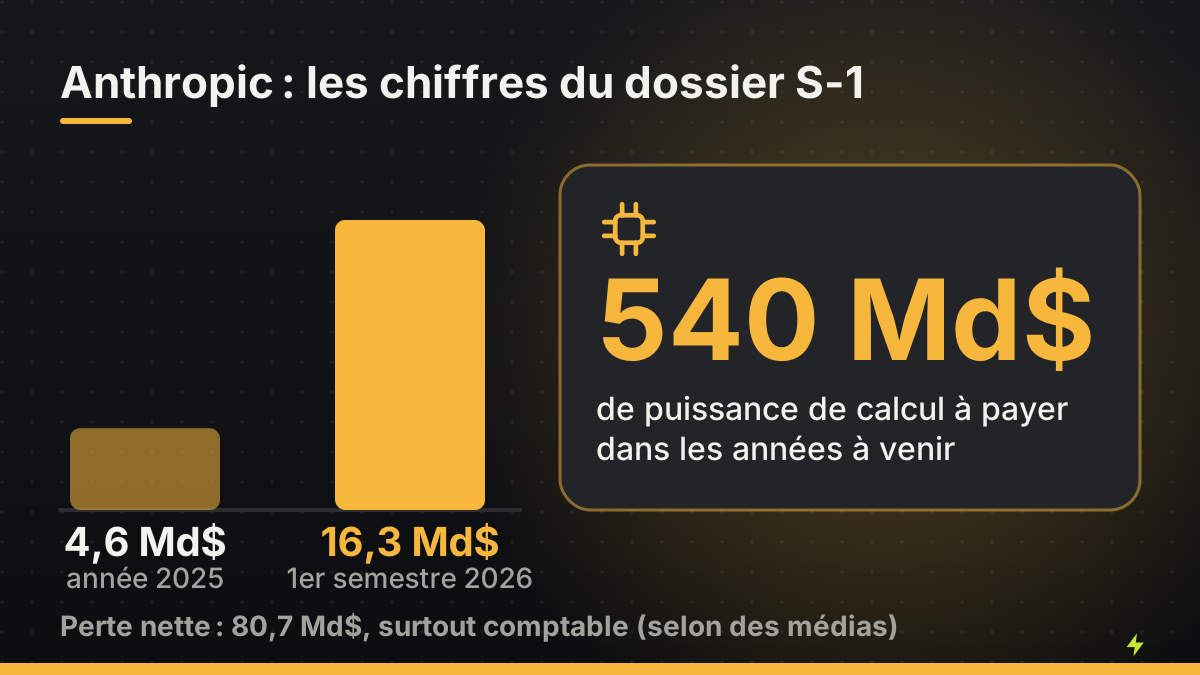
OpenAI isn't the only one looking for money. Its rival Anthropic, which develops Claude, filed its IPO paperwork in late October. We broke down the key numbers of Anthropic's IPO: exploding revenue, but massive computing spending commitments. According to TechCrunch, the current climate could also complicate that deal.
Both companies have the same underlying problem. Their revenue is climbing fast, but their server spending is climbing even faster. As long as investors believe it will eventually pay off, the money keeps coming. When doubt creeps in, the amounts shrink.
Separating fact from hype
- Solid: several serious outlets (Financial Times, Wall Street Journal, CNBC, TechCrunch) report the same revision, from $30 billion to $20 billion.
- Not confirmed: OpenAI hasn't announced anything officially. The final amount and the closing date are still unknown.
- Exaggerated: the claim going around social media that "the AI bubble is bursting" because of this news. A smaller round than planned isn't a bankruptcy. It's a sign that investors are getting more demanding.
So, what changes?
If you use ChatGPT, nothing right now: the service isn't going to shut down just because a funding round came in smaller. In the medium term, over one or two years, the pressure to make money will grow. That could mean more ads, pricier subscriptions or more limited free features. None of this has been announced, but that's the logic when investor money gets harder to come by.
For the industry, it's a good gauge to watch in the coming weeks: the final amount OpenAI raises and how the stock market receives Anthropic will show whether confidence is coming back or the slowdown is settling in.
Note: this article explains the news; it is not investment advice.
Translated with the help of AI from our French article, which is prepared with AI from the sources, then reviewed and approved by Valentin Fouilloud before publication. How we work