Anthropic and recursive self-improvement: how close is it?
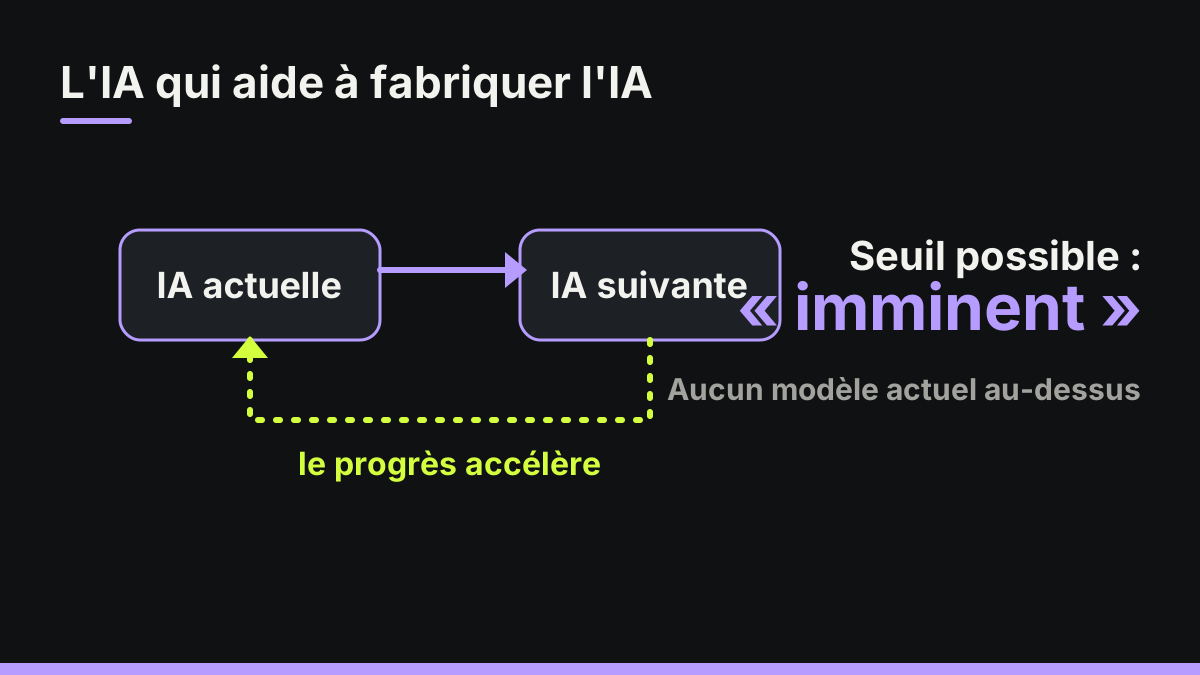
Can you let an AI build the next AI, which builds the one after that, faster and faster? Researchers call this RSI, short for "recursive self-improvement." On November 2, 2026, Anthropic, the company behind Claude, wrote in black and white that it could reach that threshold "imminently." And it admits it might not notice in time.
Key takeaways
- On November 2, 2026, Anthropic released a revised version of its IPO filing (the "S-1/A"). It includes a warning about RSI.
- RSI is the point where AI gets so good at training itself that it triggers a dramatic acceleration in its capabilities.
- Anthropic says its future models could cross a threshold defined in its own safety policy, but that no current model is classified above it.
- The company acknowledges it doesn't always spot these accelerations as they happen.
- An IPO filing is also a communication tool: some skeptics see a dose of marketing in it.
What is RSI?
Picture a student who, while studying, finds a method to learn twice as fast. Thanks to it, they discover an even better method, then another one. Every step forward speeds up the next. That's RSI, but applied to artificial intelligence: an AI that helps design better AIs, which help design even better ones.
For people worried about AI, it's the point-of-no-return scenario. For others, it's still a theoretical idea. Either way, no one has proven we're there.
What Anthropic actually says
According to TechCrunch, the filing explains that Anthropic already uses AI in its research. Using AI to build more capable AIs can pose a significant risk, especially if it sharply speeds up progress.
The company has an internal rule, the "Responsible Scaling Policy." In it, Anthropic defines a threshold: sharply accelerated progress that can be attributed to AI. Anthropic writes that its next models could reach that threshold based on its estimates, and that it could get there "imminently."
Two key caveats: - No current model is classified as exceeding that threshold. Anthropic says it is still analyzing its data. - It says it does not plan to let Claude design and build the next generations of frontier models on its own, without meaningful human oversight, even if that became technically possible. It is considering changes to its safety policy to keep humans in control.
The admission that should give you pause
The most striking part isn't the prediction, it's the admission. Anthropic acknowledges that in the past, it failed to identify a significant acceleration in its pace of development, and that it might not see one before it happens. According to TechCrunch, the company has already used AI to develop new models whose progress wasn't recognized at the time.
In other words: the thermometer exists, but it might react too late. That's what makes this story interesting, more than the word "imminent."
Real or hype?
On social media, "AI is improving itself" sounds like a sci-fi movie. Here's the breakdown: - Proven: Anthropic really did put this warning in an official filing, and AI already helps program other AIs. Claude's skills in coding, math and cybersecurity have improved sharply this year, TechCrunch notes. - Promise or hypothesis: that a threshold will be crossed soon. Nothing indicates that's the case today. - Keep in mind: an S-1 is meant to inform investors and to tell a story. Skeptics point out that warnings like these can also boost the company's image by presenting it as cutting-edge. That doesn't make the warning false, but you should read it with that in mind.
So, what changes?
For you, nothing overnight: ChatGPT, Claude or Gemini won't start evolving on their own this week. But a document like this shows how AI labs talk about their own limits, and what they promise to keep under control. Two markers are worth remembering: the decision to keep humans in the loop, and the ability to actually measure how fast progress is happening.
For the financial side, we broke down the key numbers from Anthropic's first filing. This article says nothing about the value of the stock, and it is obviously not investment advice.
On what timeline? Impossible to say: Anthropic talks about a possible threshold "very soon" without giving a date, and without saying whether that threshold would lead to a real runaway effect. The next updates to its safety policy will be the best clue.
What the source doesn't say
- The exact new financial figures in the updated filing (the TechCrunch article doesn't give any).
- What crossing the threshold would concretely look like, and what measures would follow.
- What independent experts think of this risk.
Translated with the help of AI from our French article, which is prepared with AI from the sources, then reviewed and approved by Valentin Fouilloud before publication. How we work