Nov. 12 brief: Jensen Huang quits Nvidia, 35,000 AI apps exposed
Nvidia loses the boss who founded it, Brussels goes after subscription traps and a study shows that tens of thousands of apps built with AI are open to anyone: here's what mattered on Thursday, November 12.
Jensen Huang steps down as head of Nvidia
On Thursday, November 12, Jensen Huang left his job running Nvidia, the company he cofounded in 1993, along with its board of directors. His exit comes two days after the launch of an internal investigation into his relationship with Alice Huang, an executive at Megaspeed whom US intelligence suspects of spying for China. On November 11, the New York Times revealed a second relationship, with Kimberly Powell, an Nvidia vice president who reported to him. CFO Colette Kress is taking over in the interim. The stock fell more than 10% early in the trading session, before trimming its loss to about 4%. Nvidia supplies most of the chips that train ChatGPT, Claude and Gemini: who runs it matters for all of AI. Source: CNBC
Free trials, loot boxes: Europe drafts the Digital Fairness Act
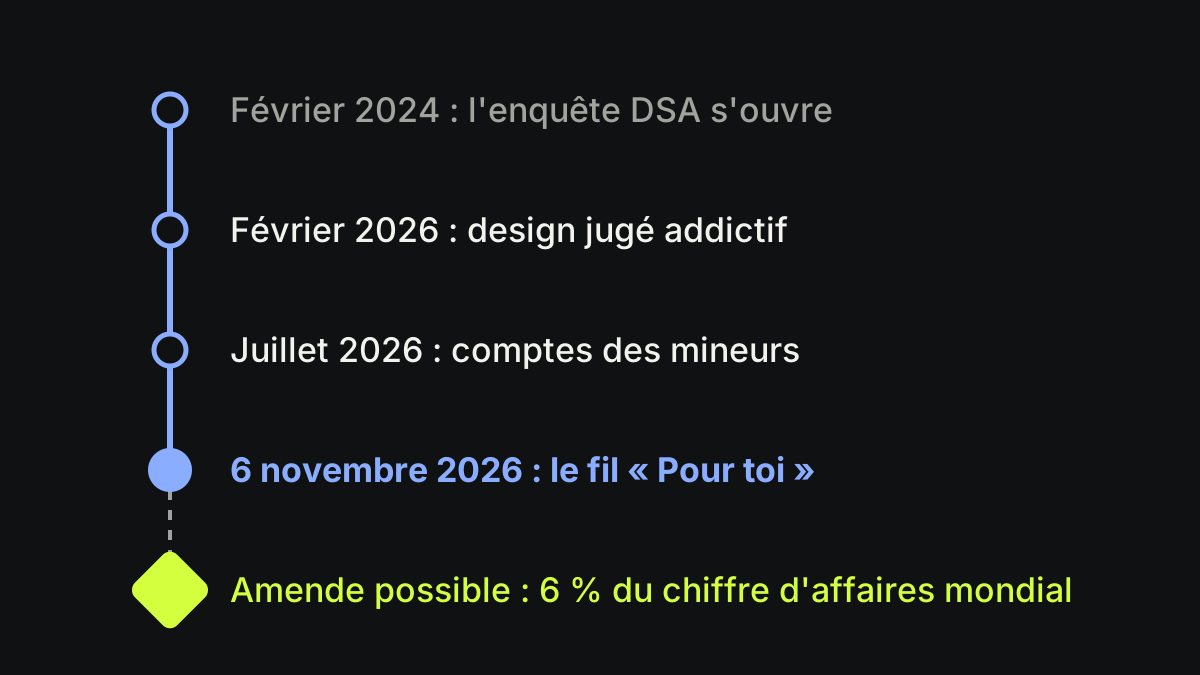
On November 11, the European Commission presented the Digital Fairness Act, a draft regulation targeting the traps built into websites and apps. It would ban manipulative interfaces (misleading stock alerts, pre-checked boxes) and free trials that turn into paid plans without your explicit consent, and it would require a cancel button. Influencers would have to clearly label their sponsored content. Minors would lose access to paid loot boxes, and games would have to show the real value of their virtual currencies. Fines could reach 6% of global revenue. The text still has to be negotiated with the European Parliament and member states, and there's no date for it to take effect. Source: Le Monde Informatique
Grok Build: 94.7% of apps open without a password
According to a study by cybersecurity firm Claroc published on November 10, 35,578 of the 37,571 active apps built with Grok Build opened without any authentication. The tool, from SpaceXSI (formerly xAI), builds an app from a simple written request. Most are games or calculators, but 650 to 800 reportedly contained private data: a hospital directory with patient information, passwords in plain text, internal SpaceXSI and X documents, since taken down. The researchers blame the sharing settings and addresses made of four random words, which protect nothing. SpaceXSI says an app stays private until its creator shares it. If you build an app with AI, check who can open it before you put any data in it. Source: Le Monde Informatique
Claude Sheets, Anthropic's spreadsheet
On November 10, Anthropic rolled out Claude Sheets, a spreadsheet the AI fills in from a prompt (tabs, formulas, drop-down lists), and Claude Whiteboards, a shared whiteboard where Claude groups ideas by theme and suggests a to-do list. Both are in beta and limited to paid plans, on the web, desktop and mobile. Claude Data, which builds dashboards from a company's data, is leaving beta. Anthropic admits Sheets only offers basic features so far. Files export to .xlsx or CSV, so you can pick up your spreadsheet in Excel or Google Sheets. Source: Blog du Modérateur
SoftBank loses more than $3 billion on gas turbines
SoftBank, one of OpenAI's biggest investors, announced on November 10 a quarterly loss of $7.1 billion, more than $3 billion of it tied to power generation equipment. To power AI data centers, the group had paid nonrefundable deposits on more than 13 gigawatts of gas turbines, nearly 50% more than it needed, and a large part of those deposits is now worthless, according to TechCrunch. An analyst quoted in the piece thinks the power grid, paired with large batteries, is still the best option for these sites. The rush for electricity to feed AI is costing the most impatient players dearly, while waiting lists for these turbines stretch into the early 2030s. Source: TechCrunch
Solar and wind: France wants to slow down mass shutdowns
When the price of electricity drops below zero, hundreds of solar and wind farms shut off at the same time to avoid losing money, then restart together. The gap between production and consumption has already hit 6 GW, the equivalent of several nuclear reactors, which RTE, France's grid operator, has to make up in a hurry. The government is proposing that future power plants and batteries no longer be allowed to change their output by more than 10% per minute, meaning at least ten minutes to go from full power to off. Drops caused by clouds or a lack of wind aren't affected. The public consultation is open until November 20, reports Révolution Énergétique, a French energy news site. Source: Révolution Énergétique
United Airlines blocks AI agents
On November 12, United Airlines announced it would restrict third-party AI assistants that book flights or manage reservations on behalf of customers, on its own website as well as through travel agencies and comparison sites. The airline gives three reasons: handing your login to an AI exposes sensitive data, the agent can buy tickets or spend miles without you wanting it to, and some federal rules require a human to do the check-in and declare what's in the bags. Bank of America had already asked its customers not to give their banking passwords to an AI. Agents that can book for you are finding the door shut at big companies. Source: TechCrunch
Translated with the help of AI from our French article, which is prepared with AI from the sources, then reviewed and approved by Valentin Fouilloud before publication. How we work