Daily brief, November 2: Anthropic, robots.txt, NYT vs. Brave
Monday, November 2: staggering numbers at Anthropic, a shared rule for saying no to AI training, and a lawsuit targeting the Brave browser.
Anthropic reveals $17 billion in revenue in a single quarter
On November 2, Anthropic filed an updated version of its IPO paperwork (the "S-1"), which originally covered only the first half of the year. It shows about $17 billion in revenue for the third quarter, but also a net loss of $23.29 billion over the period. Growth is slowing: +47% compared with the previous quarter, versus +144% in the second. Anthropic has also committed to about $895 billion in spending, almost all of it tied to computing power and infrastructure. Why it matters: you finally get to see what a chatbot really costs at scale. Source: CNBC
Google, OpenAI and Microsoft back a shared robots.txt rule against AI training
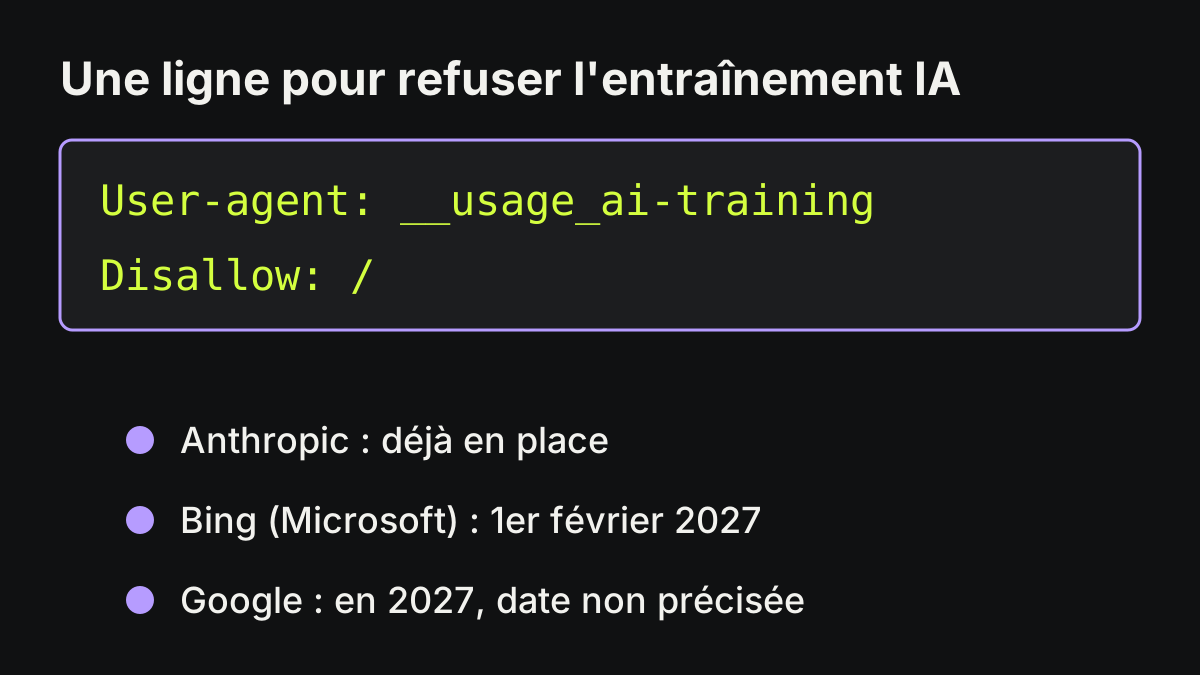
A draft standard submitted to the IETF on October 30 by an Anthropic engineer proposes a single line, __usage_ai-training, to opt your pages out of AI training. Google, OpenAI and Microsoft have agreed to respect it. Timelines vary: Anthropic already applies it, Bing starting February 1, 2027, and Google sometime in 2027 with no exact date. Nothing is mandatory, and showing up in AI answers isn't covered. Why it matters: if you post videos, a blog or code, you'll soon have a simple way to say no. Source: Blog du Modérateur
The New York Times sues the Brave browser
On November 2, the New York Times sued Brave in federal court in Manhattan. The Daily News, the Chicago Tribune and the Orlando Sentinel filed a similar complaint. They accuse Brave of copying their articles to resell them to AI companies, and of getting around their paywalls. Brave hadn't responded yet when the article was published. These are accusations, not a ruling. Why it matters: the fight over the content that feeds AI is now playing out in court, and it will decide what AI is allowed to learn from. Source: TechCrunch
OpenAI promises a future data center can ease off
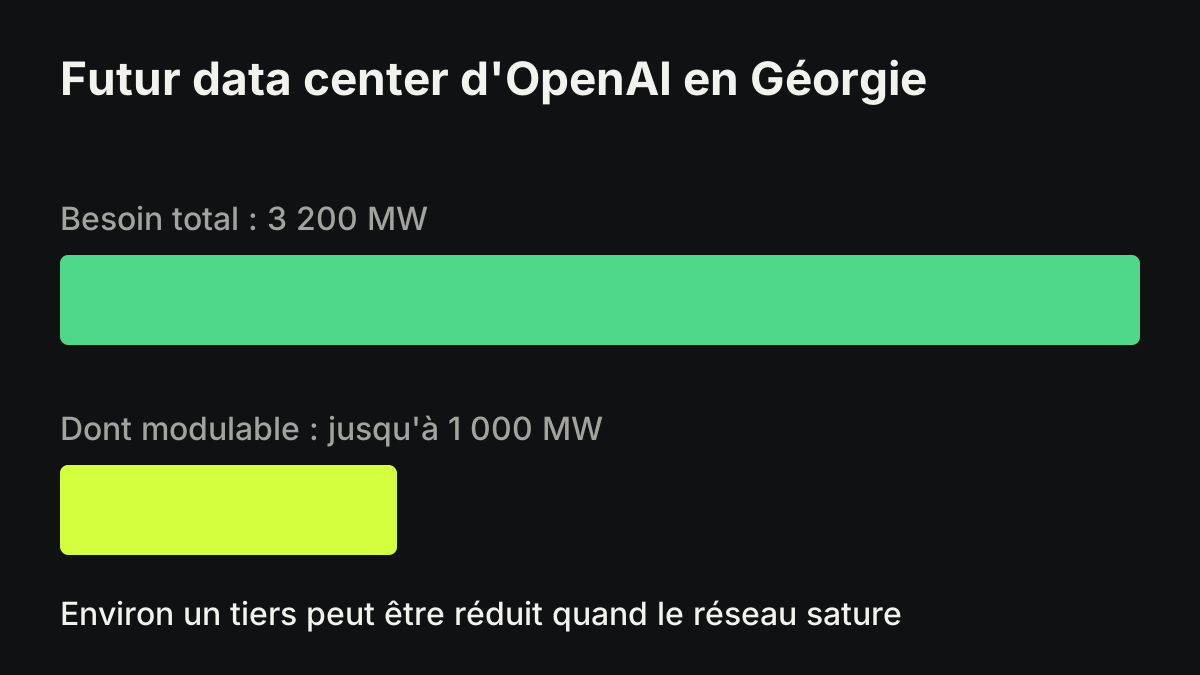
In Effingham County, Georgia, OpenAI is planning a site expected to use about 3,200 megawatts. According to Georgia Power, the company has committed, in a 25-year agreement, to provide up to 1,000 MW of flexibility: the utility will be able to cut the power delivered to the site at certain times. The exact terms (duration, frequency) aren't detailed, and the contract still has to be reviewed by the regulator. Why it matters: the question with data centers is no longer just "how much" they use, but "when." Source: Georgia Power
Italy wants to cap the price of gas for its power plants
Rome plans to cap the gas burned by its power plants at about €59/MWh, for at least one year, modeled on the 2022 "Iberian exception" used by Spain and Portugal. The stated goal: a 10% cut on the bills of households whose contracts track wholesale prices. The European Commission has given its agreement in principle, but Italy still has to file a formal state aid notification and hopes to apply it in January 2027. Eurelectric, the European electricity industry group, calls it disguised subsidies for gas plants. Why it matters: gas sets the price of electricity more than 70% of the time in Italy, versus 20% in France. Source: Révolution Énergétique
ChatGPT and Codex will soon share the same quota
In an email to subscribers, OpenAI announced that usage of ChatGPT and Codex (its coding tool) will be counted against a single shared quota. For the Plus, Pro and Business plans, the change is due in December. Conversations with the Instant model don't count toward this quota. A beta merging the Chat and Work tabs is planned in the coming weeks, with no date for a general rollout. Why it matters: if you code with Codex, you may hit your limit faster, because those tasks eat up far more than a simple chat. Source: Siècle Digital
Translated with the help of AI from our French article, which is prepared with AI from the sources, then reviewed and approved by Valentin Fouilloud before publication. How we work