PostgreSQL 19 delayed: AI is finding too many bugs at once
You often hear that AI is going to write code for us. Here's the opposite effect, and it gets less attention: it's also good at finding the hidden mistakes in very old code. The concrete result in 2026: PostgreSQL, one of the most widely used databases in the world, is going to ship its version 19 late because of it.
Key takeaways
- In a blog post on October 30, 2026, PostgreSQL developer Robert Haas explains that version 19 is late because of bugs discovered by AI.
- It will most likely ship in November, while releases over the past ten years came out between mid-September and mid-October.
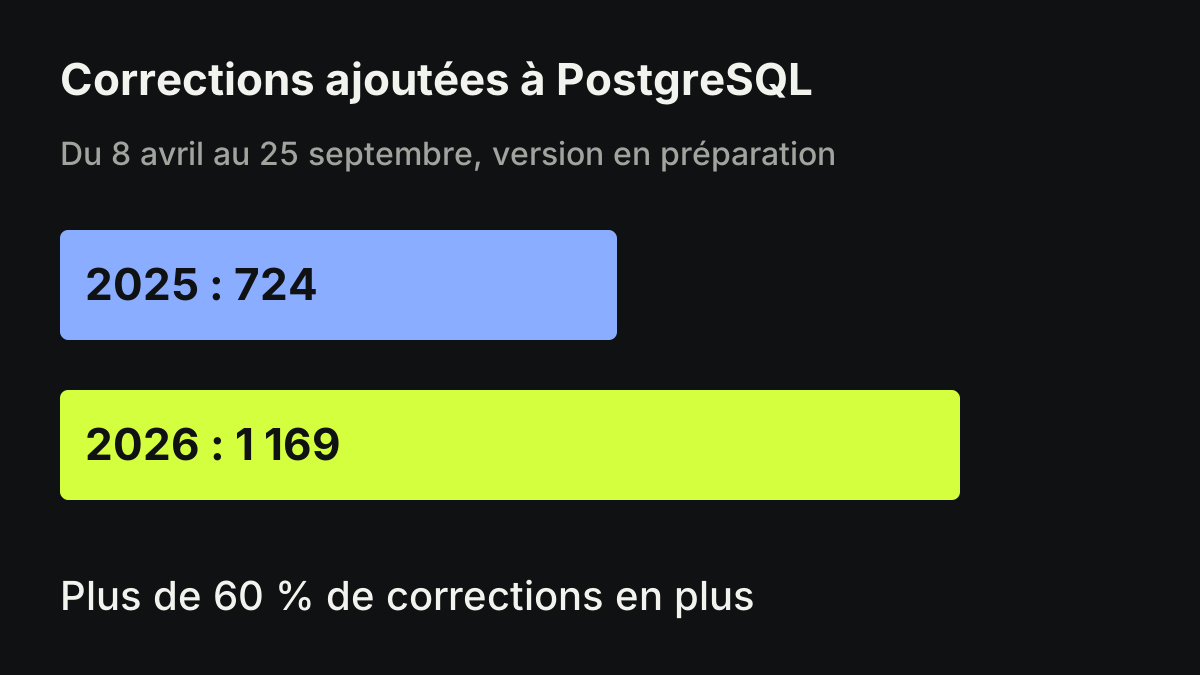
- Fixes added to the upcoming release rose by more than 60% compared with last year.
- No need to panic: according to Haas, the code is still among the cleanest he has seen.
- The real question: how do you keep innovating when you first have to fix forty years of bugs?
What is PostgreSQL?
It's software that stores and retrieves data (user accounts, orders, messages...). It's free, developed by volunteers and companies, and used by a huge number of apps and websites. You've very likely come across it without knowing it.
Every year, a new major version comes out. The schedule is fairly rigid: new features are locked in early April (the "feature freeze," on April 8 every year), then the team tests and fixes until the fall.
What happened
Haas explains that bugs have always existed in a project this old, with a history going back more than thirty years. What changed: they've become much easier to find, thanks to large language models (LLMs). Fixing them has gotten easier too, but not as much as spotting them.
As a result, three big features had to be pulled late in the testing phase, between August 27 and September 15: a command to modify or delete part of a time period in the data, support for graph queries in SQL, and commands to merge or split table partitions. Pulling features right after the April freeze happens, but not three big ones at once, this late.
The numbers
Haas compares the same period (April 8 to September 25) in 2025 and in 2026:
- Fixes added to the upcoming release: 724 in 2025, 1,169 in 2026, more than 60% more.
- Fixes applied to older versions: 248 versus 433, more than 74% more.
He doesn't think developers are making more mistakes: they were as careful as usual, but AI found many more of their mistakes.
Why it takes time
Haas gives two reasons, which can be summed up like this.
Each bug takes more time. A fix suggested by an AI isn't always correct, or in line with the project's rules. A human has to review, approve and merge it.
Review time gets diverted. Security bugs and fixes for older versions took the place of other tasks, which slowed down the decision on whether to pull certain features before the release.
So, what changes?
For you, as someone who uses apps: probably nothing visible. A delay of a few weeks for a more solid release is, if anything, reassuring.
But the signal is bigger than that. Haas writes that every new feature will now be scrutinized by AI, and that flaws that used to go unnoticed could surface within a few hours. That's good news for security, and a headache for teams, often volunteers, who have to sort through a flood of reports.
According to Numerama, a French tech news site, the release of PostgreSQL 19 is set for November 19, 2026, but Haas himself says it could still slip. Worth watching: whether other big open source projects (Linux, Firefox...) see the same thing happen. As for what comes next, nothing is settled: Haas admits he doesn't know how the project will catch up while continuing to innovate.
Translated with the help of AI from our French article, which is prepared with AI from the sources, then reviewed and approved by Valentin Fouilloud before publication. How we work