OpenAI pledges to cut 1,000 MW at its Georgia data center
Data centers have a bad reputation: they guzzle electricity and worry the people who live nearby. On November 2, 2026, OpenAI presented a program meant to flip that argument: its future site in Georgia (in the United States) should be able to cut its consumption by up to 1,000 megawatts when the grid is under strain.
On paper, it's clever. The question is what this promise is really worth.
Key takeaways
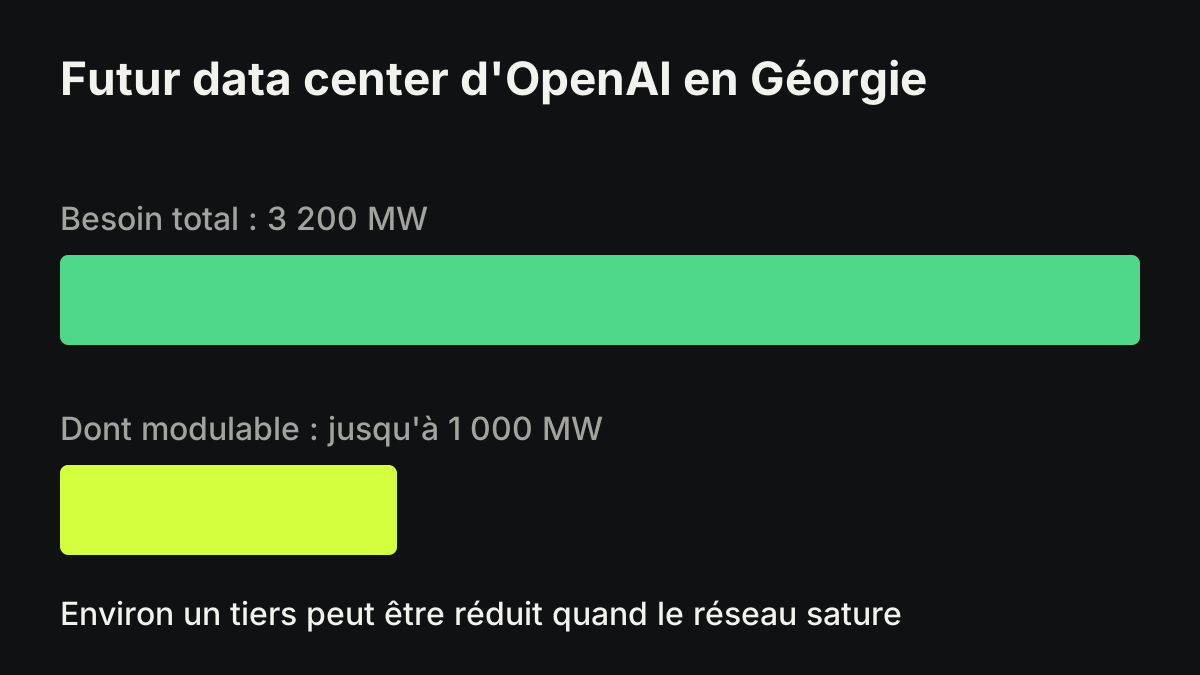
- The project, in Effingham County (Georgia), will need about 3,200 MW, according to Georgia Power.
- OpenAI has committed to provide up to 1,000 MW of "flexibility": the utility can reduce the power delivered to the site at certain times.
- The agreement runs for 25 years, and OpenAI pays the infrastructure and electricity costs for its site.
- We don't know yet at what times or how many times a year the cuts can happen.
- This isn't a power plant that "saves" the grid: it's a way to make a huge consumer less of a burden on it.
What is data center "flexibility"?
A power grid has to constantly produce exactly as much as is being consumed. The worst moments are the peaks: a heat wave when everyone cranks up the AC, or a cold snap when everyone turns up the heat.
A "flexible" big consumer agrees to lower its demand at those moments. This is called demand response. Put simply: instead of adding a power plant to cover a few peak days a year, you ask a big customer to ease off.
In OpenAI's case, Georgia Power announced on July 22, 2026 that the company would provide "up to 1,000 MW of flexibility" and that the utility could reduce the power delivered to the site at certain times for grid reliability. According to The Verge, the program presented on November 2 is called "Grid Protectors" and would be tested at this site. The program talks about freeing up power equivalent to the AC of about 700,000 homes during extreme weather.
The numbers, visualized
The full site is expected to need about 3,200 MW. To give you a reference point, that's the equivalent of the output of two to three large nuclear reactors running just for it.
The promised flexibility, 1,000 MW, is therefore about a third of that need. In the worst case, the remaining two thirds keep running. A third that can switch off is already a lot: the equivalent of the output of a large power plant.
Why OpenAI is doing this now
Three reasons, no cynicism required.
1. Getting approval. Data center projects face more and more local opposition. Showing that you relieve the grid instead of overloading it is an argument for elected officials and regulators. In fact, Georgia's authorities approved the contract on August 27, 2026, according to local press.
2. Keeping the bill off the neighbors. Georgia Power says OpenAI will pay for all of the infrastructure and electric service for its site, with financial guarantees to protect other customers. That's the sore point: nobody wants to pay more because of a data center. We saw a similar tension around xAI's gas power plant in Memphis.
3. Moving faster. A customer that can lower its demand gets connected to the grid more easily, because it doesn't force anyone to build capacity for the peak.
What the announcement doesn't say
This is the part to keep in mind, because it's where the gap between promise and reality lies.
- The terms. How many hours a year? With how much notice? In what kinds of weather? Georgia Power's press release doesn't say.
- How the site cuts back. A data center that trains models can pause computations. A service used live by millions of people, much less so. Neither the utility nor OpenAI explains what will actually be shut down, or whether batteries or on-site generation come into play.
- The timeline. According to local press, the first phase is expected in 2028: so all of this still has to be proven.
So, what changes?
For you, nothing right away: this data center doesn't exist yet. But the principle matters, because it's going to spread. Data centers will keep popping up, and the real question is no longer just "how much they consume," but "when they consume."
If these commitments are kept, AI sites could become one more tool for balancing the grid rather than just a load. If they stay vague, it will mostly look like a PR talking point. The answer will come around 2028, when the site is running and we can see, with numbers to back it up, how many times it actually eased off.
Translated with the help of AI from our French article, which is prepared with AI from the sources, then reviewed and approved by Valentin Fouilloud before publication. How we work