Daily brief, November 3: Anthropic, hacked fridges, robots.txt
Mind-blowing financials, hacked fridges and a new rule to protect websites: here's what mattered as the week kicked off.
Anthropic reveals its numbers ahead of its IPO
On November 2, Anthropic, the company behind Claude, added to the filing it submitted to the US stock market regulator (the "S-1") to go public. It reports about $17 billion in revenue for the third quarter, but growth is slowing: about +47% quarter over quarter, compared with +144% in the second quarter. It has also committed to buying or leasing $895.4 billion worth of compute and infrastructure. Why it matters: AI brings in a lot of money, but it costs staggering sums to build, and this filing shows it in black and white. Source: CNBC
Supermarket fridges hacked across Europe
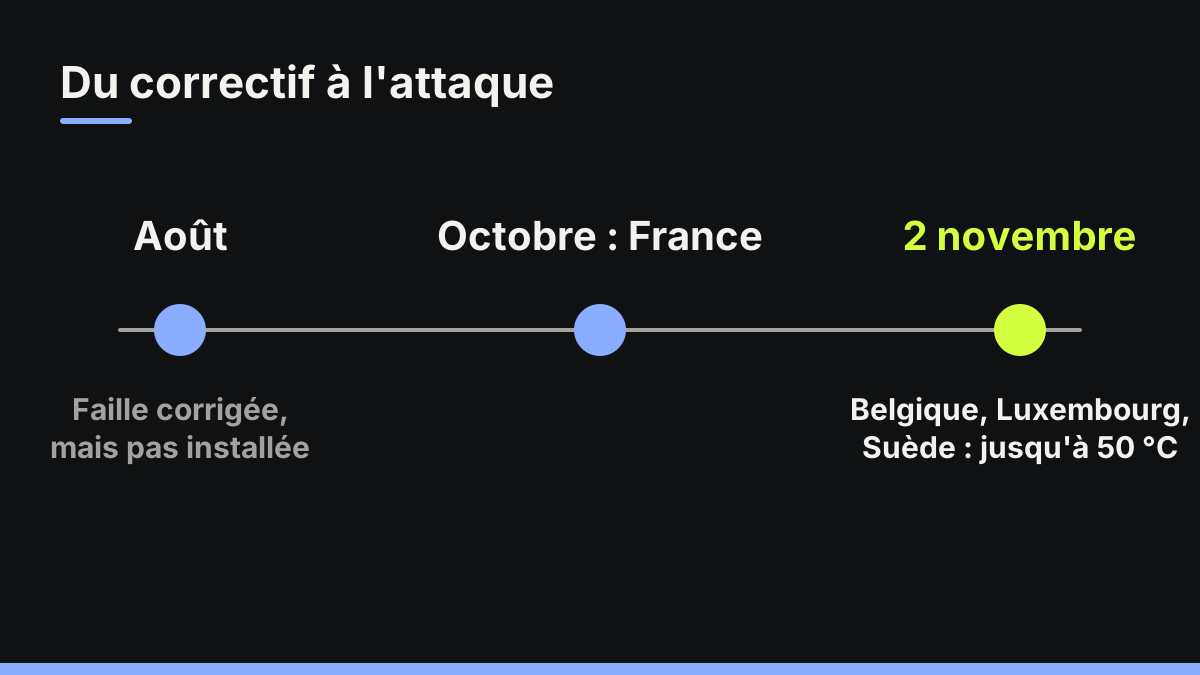
On November 2, hackers remotely took control of supermarket refrigeration systems, mostly in Belgium, Luxembourg and Sweden, with disruptions also reported in Finland, Ireland and Estonia. The temperature hit 50 °C in at least one store, and food had to be thrown out. The method looks like October's attack in France: the control boxes were reachable from the internet, and a fix released in August was never installed on thousands of devices. No one has claimed responsibility. Why it matters: a single forgotten connected device can spoil food on a massive scale. Source: CNBC
Google, OpenAI and Microsoft adopt a shared rule against AI training
Websites will soon be able to say "no" more easily: a shared identifier, placed in the robots.txt file (the one that tells bots what they're allowed to read), will signal that content must not be used to train an AI. Google announced its support on October 30. Microsoft will apply it starting February 1, 2027, Google in early 2027, OpenAI "in the coming months," and Anthropic has already started. The catch: it's not a technical block, it relies entirely on companies choosing to respect it. Why it matters: if you post online, you'll finally have a simple setting to opt out. Source: Siècle Digital
A one-gigawatt data center planned at an English power station
On November 3, Brookfield, Drax and the Radiant platform unveiled a data center project at the Drax power station in North Yorkshire. The first phase, up to 100 MW, is targeting operations starting in the first quarter of 2028, followed by 500 MW more between 2028 and 2031, with the goal of eventually exceeding 1 GW. The potential investment tops £20 billion. Nothing is locked in yet: permits, a grid connection and a customer still need to be secured, and the final investment decision hasn't been made. Why it matters: AI needs electricity, and Europe is looking for places to plug it in. Source: CNBC
ChatGPT and Codex will share the same usage limits
OpenAI is getting ready to merge the Chat and Work tabs in its ChatGPT desktop app, according to an email sent to users and announced on November 2. ChatGPT and Codex, its coding tool, will draw from the same pool of tokens (the units of text that measure your usage). OpenAI says most users won't notice a difference, but some will have to wait more often for their limits to reset. No rollout date has been given. Why it matters: if you code with Codex, you'll also be eating into your chat quota. Source: TechCrunch
Apple warns that memory keeps getting more expensive
On November 2, John Ternus presented Apple's results for the first time as CEO: better than expected, but with a projected gross margin of 45 to 46% for the end of the year, versus the 46.3% analysts expected. Apple points to rising memory prices and the cost of rolling out Siri with AI, and expects those prices to keep climbing after December. It also expects supply constraints for iPhone and Mac over the holidays. Why it matters: components are getting pricier, and the iPhone already went up $100 in September. Source: CNBC
Translated with the help of AI from our French article, which is prepared with AI from the sources, then reviewed and approved by Valentin Fouilloud before publication. How we work