Supermarket fridges hacked across Europe: how it happened
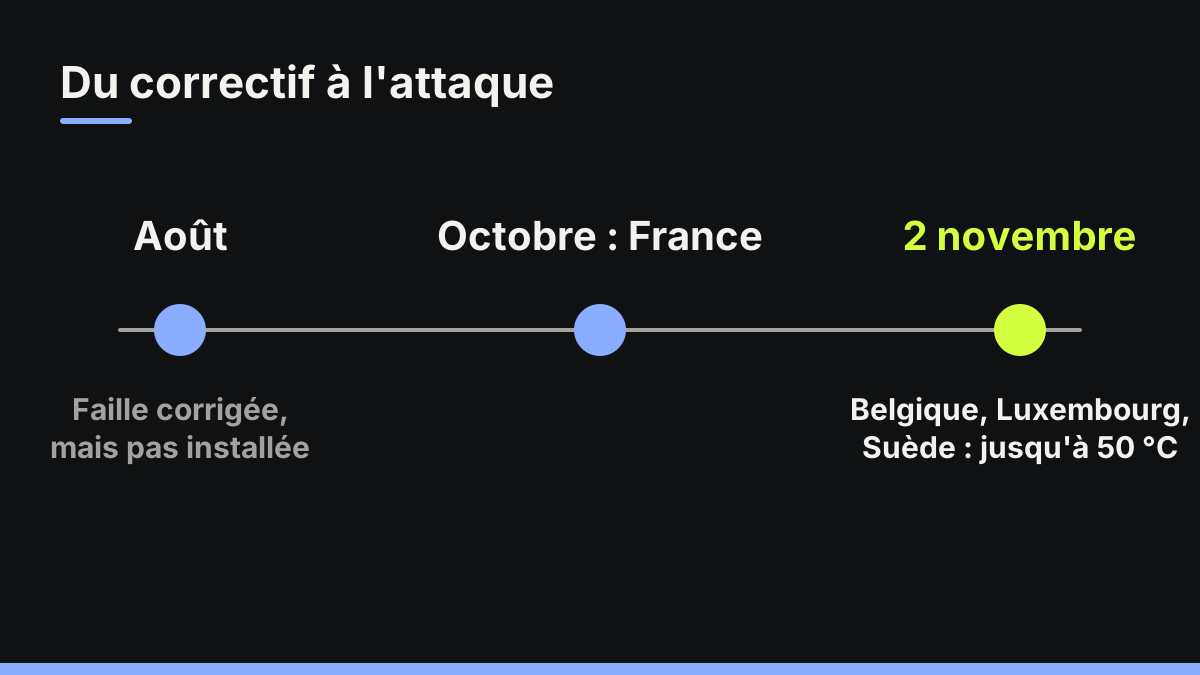
On November 2, 2026, supermarkets in several European countries watched the temperature in their fridges and freezers climb on its own. Behind it: hackers who had taken remote control of these connected devices. It's not the first time: France was hit three weeks earlier. And the most surprising part is that the flaw had been known since August.
Key takeaways
- On November 2, 2026, stores in Belgium, Luxembourg and Sweden were hit, according to CNBC. Disruptions were also reported in Finland, Ireland and Estonia.
- The hackers heated fridges up to 50 °C in at least one store, forcing staff to throw out products.
- The control boxes were directly reachable from the internet, with support credentials built into the device.
- The manufacturer fixed the flaw in August, but thousands of devices never got the update, and the oldest ones can't be updated.
- No one has claimed responsibility. Investigations are ongoing.
What happened?
According to CNBC, which reports statements from the retailers and from experts, the November 2 attack hit dozens of Delhaize stores in Belgium, 15 Belgian Carrefour stores, 15 out of 153 Intermarché stores in Belgium, five Spar stores run by the Colruyt group, and the IKEA store in Mons. Delhaize stores in Luxembourg and a limited number of ICA stores in Sweden were also targeted.
The method is the same as in France in October: hundreds of supermarkets were targeted there, with overheating fridges, spoiled food and even fires. Les Mousquetaires, the French retail group that owns Intermarché, expected several million euros in damage. Ahold Delhaize, for its part, says things are back to normal.
Why it's possible: a fridge that answers anyone
A supermarket fridge isn't just a motor anymore. It's a connected device: a small box monitors and adjusts it remotely, so staff can check temperatures without walking across the store. Handy, but that box is a computer like any other.
The problem, according to the researchers quoted by CNBC: - these boxes are directly reachable from the internet, like a door with no lock opening onto the street; - they contain built-in support credentials, whose password could be figured out the same day; - the flaw was reported in August, and the vendor released a fix, but thousands of units never installed it. The oldest models can't be updated at all.
Fredrik Blix, a cybersecurity expert at the company Visente, considers the attack unsophisticated. This isn't movie-style high tech: it's a basic oversight, multiplied across thousands of devices.
Who's behind it? Nobody knows
No group has claimed responsibility. Blix sees a clue in that: the lack of a claim tends to rule out ransomware groups, which want to get paid and therefore make themselves known. He mentions two hypotheses: an opportunistic attack, or an attempt to sow chaos in countries that support Ukraine. These are hypotheses, not conclusions. Rafe Pilling, from the company Sophos, notes that there's no evidence AI played a role.
Another signal: according to Reuters, cited by CNBC, stores on six US military bases suffered freezer failures in late August, and the Pentagon is treating these cases as a suspected hack. The article doesn't establish a link with the European attacks.
So, what changes?
For you, at the grocery store: when an attack happens, damaged products get thrown out, and some shelves may be empty for a few days. Nothing to worry about for what you buy at the checkout: stores pull the affected food.
The real issue is elsewhere. Anything you connect to the internet becomes a potential target, and security depends on a chain: the manufacturer releases a fix, but someone still has to install it. CERT-FR, the French government service that handles cybersecurity alerts, asked operators to take these devices off the internet. Same logic at home: a router, a camera or a speaker that's never been updated is an open door.
On what timeline? The fix already exists. The risk will remain as long as thousands of boxes aren't updated or replaced, which could take months. For the older models, the only fix is to disconnect them from the internet or replace them.
What the source doesn't say
- The name of the boxes' manufacturer, or the specific flaw.
- The total number of stores hit in each country.
- Who's behind it and why.
Translated with the help of AI from our French article, which is prepared with AI from the sources, then reviewed and approved by Valentin Fouilloud before publication. How we work