Gravity battery: a 148 m tower stores power in concrete blocks
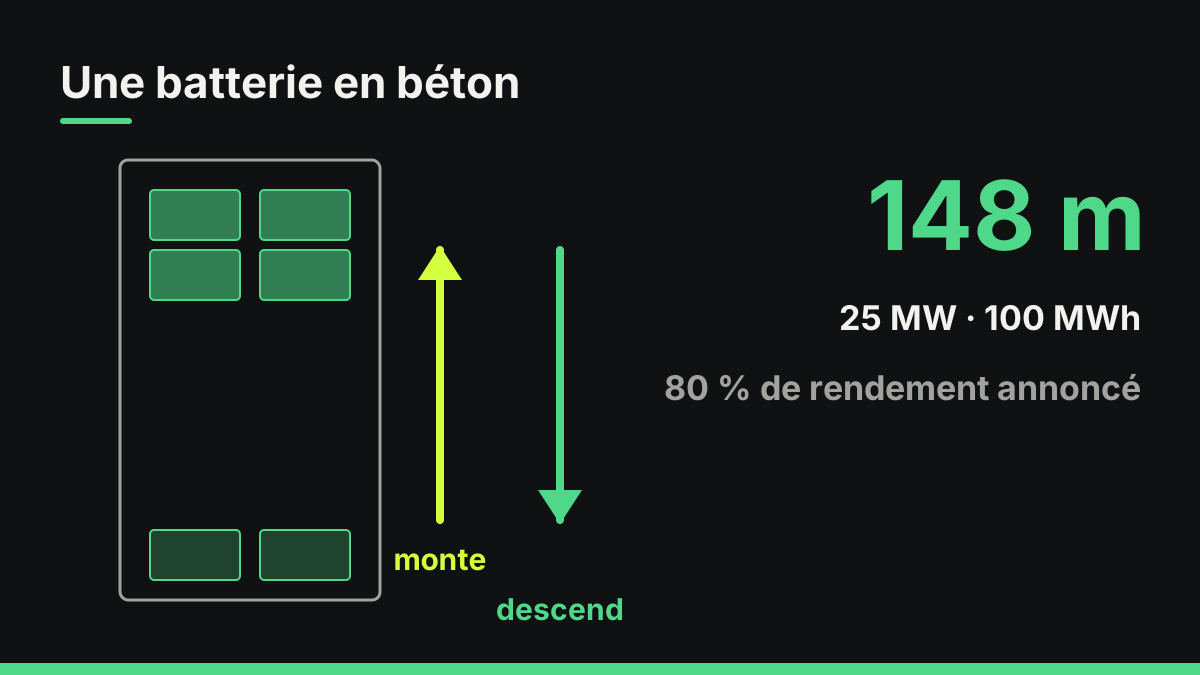
In Rudong, China, a 148-meter concrete tower works as a giant battery. No lithium, no chemicals: just heavy blocks that get lifted when electricity is plentiful and lowered when it runs short. It sounds like a giant Lego set. It works, but it's not about to replace the batteries in your phone or your car.
Key takeaways
- The project, built by the company Energy Vault, is located in Rudong (China). It offers 25 MW of power and 100 MWh of capacity, or about four hours at full power.
- The principle: winches lift concrete blocks using surplus electricity, then the blocks come back down and generate power.
- The announced efficiency is about 80%: for every 100 units of electricity stored, you get roughly 80 back. For now, that's a figure announced by the builder.
- Announced lifespan: 35 years, with no risk of thermal runaway (the typical fire in lithium batteries).
- The big weakness: lithium costs much less and can be deployed in small modules.
The principle: a battery that stores height
When you lift something heavy, you spend energy. That energy hasn't disappeared: it's stored in the object's height. If you let it drop, you get it back. That's exactly what a mountain reservoir does in what's called pumped-storage hydro: water is pumped uphill, then released back down through turbines.
The Rudong tower swaps water for concrete. According to Révolution Énergétique, a French energy news site, winches raise the blocks when there's too much electricity on the grid, for example in full sunshine. When demand rises, the blocks come back down and the released energy is converted back into electricity. The building measures 110 meters per side and stands 148 meters tall.
Numbers that speak for themselves
- 25 MW of power: enough to supply a lot of homes at once, but not for very long.
- 100 MWh of capacity: 25 MW for four hours. For comparison, a French household uses roughly 12 kWh per day (average estimate), so 100 MWh is the daily consumption of about 8,000 households.
- 80% efficiency: that's close to recent pumped-storage plants like Nant de Drance in Switzerland, which the article mentions.
- 35 years of announced lifespan, maybe more with good maintenance.
Why does the tower need to be so huge? A quick back-of-the-envelope calculation, which doesn't come from the builder: lifting one metric ton by 100 meters stores only about 0.27 kWh. To reach 100 MWh, you need to move hundreds of thousands of tons. Height and mass are the only "raw materials" of this kind of battery.
What's proven, what's a promise
On the proof side: according to the project page on Energy Vault's website, the facility has been tested, commissioned with the local grid authorities and connected. On the promise side: the efficiency of more than 80% and the 35-year lifespan are presented as projections on that same page. As far as we know, no independent long-term measurements have been published.
Another advantage the company highlights: the storage medium barely degrades over time, unlike a lithium battery, which loses capacity with every cycle. And a concrete block can't catch fire.
So, what changes?
For you, nothing directly: this kind of tower won't fit in a car or a smartphone. Its job is the power grid. With solar and wind, we sometimes produce too much and sometimes not enough, so we need somewhere to keep energy for a few hours. We saw in this power grid mystery and its batteries how these adjustments happen down to the second.
Against lithium, concrete has a big disadvantage. Révolution Énergétique says it bluntly: lithium batteries are modular and their upfront cost is much lower, which could overshadow gravity storage. Other approaches are also trying to avoid lithium, like the nonflammable sodium electrolyte.
On what timeline? The facility already exists, but it's a niche: it's there to prove an alternative is possible. Price and ease of construction will decide whether this kind of tower spreads or stays a curiosity. Neither the source nor Energy Vault gives the project's cost here: without that number, it's impossible to judge whether it pays off.
What the source doesn't say
- The weight and number of blocks.
- The total cost of the tower.
- Real-world efficiency measurements after several months of operation.
That's exactly what to look at before calling it a miracle.
Translated with the help of AI from our French article, which is prepared with AI from the sources, then reviewed and approved by Valentin Fouilloud before publication. How we work