Daily brief, November 7: OpenAI, Canva, Clutch and Claude
This morning, AI news is mostly about company balance sheets: a funding round, a restructuring, an acquisition, and new tools that reach users directly.
OpenAI has reportedly already raised $11 billion
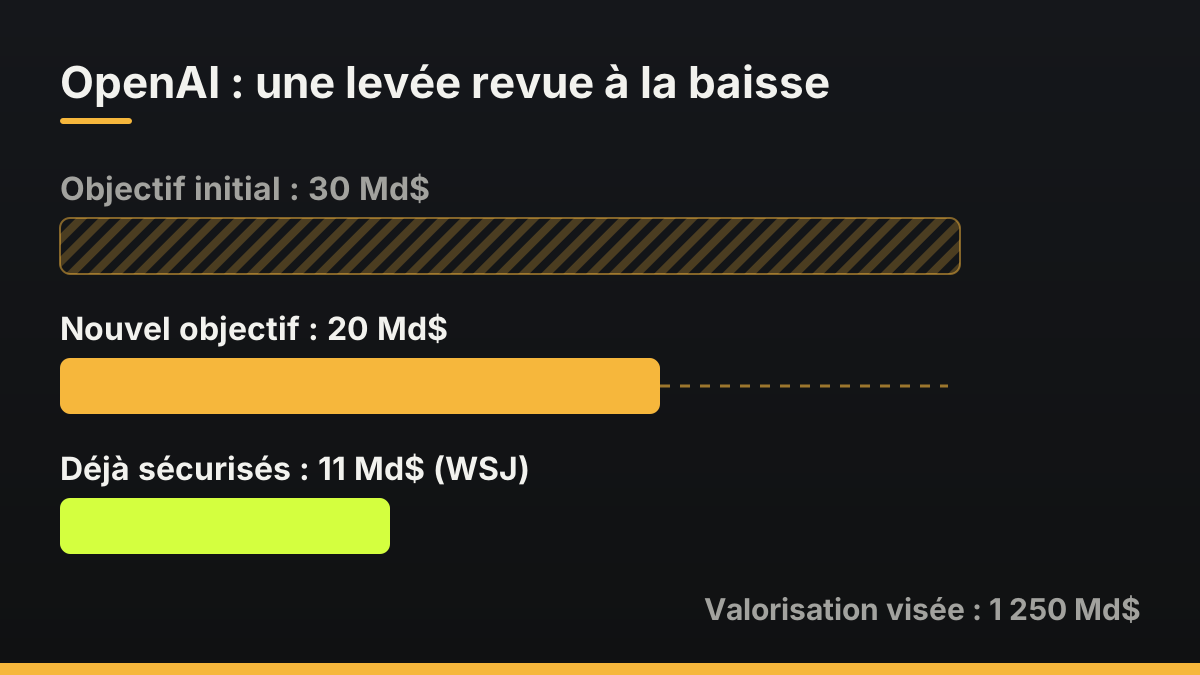
According to Bloomberg, as reported by TechCrunch on November 6, OpenAI has reportedly raised $11 billion in a new funding round, at a valuation of $1,250 billion. The round isn't closed yet: one source mentions about $20 billion in total, with the round expected to close in the coming weeks. That's still far from the $30 billion it was aiming for at the end of September. OpenAI didn't comment. Why it matters: a valuation tells you the price investors are willing to pay for a piece of the company, and OpenAI's is the benchmark for the whole industry.
Canva restructures, 1,271 employees affected
Canva has launched a restructuring that affects 22% of its staff, or 1,271 people, according to Siècle Digital, a French tech news site (article from November 5). The company says its AI features cost more and took longer than planned, which forced it to slow down their rollout. Its growth forecast for 2026 had already dropped from 30% to 20% in August. Why it matters: Canva claims 265 million monthly active users, and its case shows that adding AI to a product comes with a very real cost.
Palo Alto Networks in talks to buy Clutch
According to a person familiar with the matter, quoted by TechCrunch on November 5, Palo Alto Networks is reportedly in talks to acquire Clutch, a startup that secures AI agents' access to company systems. The offer would be $500 million in cash, plus payments tied to performance targets. Clutch had been valued at $85 million in its Series A round in January 2025. Nothing has been signed, and neither company responded to requests for comment. Why it matters: an agent that acts on your behalf needs access to your tools, and someone has to make sure that access isn't used for something else entirely.
Claude connects to your bank, in the US
As of November 5, Claude can analyze your finances, in beta in the US for Pro, Max and Ultra subscribers. You link your bank accounts and cards through Plaid, then ask questions like "where did my money go this month?" Claude sorts your spending and spots duplicate charges and bills that keep creeping up. Access is read-only: the tool can't transfer or invest money. Anthropic says these conversations aren't used to train its models. Why it matters: it's a concrete example of what you hand over to an AI when you open up your account to it.
Airbnb's AI agent, planned for the first half of 2027
In its third-quarter shareholder letter, published on November 5, Airbnb announced an AI agent that will help plan and book a stay. Instead of a plain chat, it would show maps, comparisons and itineraries. It would first book places to stay, then activities. During the trip, it would handle changes, payments and refunds, with 24-hour safety support. Countries, pricing and whether it will be free haven't been specified. Why it matters: it's a real-world test of an agent that spends money on your behalf.
Mistral buys SkipLabs and creates its Language team
On November 6, Mistral AI announced it had acquired SkipLabs: its six engineers are joining Mistral to form a team called "Language," according to Le Monde Informatique, a French IT news site. SkipLabs, founded by former Meta engineer Julien Verlaguet, works on compilers and programming languages. It released Skip, an open-source tool, and built Skipper, an agent that generates back-end services from natural-language instructions. The price wasn't disclosed. Why it matters: it's a small acquisition, but it shows an AI player buying an entire team to gain skills.
Translated with the help of AI from our French article, which is prepared with AI from the sources, then reviewed and approved by Valentin Fouilloud before publication. How we work