Mistral Large 4: the giant French AI model you can download
In late October 2026, French startup Mistral AI released the "weights" of its biggest AI model, Mistral Large 4, nicknamed "Le Chonk." In practice, anyone can now download it, install it on their own servers and modify it. That's rare for a model this size. But careful: "downloadable" doesn't mean "runs on your PC."
Key takeaways
- Mistral Large 4 was unveiled on October 6, 2026, then its weights were published on Hugging Face in late October.
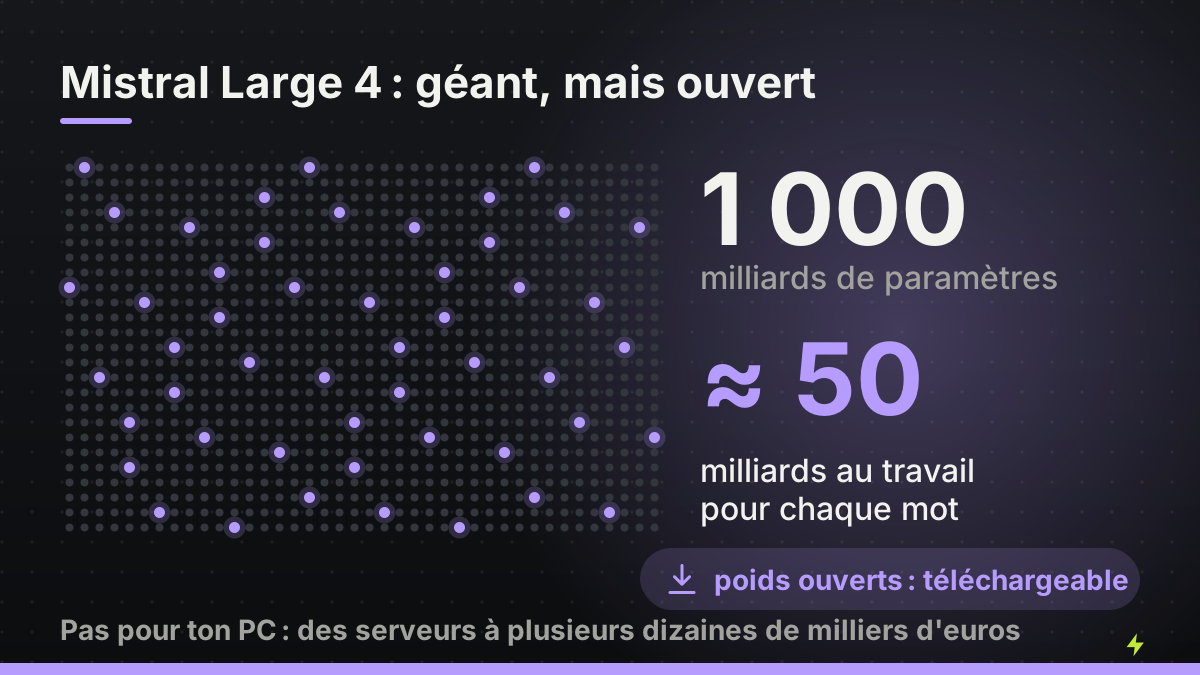
- It's a giant model: about 1,000 billion parameters, of which only about fifty billion work on each word it generates.
- Mistral presents it as the best open model developed in the West, especially for writing code. That's based on its own tests.
- The license allows commercial use, except for companies that resell access to the model as a service: they have to pay Mistral.
- Running it takes servers costing tens of thousands of euros. You'll mostly use it through the API or the apps.
What does "open-weight" mean?
An AI model is a huge file of numbers, the "weights," tuned during training. They hold everything the model has "learned."
At OpenAI or Google, those weights stay secret: you use the model through their site or their API, period. When a company publishes the weights, it's as if a chef gave you not the detailed recipe, but the finished dish, which you can reheat and season at home. You can use it without going through Mistral, adapt it to your field (that's called "fine-tuning") and keep your data on your own machines.
One catch: "open-weight" isn't "open source" in the strict sense. Mistral doesn't publish the training data or the full process used to build the model.
A giant that never runs at full size
A thousand billion parameters sounds impressive. But Large 4 uses an architecture called "mixture of experts" (MoE). Picture a school with hundreds of specialized teachers: for each question, only a few of them answer. Here, about 52 billion parameters are active at each step, judging by the name of its Hugging Face repository. The result: the model is faster and needs less computing power than a "dense" model of the same size.
It's also multimodal: it understands images as well as text, and Mistral says it handles more than 160 languages. It offers three reasoning levels (low, medium, high): the more you ask it to think, the more accurate it is… and the longer it takes.
What it can do, according to Mistral
Mistral's big focus is software development with "agents," AI systems that carry out several steps on their own (reading a project, fixing a bug, running tests).
A few figures announced by the company: - Terminal-Bench 4.0 (tasks to complete in a terminal): 41%, versus 28% for the October preview. - Coding Agent Index from Artificial Analysis: 48%, tied with the Chinese model GLM-5.3, but using about half as many "tokens" per task. Fewer tokens means cheaper and faster. - Safety: it refused malicious hacking requests 96.6% of the time on average, across several standard tests.
Mistral also cites uses like analyzing financial spreadsheets, automated web browsing or analyzing satellite images (wildfires, crops, power lines).
What the announcement doesn't say
Time for a reality check.
- These are in-house numbers. The scores above were picked and published by Mistral. Independent evaluators, like Vals, measured more modest results on some tests, especially on the preview. The best closed models (Claude, GPT, Gemini) are still ahead on several leaderboards.
- "Best Western open model": the wording matters. Chinese open models (GLM, Kimi, DeepSeek) are neck and neck, and sometimes ahead depending on the test.
- The hardware. Mistral doesn't specify the minimum setup. Independent estimates point to several latest-generation professional Nvidia graphics cards, even with a compressed version. In other words: a data center, not a gaming graphics card.
- Mistral acknowledges a risk. The company admits the model could help real hackers and says it's still working on its guardrails. A version specialized in cybersecurity is reserved for hand-picked partners.
Why it matters for Europe
Mistral has raised about $6 billion in three years, according to its CEO Arthur Mensch. That's a lot for Europe, but far from the sums raised by OpenAI or Anthropic. Publishing its weights is a strategy: making itself indispensable to companies, governments and researchers who want an AI they control, hosted in Europe, without depending on an American giant.
The model was also trained on about 3,800 Nvidia chips in Mistral's European data centers.
So, what changes?
For you, starting tomorrow: not much you'll notice. You can try the model through Mistral's tools, and its API price is low: $0.70 per million input tokens and $2.10 for output. A million tokens is on the order of several hundred pages of text.
In the medium term, the effect is indirect: French companies and government agencies will be able to build their own assistants on this model, without sending their data to the US. The first apps based on Large 4 could show up in the coming months.
If you code, it's a serious, cheap option worth watching. If you just want the most powerful chatbot right now, the big closed models are still a step ahead, according to the independent tests available.
Translated with the help of AI from our French article, which is prepared with AI from the sources, then reviewed and approved by Valentin Fouilloud before publication. How we work