Dopamine Detox: Real or Hype? What the Science Actually Says
On TikTok, thousands of videos promise to "reset" your brain: 24 hours with no phone, no music, no sugar, to bring your dopamine levels "back up." It's a tempting idea. But it's built on a scientific misunderstanding, and even the person who came up with the method admits it.
Key takeaways
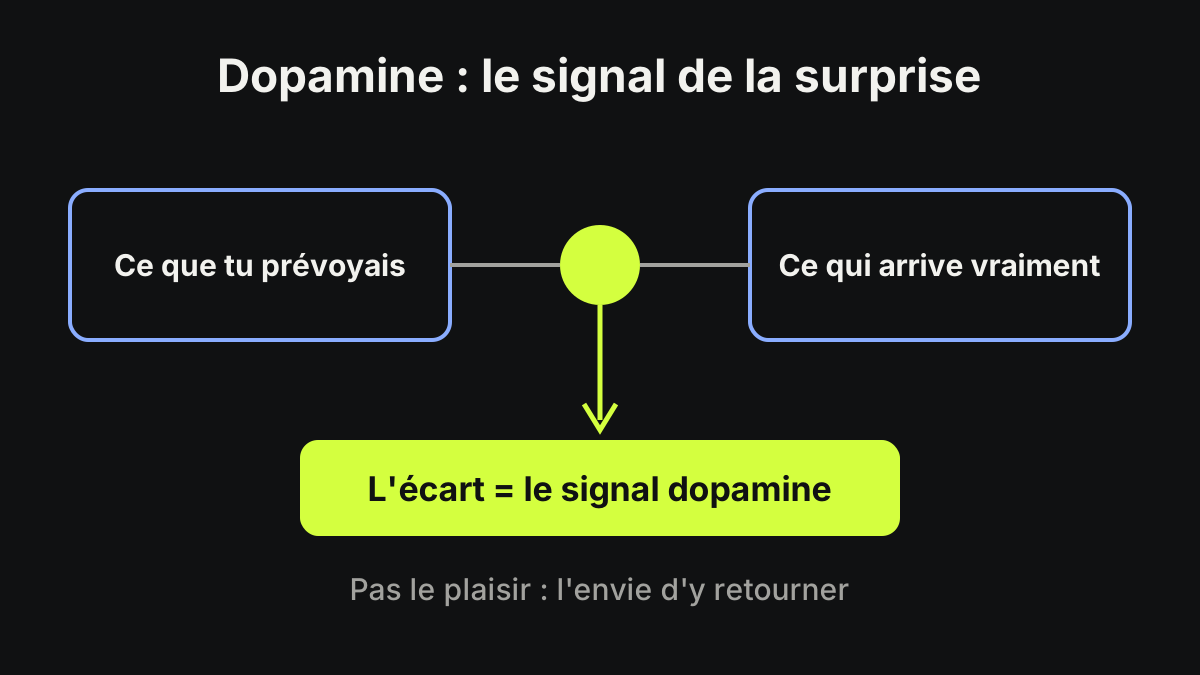
- Dopamine isn't the "pleasure molecule": its main job is to signal the gap between what your brain expected and what actually happens.
- A day without screens doesn't "lower" your dopamine, and it doesn't "recharge" any kind of reserve.
- The psychiatrist who launched "dopamine fasting" says himself that the name shouldn't be taken literally.
- Likes, on the other hand, really do activate the reward circuit: a UCLA study showed it in 32 teens in 2016.
- What matters is taking back control of a habit, not "draining" a molecule.
Dopamine isn't about pleasure
Everyone calls it "the happiness hormone." That's an oversimplification. Dopamine is a chemical messenger in the brain that does a lot of things: helping you move, learn and stay motivated.
In 1997, in the journal Science, researchers Wolfram Schultz, Peter Dayan and Read Montague described how dopamine neurons behave in monkeys. Their activity tracks prediction errors: the gap between what the brain expected and what really happens. Put simply, dopamine tells your brain "hey, that was better (or worse) than expected, remember this."
Here's an easy way to remember it: dopamine is less about the taste of the cake and more about the urge to go open the cupboard. It's a learning and motivation signal more than a feeling of pleasure.
So where does scrolling fit in? A feed where you never know if the next video will be terrible or amazing is a feed full of surprises. This hasn't been proven directly for TikTok, but the mechanism helps explain why an unpredictable feed is so hard to put down.
"Dopamine detox": where the idea comes from
The method was popularized by Cameron Sepah, a psychiatrist in California. According to a Harvard Health article by Peter Grinspoon, a physician at Massachusetts General Hospital, published on February 26, 2020, it started out as a technique inspired by cognitive behavioral therapy (therapies that work on habits and thought patterns).
Its goal: to loosen the grip of all the stimulation of online life, like notifications and messages, and to get better control over behaviors that become compulsive. The list it covers is broad: emotional eating, too much internet and gaming, shopping, gambling, thrill-seeking. Sepah says it himself: the title "is not to be taken literally." The goal was never to lower dopamine.
Why "draining your dopamine" is a myth
This is where the TikTok version goes off the rails. According to Peter Grinspoon, avoiding stimulating activities doesn't lower your dopamine level. The idea of a break that would recharge your reserves, like a battery left to rest, "doesn't work like that at all."
Your brain makes dopamine all the time, because it needs it to function. There's no gauge to reset to zero in 24 hours. The doctor also points out a harmful side effect: some people cut themselves off from things that are good for them, like seeing friends or exercising, in the name of misunderstood science.
Likes, though, really do speak to your brain
That doesn't mean the link between social media and reward is made up. In 2016, researchers at UCLA, led by Lauren Sherman, published a study in the journal Psychological Science.
They had 32 teenagers ages 13 to 18 believe they were using a small, Instagram-like social network. Lying in an MRI scanner, the teens viewed 148 photos over 12 minutes, including 40 they had submitted themselves. The result: photos with lots of likes triggered more activity in the nucleus accumbens, a part of the reward circuit. And the teens were more likely to like a photo that already had lots of likes, especially when it was their own.
The limits matter: 32 participants is a small number, the likes were set by the researchers and the network was fake. The study shows the brain reacting to approval from others. It doesn't show an "addiction."
So, what changes?
Real: social media plays on the reward circuit, through likes and the surprise effect of the feed. Hype: the idea that you need to "drain" or "recharge" your dopamine with a single day without screens.
What's still useful in the original method is the approach: spot the habit that's actually bothering you and set limits on it, instead of cutting everything off at once. And if you feel like you can't control your use anymore despite your efforts, talking to a health professional is a real option, not a sign of weakness.
Translated with the help of AI from our French article, which is prepared with AI from the sources, then reviewed and approved by Valentin Fouilloud before publication. How we work