Altermagnetism: a third type of magnetism finally proven?
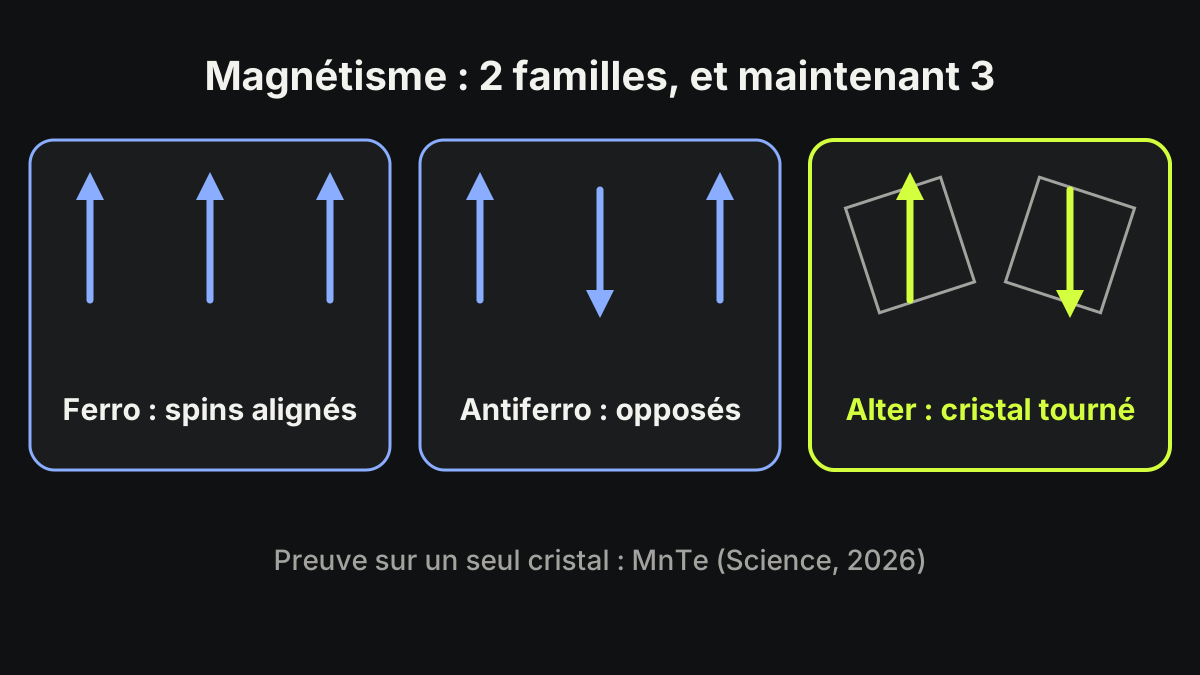
Fridge magnets on one side, materials with "no visible magnetism" on the other: for about 90 years, physicists have sorted magnetic materials into two families. Researchers at SLAC, a US national lab, have just confirmed the existence of a third one, altermagnetism, in a crystal of manganese telluride. The discovery is solid, but the applications still have to be built.
Key takeaways
- Until now: ferromagnets (like a magnet) and antiferromagnets (no field on the outside).
- Altermagnets look like the latter from afar, but behave differently up close: it's the third family, named in 2022.
- The proof, published in the journal Science, comes from X-ray experiments on a single material, manganese telluride (MnTe).
- The hope: faster, more energy-efficient memory and chips.
- No timeline has been announced: first, scientists need to learn how to control these states with light and electricity.
Quick refresher: magnetism is all about "spins"
Every electron acts like a tiny compass, called its spin. Depending on how these compasses point relative to each other, the material behaves differently.
- Ferromagnetic: all the spins point the same way. Their effects add up, and you get a magnet (iron, a fridge magnet).
- Antiferromagnetic (identified in 1933): neighboring spins point in opposite directions and cancel out. No magnetic field on the outside.
Altermagnets look like antiferromagnets: their spins alternate too. But the lattice of atoms around them is rotated from one region to the next. That small difference breaks a symmetry, and it changes everything.
Why it matters for electronics
Tomorrow's electronics could use the spin of electrons on top of their electric charge: that's called "spintronics."
Here's the current dilemma. A ferromagnet is easy to read, but an outside field can accidentally flip its data. An antiferromagnet resists those disturbances, but it's hard to get information out of it.
An altermagnet promises the best of both: no net field on the outside, so good stability, but the ability to produce spin currents that let you read the information. According to the researchers, this paves the way for faster computers, advanced memory, more energy-efficient data centers and components for quantum computing.
How they proved it
The team, led by Daniel Jost (SLAC), with Rachel Nickel from the European synchrotron ESRF in Grenoble, France, studied manganese telluride. This material had long been classified as an ordinary antiferromagnet.
They used "spiral" polarized X-rays, twisting to the left or to the right. The material scatters these two kinds of rays differently. An ordinary antiferromagnet would treat them the same: the difference is the signature of altermagnetism, because it reveals chirality, a kind of "left hand / right hand" in the material.
The experiment was first done in 2024, then repeated in early 2025 with the same results. The study, titled "Chiral altermagnon in MnTe," was published in Science (SLAC press release dated October 29, 2026, picked up by ScienceDaily on November 4).
What it doesn't prove (yet)
- The confirmation is based on a single material.
- Scientists don't yet know how to control these magnetic states with light or electricity: that's the next step they've announced.
- The applications (memory, chips, quantum) are possibilities. The source article says significant development is still needed before any wide use, without giving a date.
So, what changes?
In your phone or your PC? Not for a long time: no product has been announced. This is fundamental physics, and that's what makes it interesting: it answers a 90-year-old question.
It's still worth following, because it hits a real problem today: AI and data centers use enormous amounts of energy, and any more efficient memory or chip is welcome. But going from a measurement on a lab crystal to a component in a device often takes more than ten years. We'll come back to it once someone shows off a working component.
Translated with the help of AI from our French article, which is prepared with AI from the sources, then reviewed and approved by Valentin Fouilloud before publication. How we work