Geothermal earthquakes: France's Rittershoffen plant to restart
Verdict: True
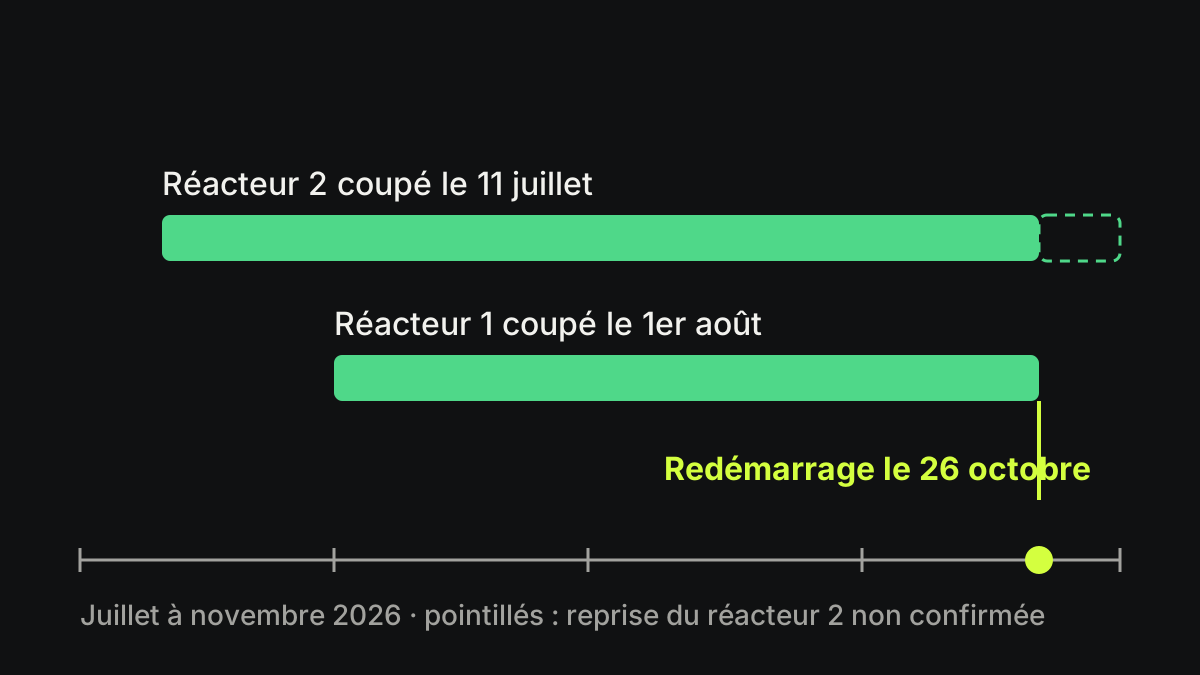
Can geothermal energy cause earthquakes? In Rittershoffen, in the Bas-Rhin department of eastern France, the answer is yes. On December 4, 2025, at 1:45, a magnitude 2.5 earthquake exceeded the safety thresholds and forced the shutdown of the geothermal plant, which has been heating a nearby factory since 2016. Électricité de Strasbourg, the regional power utility, is now preparing a restart for the end of 2026, after changes that must be approved by the BRGM, France's national geological survey.
Key takeaways
- More than 400 tremors were recorded between December 4 and 17, 2025, the strongest at magnitude 2.6.
- The operator attributes these earthquakes to the cooling of the rock around the well where water is reinjected.
- If nothing changed, 20 more years of operation could release a magnitude 3.1 earthquake, according to its own modeling.
- The restart depends on the BRGM's green light, expected in the coming weeks.
Can geothermal energy cause earthquakes?
Yes, deep geothermal energy can trigger small earthquakes, and that's exactly what happened at Rittershoffen: the operator itself acknowledges it in its analysis. The plant went through 81 seismic sequences during its first eight years. The one in December 2025 is the strongest since drilling began in 2012. Shallow geothermal energy, the kind used by heat pumps that draw heat from a few dozen or a few hundred meters under a backyard, is a different thing entirely: it doesn't touch deep faults.
Water at 170 °C for a starch factory
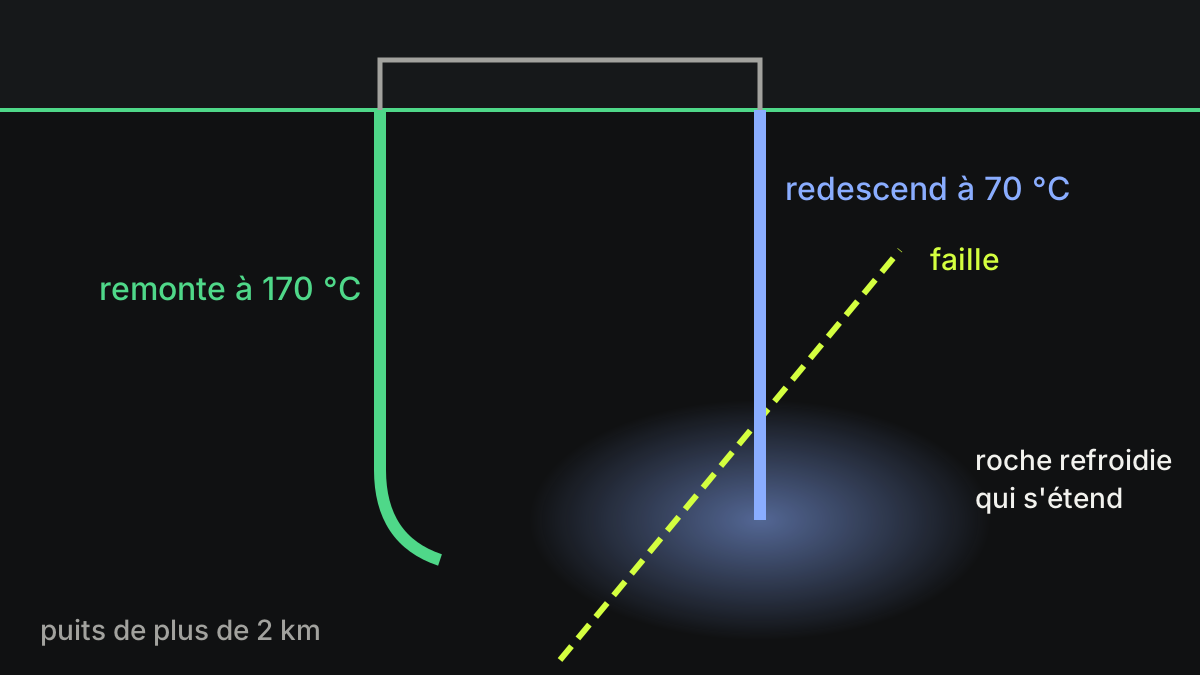
The plant doesn't produce electricity. Two wells go down more than 2 km under the Alsace plain. Through the first one, salty water at about 170 °C is pumped up. It passes through a heat exchanger, gives up its heat, then goes back underground through the second well at about 70 °C. The recovered heat travels through a pipe to the Roquette factory in Beinheim, 15 km away, which turns grain into starch and glucose.
Its capacity is 24 megawatts of heat. At the inauguration, the Caisse des Dépôts, a French public financial institution and a 20% shareholder alongside Électricité de Strasbourg and Roquette (40% each), announced 39,000 tons of CO2 avoided per year, the equivalent of the emissions of 25,000 cars.
1.5 mm/s: the threshold that shut the plant down
A network of sensors constantly measures how fast the ground moves. The prefectural order, the local government permit, sets a limit of 1.5 millimeters per second. If it's exceeded at two or more stations, the plant has to shut down. That's what happened on the night of December 4: the gradual shutdown started right away, and by 2:50 everything was off. A second tremor, at magnitude 2.6, followed on December 12, while the pumps were already stopped.
How lukewarm water makes a fault slip
The analysis published by the operator, summarized by the specialist site ThinkGeoEnergy, describes a four-step mechanism:
- Since 2016, water reinjected at 70 °C has been cooling the surrounding rock, which is naturally much hotter.
- This cold zone grows year after year around the injection well.
- As it cools, the rock contracts, a bit like a glass jar you run under cold water. It then squeezes a nearby fault, already under stress, less tightly.
- The fault suddenly slips over a small area: that's the earthquake.
The strongest tremors are located precisely on the fault that connects the two wells. They happened at normal operating pressure, with no sudden spike, which leads the authors to rule out a cause purely linked to water pressure.
Magnitude 2.5 at Rittershoffen, 3.9 at Vendenheim
In the same region, the Vendenheim project, north of Strasbourg, is remembered for all the wrong reasons. After a series of earthquakes, including a magnitude 3.5 on December 4, 2020, the prefecture ordered the work permanently halted. A magnitude 3.9 tremor came anyway, on June 26, 2021.
The gap looks small on paper. The magnitude scale is logarithmic: one extra point means about 32 times more energy released. Between 2.5 and 3.9, the ratio is therefore over 100. The two sites don't really compare in other ways either: Rittershoffen had been running for nearly ten years, and its alert system shut the plant down in just over an hour.
Restarting in late 2026, under what conditions?
Électricité de Strasbourg talks about "minor technical changes," without publicly detailing what they are. Its own simulation still sounds a warning: with 20 more years of operation and no changes, the cooling could release about 10 times more seismic energy, the equivalent of a magnitude 3.1 earthquake. For local residents, that would be the level of Vendenheim in 2019.
The company acknowledges that reassuring residents will be the main obstacle. The site is also used to test lithium extraction from geothermal water with Eramet, a French mining group, a project that will have to adapt to the same constraints. We covered another way to draw energy from the Earth's heat, at the bottom of the Pacific, near an underwater volcano.
During the shutdown, the Roquette factory had to find other ways to heat itself: the extra cost was estimated at €1.6 million for the first quarter of 2026 alone, according to Le Journal des entreprises, a French business news outlet.
Translated with the help of AI from our French article, which is prepared with AI from the sources, then reviewed and approved by Valentin Fouilloud before publication. How we work