Oil refining membrane cuts energy use by 31.6% in simulations
Verdict: Half true
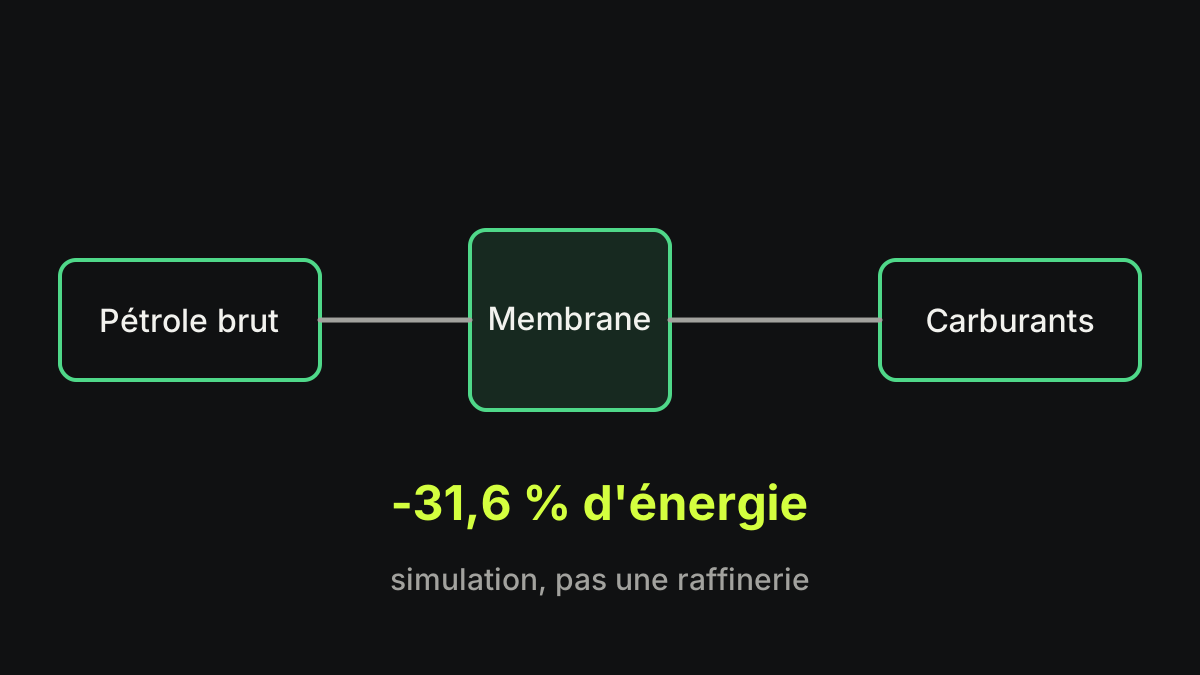
A cheap plastic membrane could separate crude oil at room temperature, without heating it. The researchers behind it, from South Korea's KAIST institute and Georgia Tech in the US, claim it uses 31.6% less energy. Those numbers come from simulations, not from a refinery.
Key takeaways
- A porous polyacrylonitrile (PAN) membrane separates crude oil into fuels like gasoline, naphtha and kerosene.
- It works at room temperature, without the distillation step that heats the oil.
- According to simulations, it cuts energy use by 31.6% and CO₂ emissions by 37.6%.
- It held up for 28 days straight in the lab. No refinery has tested it yet.
The buildup that turns into a filter
In a standard refinery, crude oil is heated to separate its components by boiling point. That's distillation, and it uses a lot of energy.
The team took a different route. During filtration, heavy hydrocarbons build up on the walls of the membrane's pores. This buildup, called fouling, is usually a problem. Here, it creates channels smaller than 2 nanometers, which let the light fractions through and hold back the heavy ones. So the oil makes its own filters, and the membrane doesn't need any specialized coating.
Numbers that come from simulations
The percentages come from process simulations. According to the authors, cooling water use would drop by 20.7% and operating costs by 36%. Permeation would be about 23 times higher than with previously published benchmark membranes.
The oil tested is real crude, supplied by HD Hyundai Oilbank, a South Korean refiner. But the savings weren't measured in a working plant. The authors also project about 10 million tonnes of greenhouse gases avoided per year in South Korea. That projection relies on the same simulations.
What's left before it reaches a refinery
Three steps are missing. Large-area membranes have to be made and assembled into modules. Then they have to last longer than 28 days. And the savings have to be confirmed under real conditions, which the paper doesn't do yet.
The work is published in the journal Nature. The principle has been proven in the lab. The savings figures, however, are still forecasts, and that's why the verdict is half true.
Translated with the help of AI from our French article, which is prepared with AI from the sources, then reviewed and approved by Valentin Fouilloud before publication. How we work