Underwater volcano electricity: 8.7 seconds of net power
At the bottom of the Pacific, on an active volcano, a small machine managed to produce more electricity than it used. For 8.7 seconds. That sounds tiny, but it's a first step toward an energy source that depends on neither sun nor wind. Let's sort the achievement from the promise.
Key takeaways
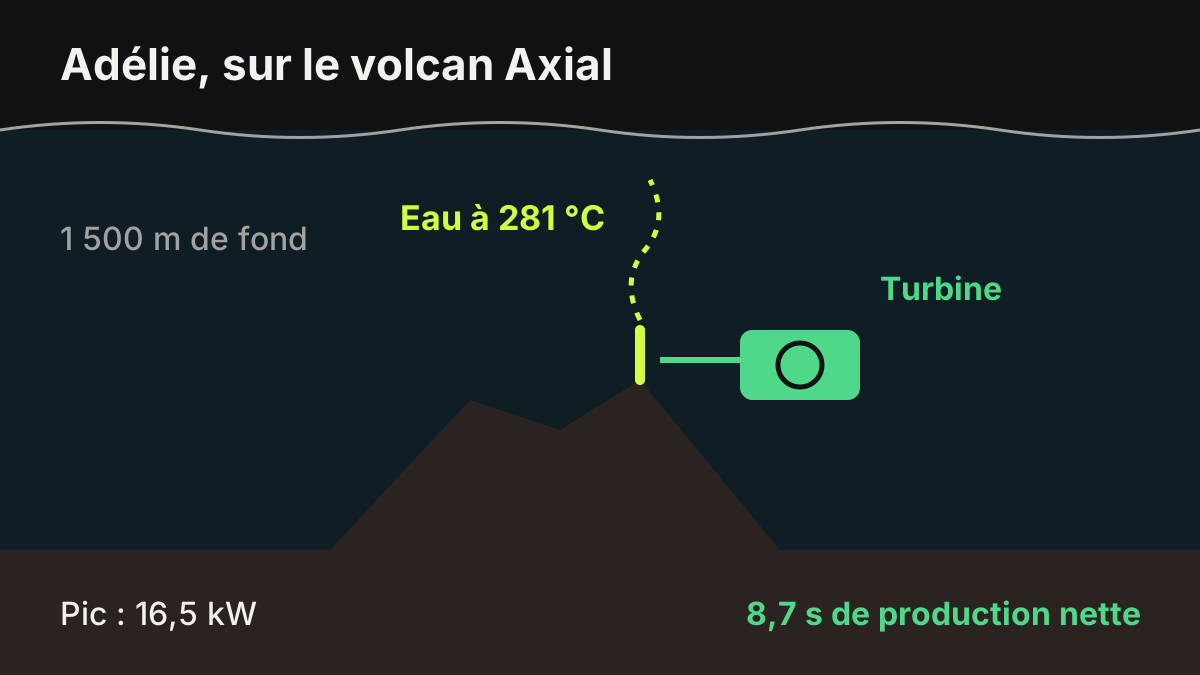
- On September 27, 2026, the American company Endurance Energy tested a prototype called Adélie on the underwater volcano Axial, about 1,500 meters deep.
- The machine uses water at about 281 °C, heated by the volcano, to spin a turbine and produce electricity.
- For 8.7 seconds, it produced more than it used, with a peak of 16.5 kW.
- The test stopped because of technical problems. The results come from a company press release, not a peer-reviewed scientific study.
- A new test is planned for winter 2026-2027.
A volcano, a turbine, and a lot of pressure
Axial is an active volcano in the Pacific Ocean, about 480 kilometers off the coast of Oregon, in the United States. Like many underwater volcanoes, it has hydrothermal vents: natural chimneys that blast out seawater heated by magma.
At 1,500 meters deep, this water can go above 250 °C without boiling. The reason: the enormous pressure of the ocean above, about 150 times what you feel at the surface. It's the same principle as a pressure cooker, just way stronger.
Endurance Energy's idea is simple on paper: capture this scalding water and use it to spin a turbine connected to a generator, like in a regular power plant. Except here, the power plant sits on the seafloor.
How the test went
The Adélie prototype weighs 3 metric tons. It was controlled from Seattle through an undersea communication cable. According to Techno-Science, a French science news site that published the results on October 30: - a first 16-meter well was drilled under the ocean floor. The water there reached 260 °C, but it didn't flow strongly enough; - so the team tapped into a nearby hydrothermal vent, at about 281 °C; - the turbine spun up to about 26,000 revolutions per minute; - for 8.7 seconds, the machine produced more electricity than it used. The peak hit 16.5 kW, and net output was more like 2 kW.
To give you an idea: 2 kW is roughly the power of an electric space heater or a kettle. The 16.5 kW peak is more like a fast home charger for an electric car.
Then things went wrong. An electrical protection system shut the device down. On restart, a pump cable was damaged, and the test was stopped.
Why it's still interesting
The big weakness of solar and wind is that they don't produce all the time. At night or with no wind, you need batteries or other power plants. Geothermal energy, which uses the Earth's heat, doesn't have that problem: it works day and night, all year round.
On land, geothermal already produces electricity in volcanic countries like Iceland. But good spots are rare. Under the sea, hydrothermal vents are common along mid-ocean ridges, those chains of underwater volcanoes. If we knew how to tap them, they'd be a continuous, low-carbon energy source.
That's Endurance Energy's goal: eventually, underwater power plants that would run nonstop.
What's still unproven
Everything, or almost. Here are the big questions: - Reliability. A machine that lasts 8.7 seconds has to learn to last for years, with no technician to fix it, under crushing pressure and in very corrosive water. - Flow. The first well didn't deliver enough water. The company wants to drill deeper to get more. - Transmission. Producing electricity at the bottom of the ocean is great. Getting it to the coast, hundreds of kilometers away, is a whole other project. - The environment. Hydrothermal vents are home to unique ecosystems, with animals that live without sunlight. The impact of tapping them at large scale is still unknown.
Also worth noting: the numbers come from Endurance Energy's press release. No scientific paper reviewed by other researchers has confirmed them yet.
So, what changes?
What's proven: according to the company, you can pull a bit of net electricity from a deep hydrothermal vent, for a few seconds.
What's a promise: underwater geothermal power plants that would supply cities, day and night. Next step: a new test with a modified prototype during winter 2026-2027.
How long until it's real? Not for a long time. Getting from a few-second test to a power plant feeding the grid will take years of testing, probably more than a decade if everything goes well. If you see "infinite energy from underwater volcanoes" on TikTok, you'll know that, for now, it lasted less than ten seconds.
Translated with the help of AI from our French article, which is prepared with AI from the sources, then reviewed and approved by Valentin Fouilloud before publication. How we work