France's off-peak electricity hours change on December 1
Think cheap electricity always means nighttime? That's less and less true. Starting December 1, 2026, a new wave of customers on France's peak/off-peak rate will see their schedules shift, with some off-peak hours moved right into the middle of the day. The reason fits in one word: solar.
Key takeaways
- December 1, 2026 kicks off a second wave of off-peak hour changes, decided by the CRE (France's energy regulator).
- In all, about 9.3 million customers will gradually switch over by October 2027.
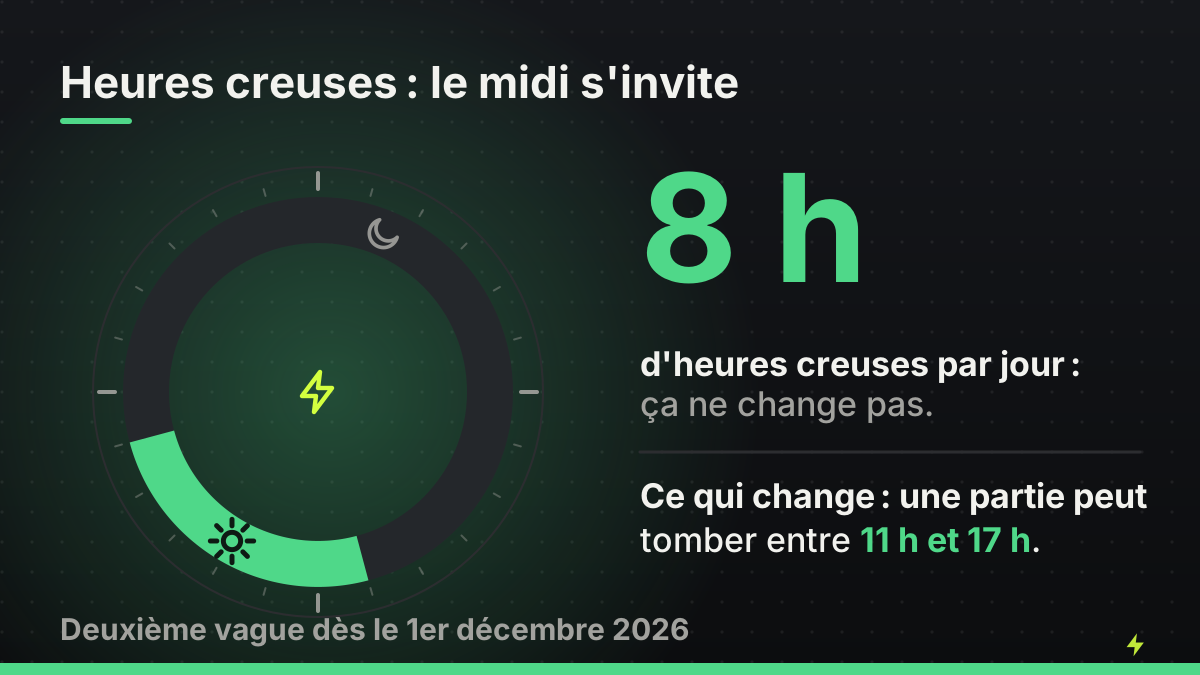
- You still get 8 off-peak hours a day, but some of them can fall between 11:00 and 17:00, especially from April to October.
- A water heater connected to the Linky meter (France's smart electricity meter) adjusts on its own. Charging an electric car, on the other hand, may take some tweaking.
- Your supplier has to warn you one month before the change.
Why off-peak hours are moving toward noon
Nighttime off-peak hours date back to another era. When they were created, almost everyone slept at night, demand plummeted, and nuclear plants kept running. The goal was to get people to use power at that time: hence the lower prices.
Today, France has about 30 gigawatts of solar panels, the output of around thirty nuclear reactors when the sun is blazing. The result: around noon on sunny days, there's sometimes too much electricity on the power grid. Prices on the wholesale market (where suppliers buy their power) can even go negative: some producers pay people to use their electricity.
So the idea is simple: shift some of the cheap hours to when electricity is truly abundant. It's like happy hour at a bar: you schedule it when the place is empty, not during the rush.
The power grid is also getting more and more sensitive to this kind of fine-tuning, as shown by the mystery of the 60-second dips caused by batteries.
The new time slots, in practice
A first wave of customers has already been switching over since fall 2025: two to three of their eight off-peak hours moved from the night to the 11:00 – 17:00 window. The phase starting December 1 rolls this approach out more widely, with rules that change by season.
From April to October ("summer"): - at least 5 consecutive off-peak hours at night, between 23:00 and 7:00; - at least 2 consecutive off-peak hours during the day, between 11:00 and 17:00.
From November to March ("winter"): - at least 5 consecutive off-peak hours at night, between 23:00 and 7:00; - a daytime slot isn't guaranteed: some customers will get one, others won't.
Either way, the total stays at 8 off-peak hours a day. You don't lose any cheap hours; they just move around.
Who's affected, and who isn't
Standard peak/off-peak contracts are affected. If you live with your parents or share an apartment with this kind of contract, this probably applies to you.
Not affected: - the Tempo option (a special rate plan), which keeps its fixed 22:00 to 6:00 window; - non-regulated offers that have their own time slots, like the "super off-peak hours" or "solar hours" from some suppliers.
If your home is served by a local distribution company (a municipal utility, for example, in some cities), the slots change too, but on a separate schedule from Enedis, the company that runs most of France's power grid.
To find out when you switch and what your hours will be, you need your delivery point number (PDL), printed on your bill. The supplier Octopus Energy offers an online tool that uses it to show your future time slots.
What you need to do (or not)
Water heater and heating connected to the Linky: nothing to do. They're controlled by a switch built into the meter, which automatically follows the new schedule.
Washing machine, dishwasher, dryer: if you set them to run at 2:00 a.m. out of habit, that's no longer necessarily the best time. In summer, running a load between 11:00 and 17:00 could cost less. Check your exact hours before changing your settings.
Electric car: this is where it gets tricky. Over the current eight nighttime hours, you can charge about 30 kWh on a heavy-duty outlet, and roughly double that with a wall charger (wallbox). With only five guaranteed hours at night, people who drive a lot will see two or three hours of charging land in peak hours. With a 7.4 kW charger, the extra cost is estimated at about €1 per charge.
You'll also need to reprogram the charger twice a year, on April 1 and November 1, unless it's controlled directly by the Linky. If you can plug in your car during the day (working from home, a company parking lot with chargers), you have every reason to target the midday slots.
So, what changes?
For most households, the impact on the bill should stay small, since the number of off-peak hours doesn't change. The real change is in our habits: cheap electricity now follows the sun.
It's a real turning point. For decades, the grid was organized around nuclear power, which produces the same amount day and night. With solar, consumption has to adapt to production, not the other way around. Midday off-peak hours are a first tool for this. Home batteries and smart car charging will be others.
As for the timeline, don't panic: the switch happens in stages through October 2027, and your supplier has to warn you one month ahead. Keep an eye on your emails and bills over the coming months.
Translated with the help of AI from our French article, which is prepared with AI from the sources, then reviewed and approved by Valentin Fouilloud before publication. How we work