Google Genie 4: the AI that invents a video game in real time
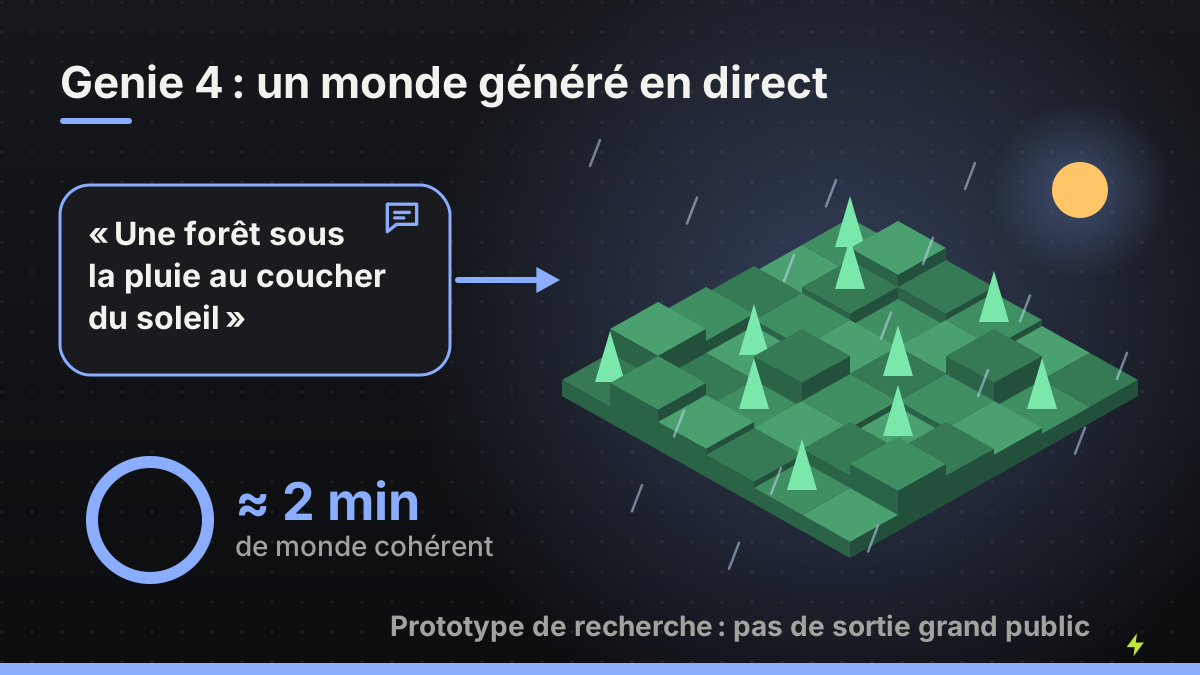
You type "a forest in the rain at sunset," and a world appears that you can move around in with your keyboard, like in a video game. Except no developer designed it: an AI invents it frame by frame. That's the promise of Genie 4, which Google DeepMind unveiled on October 27, 2026. The videos are going viral, but for now the tool is still a research prototype.
Key takeaways
- Genie 4 is a "world model": it generates, in real time, an environment that reacts to your actions.
- What's new: it also creates sound (ambience, music, dialogue), a first for this kind of model at DeepMind.
- You can change the scene on the fly with a sentence: switch the weather, add a character, move the camera.
- The world stays consistent for about two minutes, then the details start to "drift."
- Access is limited to testers, then Google AI Ultra subscribers. No public release has been announced.
A video game… without a game engine
In a regular game, everything is programmed in advance: the map, the walls, the rules of physics. The game engine calculates what you see based on those rules.
Genie 4 works the other way around. It has no map and no written rules. It has watched a huge amount of video and learned to predict "what the next frame looks like if the player moves forward." Every time you press a key, it invents what comes next. It's a bit like a super-fast artist improvising a cartoon by following your directions.
Google says Genie 4 handles collisions, human movement and aerodynamics better than previous versions. The model also relies on Gemini, Google's AI, to keep the scene consistent and break goals down into several steps.
What's different from Genie 3
According to TechCrunch, as cited by Le Monde Informatique (a French IT news site), the scene stays consistent for about two minutes, twice as long as with Genie 3. The other big new feature is sound generated at the same time as the image: ambient noise, music and dialogue that react to what you do.
Google says every image and sound it produces carries an invisible watermark, SynthID, which lets you detect that it was generated by AI.
The limits, acknowledged by Google itself
This is the part viral videos often leave out. DeepMind itself lists several flaws:
- Memory slips. In long sessions or after several edits, objects and details "drift." You turn around, and the tree you just passed isn't quite the same anymore.
- Text is unreadable. Signs or writing in the scene are often gibberish.
- Physics is approximate. Complex interactions (stacking objects, liquids, chain-reaction collisions) still need work.
- Sound isn't always right. Audio accuracy is one of the areas still being worked on.
Two minutes of consistency is impressive for a demo. But it's very far from a video game session lasting several hours.
What it could be used for
Google puts forward three ideas, all still to be proven:
- Video games: prototyping a level idea in a few seconds, before building it for real in a traditional engine.
- Film and TV: testing a shot, lighting or camera movement before filming.
- Robotics: this may be the most serious use. Training a robot in the real world is expensive and breaks equipment. DeepMind is testing the idea of having a robot "rehearse" a task in a world simulated by Genie before trying it for real.
One caveat, though: a scene that looks realistic doesn't guarantee the physics is right. A robot trained in a world where objects warp a bit at random could pick up bad habits.
Who can try it?
For now, a small group of testers chosen by Google (film, journalism, education, video games, engineering). Access should then open up to Google AI Ultra subscribers through Project Genie, and to some Gemini API developers. Google hasn't given a specific date or price for this rollout, or the list of countries involved.
Google isn't alone: other companies, like Runway, are also building playable generated worlds. The race for "world models" is on.
So, what changes?
For you, not right away. Genie 4 is a research demo, not a game you can download. Even when it reaches Ultra subscribers, that's Google's most expensive plan.
What's real: it's now possible to generate a few minutes of an interactive world, with sound, that reacts to what you do. What's still a promise: entire games generated on the fly, or robots trained mostly in AI simulations.
Realistic timeline: prototyping tools for creators could arrive in the next few years. A real video game entirely improvised by an AI, consistent for hours, hasn't been announced and still seems far off.
Translated with the help of AI from our French article, which is prepared with AI from the sources, then reviewed and approved by Valentin Fouilloud before publication. How we work