Subvocal silent speech glasses: type without talking, really?
Writing a message without touching your phone and without saying a word out loud: that's the promise of Subvocal, a young American startup. Its glasses pick up the tiny movements of your face when you mouth words silently and turn them into text. Preorders opened in late October 2026. The technology is real, but several big questions are still unanswered.
Key takeaways
- Subvocal sells glasses that turn words mouthed without sound into text, using radio sensors and no camera.
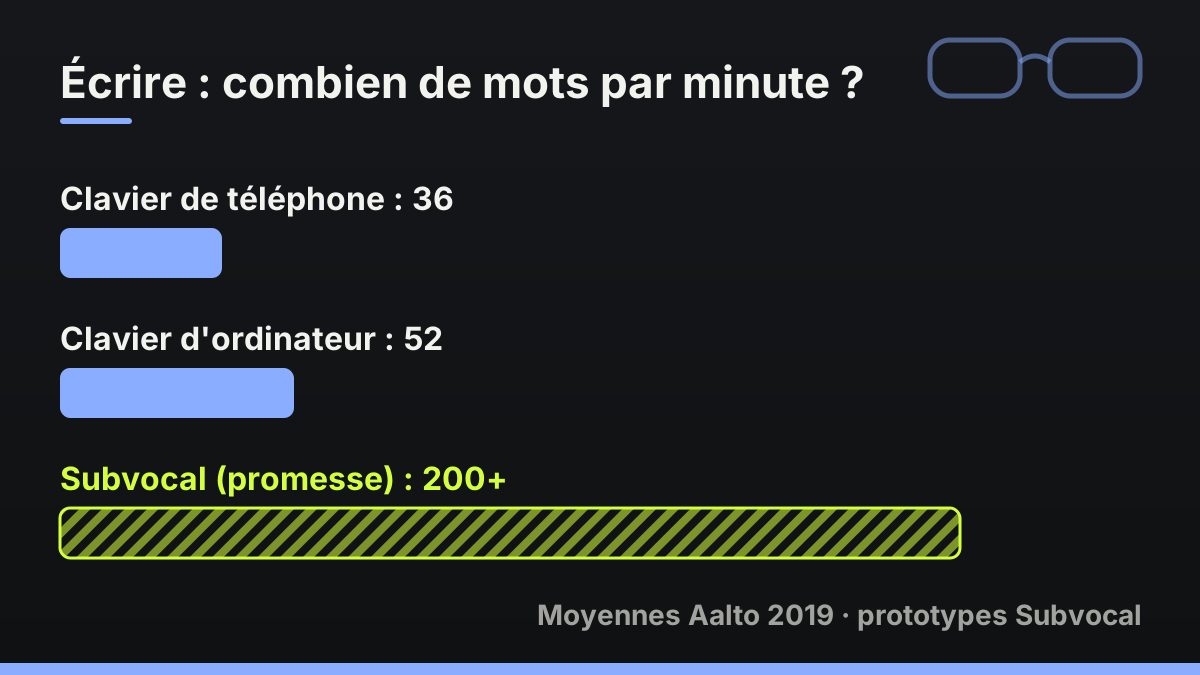
- The cofounder claims more than 200 words per minute on its prototypes, a number that hasn't been independently verified.
- Preorder price is $499 (with a $199 refundable deposit), only 100 pairs, shipping in the United States starting in Q2 2027.
- No accuracy rate has been published, and each user needs a personal calibration.
Who's behind Subvocal?
The Subvocal Company was founded by Aarush Yadav and Arnav Kumar, two computer science students at Georgia Tech, an American university. They built their first prototype in February 2026 at TreeHacks, a hackathon (a programming competition that lasts a few days) held at Stanford. They then moved to San Francisco to work on it full-time.
In late September 2026, they announced they had raised about $1.3 million, from backers including the venture fund Afore Capital and Y Combinator, the famous startup accelerator that Airbnb and Dropbox went through. According to Dealroom, the glasses were publicly launched on October 30, when preorders opened.
How does it work?
When you talk "in your head" while barely moving your lips, your face still moves: your jaw, your cheeks, the muscles around your mouth. These movements are tiny, but not invisible to sensors.
The first prototype used electrodes placed on the skin to measure muscle activity. The commercial version uses radio detection instead: the glasses send out waves and analyze how they're changed by your face's movements. So, no camera. AI software then translates these signals into words, in real time.
One catch: you first have to calibrate the glasses, meaning train them for a while on the way you mouth words. Every face moves differently.
Is 200 words per minute a lot?
It's huge. For comparison, a large study run in 2019 by Aalto University (Finland) measured an average of about 36 words per minute on a phone keyboard, and 52 words per minute on a computer keyboard. A spoken conversation is more like 150 words per minute.
So typing at 200 words per minute would be faster than normal speech. That's exactly where you should stay cautious: this number comes from the cofounder, it's about prototypes, and we don't know under what conditions it was measured. Typing fast is useless if one sentence in three is wrong, and Subvocal hasn't published any error rate.
Not a new idea
Reading "silent speech" is an old dream for researchers. In 2018, MIT showed AlterEgo, a device worn on the jaw that reached about 92% accuracy, but only on a small vocabulary. In 2023, Cornell University showed sonar glasses that could recognize a limited set of commands. Meta has also filed patents on the subject.
What sets Subvocal apart: the promise of going from the lab to a product you wear every day, with an open vocabulary. That's exactly the hardest part.
What's still unproven
- Accuracy: no public numbers. Even one of the investors mentions open questions about whether it works for every user.
- Comfort: glasses people are willing to wear all day, with a battery that lasts, aren't easy to make.
- Privacy: a device that decodes what you mouth captures very personal information. We don't know yet where the data is processed or stored.
- Production: only 100 pairs for the first batch, and shipping planned more than six months from now.
So, what changes?
Right now, unless you're in the United States, nothing: preorders are US-only, in very small numbers. If the technology delivers, the appeal is real: dictating a message on the bus or in the library without bothering anyone, or controlling a computer with your hands full.
But going from an impressive prototype to a product that works reliably for everyone often takes several years. The first real reviews will come in mid-2027 at the earliest, when the first pairs ship. Until then, treat the 200 words per minute as a promise, not a fact.
Translated with the help of AI from our French article, which is prepared with AI from the sources, then reviewed and approved by Valentin Fouilloud before publication. How we work