Google Suncatcher: AI chips tested in orbit, and they work
A satellite that writes poems: that's the first result of Google's Suncatcher project. On October 30, 2026, the company announced that its prototype, in orbit since early October, had run an AI model and sent its answer back to Earth. Behind this little haiku is a wild idea: one day putting data centers in space, powered nonstop by the Sun.
Key takeaways
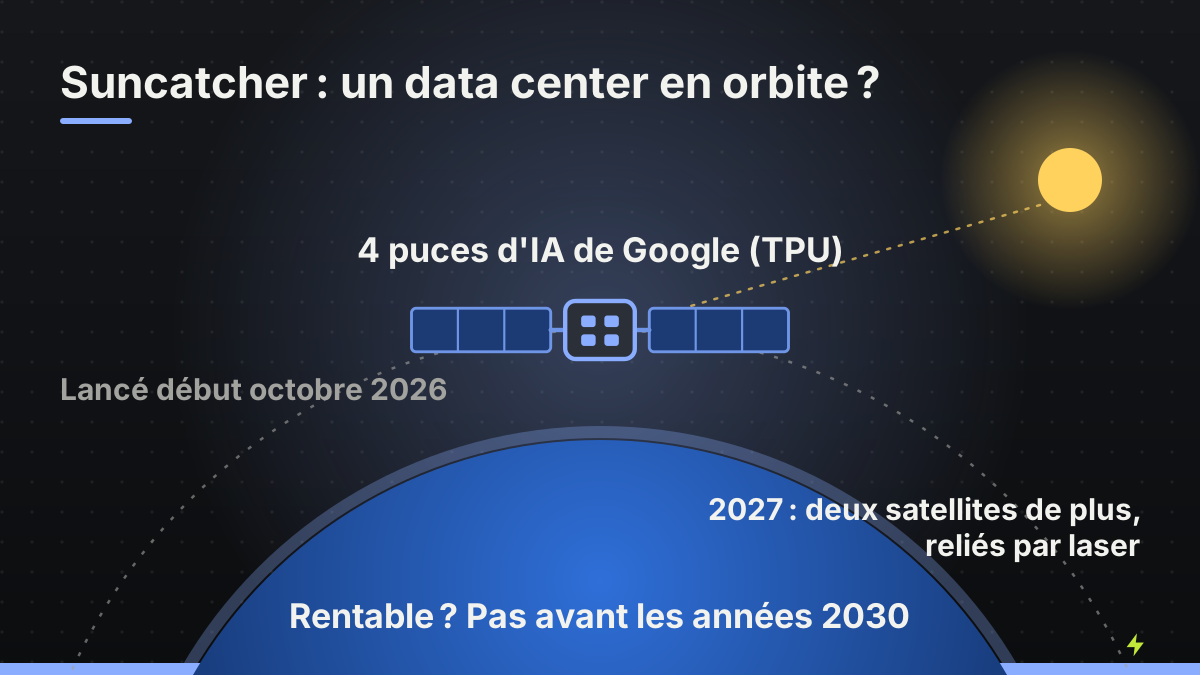
- The Suncatcher satellite, built with the company Planet, was launched in early October 2026 on a SpaceX rocket, along with more than 100 other spacecraft.
- It carries four Google AI chips (TPUs) and runs the Gemma 4 model. First successful test: a haiku about space.
- The goal is to check that these chips survive radiation and temperature swings in orbit.
- Two more satellites, more powerful and linked by laser, are planned for 2027.
- Google itself is only aiming for a cost-effective version in the 2030s, and everything depends on launch prices coming down.
Why put a data center in space?
AI data centers devour electricity. On Earth, you need power plants, power lines, water for cooling, and neighbors who are on board. Projects increasingly run into local opposition.
In space, energy is almost unlimited. In the right orbit, a solar panel can produce up to 8 times more than on the ground, according to the study Google published in November 2025. No clouds and almost no night: Google is aiming for a so-called "dawn-dusk" orbit, where the satellite follows the line between day and night and stays in sunlight nearly all the time.
It's the same logic as chips that only compute what's useful: faced with AI's appetite for energy, everyone is looking for a workaround. Google is looking up.
What the satellite actually did
After about three weeks of commissioning, the engineers switched on one of the chips and asked it for a haiku about being in space. The answer, in English, talks about a "blue marble" below and "starlight that feeds my heart." Not a masterpiece, but proof that the whole chain works: send a question, have the chip compute in orbit, get the answer back on the ground.
Google also tested short funny poems and asked the satellite to report on its conditions in orbit.
Keep in mind this prototype's limits, which TechCrunch details: - It has four chips, but only one can run at a time. - It produces at most 1 kilowatt, roughly what a microwave oven uses. - Because of limited power, a chip can only run for about 20 minutes straight.
So we're very far from a data center. It's a flying test bench.
The real test: radiation
In space, particles from the Sun and the cosmos constantly bombard electronics. They can cause "bit flips": a 0 that turns into a 1 in memory, without any alarm going off. For an AI, that can silently skew a result.
Google had already tested its chips on the ground, under a proton beam. The memory only started showing anomalies after a radiation dose nearly three times higher than what it would receive over five years in orbit, and no permanent failure appeared even at much higher doses. These tests suggested radiation would barely affect running an already trained model, but would be more of a problem for training itself, which requires error-free calculations for weeks. Orbit now has to confirm all of this in real conditions.
Next up: clusters of satellites linked by laser
Google's plan is to fly satellites in very tight formation, a few hundred meters apart, linked by very high-speed laser beams. The 2025 study imagines, for example, a cluster of 81 satellites within a one-kilometer radius, at an altitude of 650 km. Together, they would work like a single big computer.
That's what the two satellites planned for 2027 are supposed to test: more power, newer chips, and optical links between them. Google isn't alone in this space: SpaceX, Starcloud and Cowboy Space are also preparing computers in orbit, but with satellites that mostly work on their own.
Real progress or a mirage?
What's proven: a Google AI chip works in orbit and can answer requests sent from Earth.
What's still a promise: everything else. Flying dozens of satellites in tight formation, cooling chips in a vacuum (where heat is hard to get rid of), fixing a breakdown without a technician, and above all making the whole thing cheaper than a data center on the ground.
The key factor is launch cost. Google estimates it would need to drop below $200 per kilo by the mid-2030s for the idea to hold up. That assumes SpaceX's Starship rocket becomes fully and rapidly reusable. A scientific analysis cited by TechCrunch estimates it would take about 1,800 Starship flights to reach the hoped-for cost reductions.
So, what changes?
For you, nothing for a long time: your ChatGPT or Gemini requests won't be going through space in the next few years. Google itself talks about cost-effective infrastructure in the 2030s, and even then, only if everything goes well.
But the experiment shows how much AI's race for energy is pushing tech giants to explore ideas that seemed like science fiction two years ago. See you in 2027 for the laser-linked satellites: that will be the real credibility test for the project.
Translated with the help of AI from our French article, which is prepared with AI from the sources, then reviewed and approved by Valentin Fouilloud before publication. How we work