Iron powder: storing summer sunshine for winter in coal plants
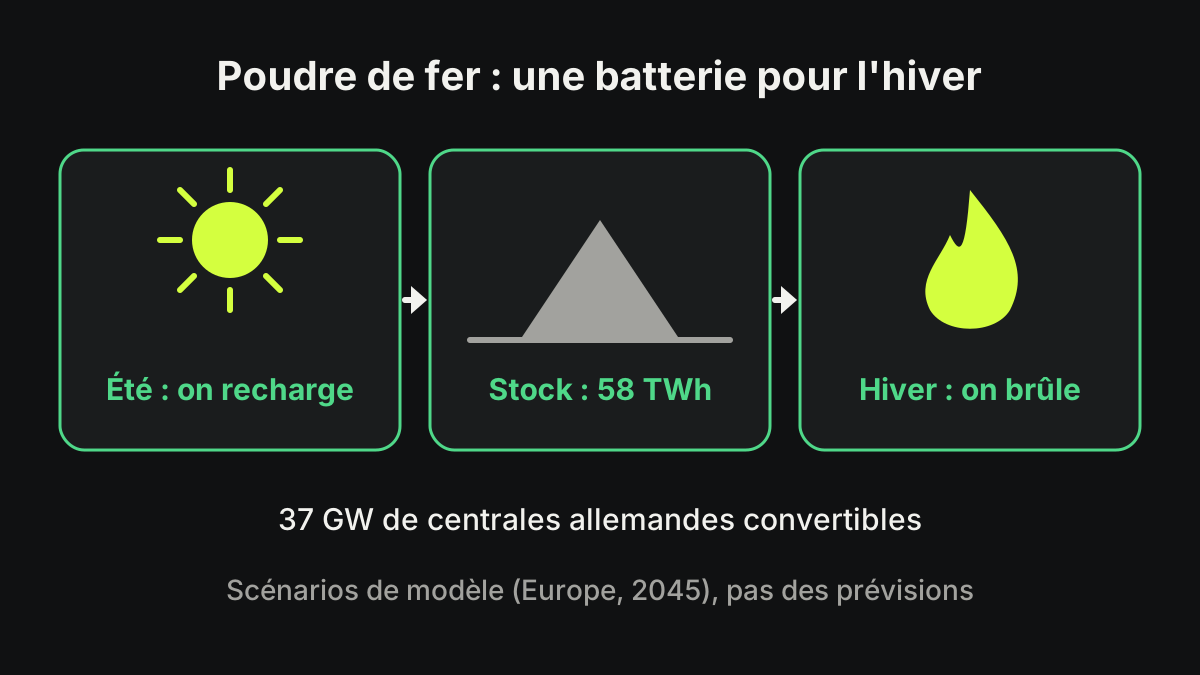
What if we could save summer's extra sunshine to stay warm in winter, in the form of a gray powder? That's the idea behind a study reported on November 3, 2026: finely ground iron, "recharged" with green hydrogen, then burned in old coal power plants. It sounds great on paper, but these are model scenarios, not a ready-to-use technology.
Key takeaways
- Iron powder burns without emitting CO₂: it turns into iron oxide (rust), which can be "recharged" with green hydrogen.
- The study imagines converting about 37 GW of coal plants in Germany, and 83 GW across Europe.
- In the model, the iron stockpile would reach about 58 TWh in summer and be drawn down in winter: roughly comparable to Germany's gas reserves.
- These are scenarios for 2035-2045, not forecasts, and the overall efficiency isn't given.
- The study was commissioned by projects that promote this technology: keep that in mind.
The real problem: winter
Solar produces a lot in summer and little in winter. But winter is when we use the most energy for heating. Lithium batteries can store power for a few hours, sometimes a day, but not for months. To last a whole season, you need much bigger "batteries."
Right now, the two main options are hydrogen and carbon capture (CCS, which buries the carbon that gets emitted). The catch: both need infrastructure that doesn't exist yet at large scale. Iron powder is emerging as a third option.
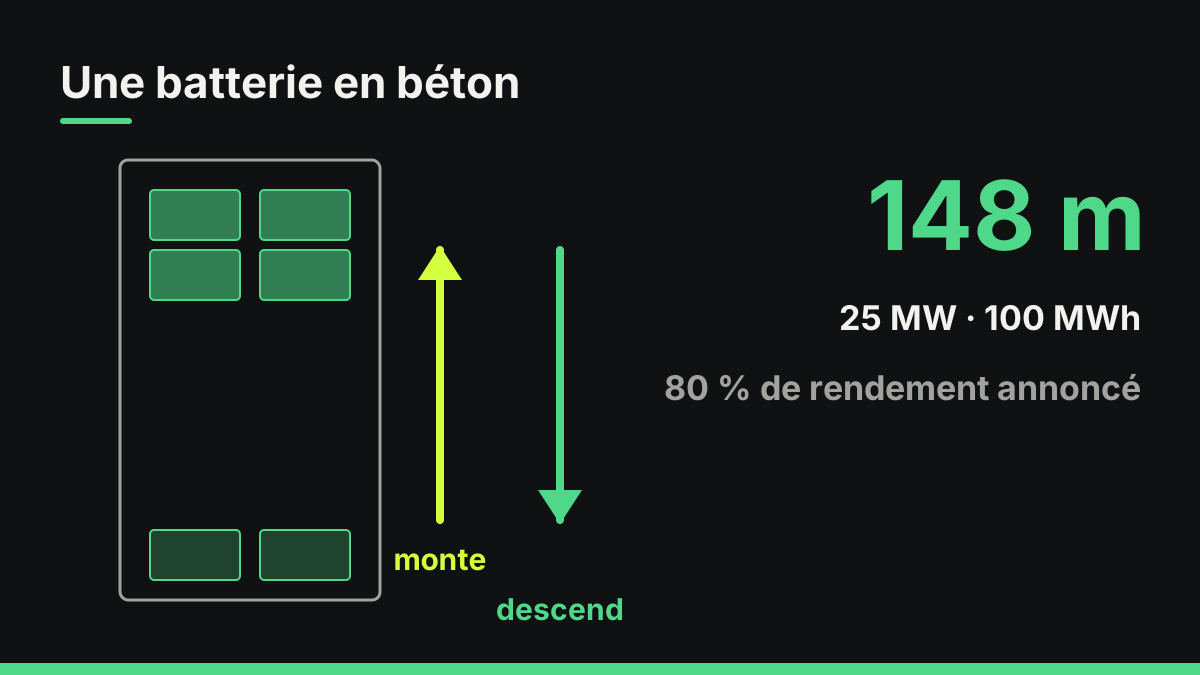
If you're into energy storage, we also covered a 148-meter tower that stores electricity with concrete blocks: same challenge, very different solution.
How it works
The idea comes down to three steps.
- Recharge. When wind and solar produce too much, you make green hydrogen (by splitting water with renewable electricity). That hydrogen is used to strip the oxygen out of iron oxide: you get pure iron back, which now holds the stored energy.
- Store and ship. The powder keeps, and it can travel by boat or by train. Unlike hydrogen, it's a solid.
- Discharge. In winter, the powder is burned in a power plant (a converted former coal site, or a district heating network). Burning it releases no CO₂ and leaves iron oxide behind, which is sent back to step 1.
So the iron isn't "used up": it loops between a charged state and a discharged state, a bit like a giant rechargeable battery. The work is led in particular by the Technical University of Darmstadt and KIT (the Karlsruhe Institute of Technology), which have been working together on the topic since 2021.
What the study says, by the numbers
The analysis was carried out by the Institute of Energy Economics at the University of Cologne (EWI), at the request of Darmstadt's Metal Energy Hubs project and the DESERTEC Foundation. It models Europe through 2045, optimizing electricity, hydrogen and heat together.
The main findings: - about 37 GW of German coal and lignite plants could be converted, and about 83 GW across Europe; - the iron stockpile would be filled to about 58 TWh in summer, then drawn down in winter; - these plants could cover about 25% of Germany's district heating needs; - annual system costs could drop by €15 billion between 2035 and 2045, with savings of around €18 billion a year in 2040 and 2045 according to the model.
To give you a picture: 1 GW is roughly the output of a typical nuclear reactor. Converting 37 GW would therefore equal, in power, around forty reactors. That's huge.
What the study doesn't say
The published summary doesn't give the efficiency of the full chain (how much energy you get back compared to what you put in), the cost of the iron powder, the cost of converting the plants, or any commercial timeline. And efficiency is the key question: making hydrogen, turning it into iron, then burning that iron loses energy at every step. That's not a minor detail.
The authors themselves present iron as a complement to renewables and hydrogen, and as insurance in case the rollout of renewables falls behind, not as a replacement.
So, what changes?
For your energy bill or your heating in the next few years: nothing. The numbers cover 2035-2045, and the technology still has to be proven at large scale. What's true: the chemistry is real and the research is moving forward, with public institutions behind it.
What's still a promise: the billions of euros in savings, which depend on model assumptions. The smart move when you come across this kind of announcement on social media: look for the efficiency, the cost and the timeline. As long as those are missing, it's a serious lead, not a solution.
Translated with the help of AI from our French article, which is prepared with AI from the sources, then reviewed and approved by Valentin Fouilloud before publication. How we work