Tin flow battery: new electrolyte unlocks its full capacity
To store electricity from the sun and the wind, you need big batteries. One option: "flow" batteries, which store energy in liquids. Chinese researchers just showed, in the journal Nature Chemistry (paper dated October 31, 2026), how to get tin working at full capacity in this kind of battery. It's a promising lab result, but still a long way from a real-world installation.
Key takeaways
- In tin flow batteries, only half of the possible charge was used until now: 2 electrons instead of 4.
- By adding iodide to the liquid, the team managed to use all 4 electrons.
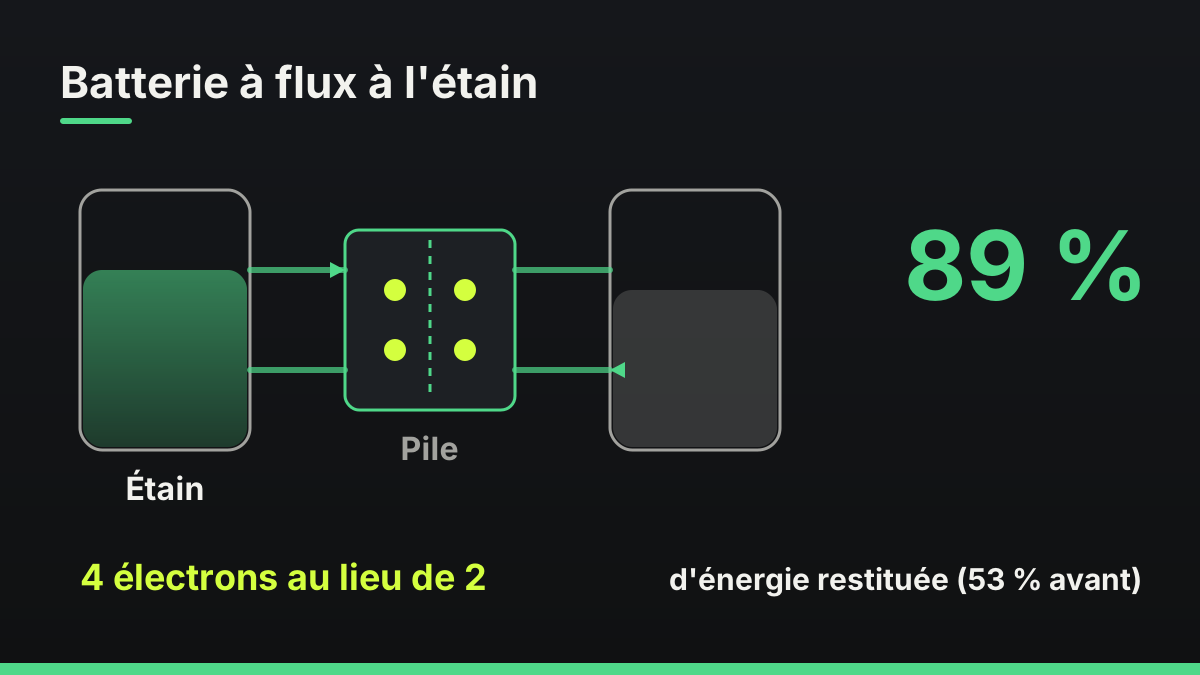
- Efficiency climbs to about 89%, versus 53% without this trick, under the same test conditions.
- A 20-cell prototype delivered about 800 watts and lasted more than 260 cycles over 1,000 hours.
- The remaining problem: some ingredients in the liquid slowly cross the membrane, which drags performance down.
What is a flow battery?
In your phone's battery, everything is sealed inside a small case. A flow battery works differently: energy is stored in two liquids, kept in two separate tanks. Pumps push these liquids through a "stack," where they exchange electrons across a membrane. That's where electricity gets produced or stored.
The big advantage: to store more energy, you just need bigger tanks. That's why people picture them next to a solar or wind farm, saving the daytime surplus and releasing it in the evening. Not in a car or a phone: they're bulky and heavy.
The downside: these liquids store fairly little energy per liter. Hence the push to find chemical reactions that pack more into every drop.
Tin's problem: half of it wasted
Tin is an interesting metal for this. In theory, it can exchange 4 electrons when it goes from a dissolved state (ions in the liquid) to solid metal deposited on an electrode. More electrons exchanged means more energy stored.
Except that in practice, in acidic tin batteries, only the 2-electron reaction was being used. The other half stayed out of reach. It's like owning a 40-liter backpack you can only fill with 20 liters.
The trick: change the liquid around the tin
The team, from the Dalian Institute of Chemical Physics and Wuhan University, didn't touch the tin itself. Instead, it changed the liquid surrounding it, the electrolyte.
The original liquid contains chloride, which keeps a lot of tin dissolved. The researchers added iodide. Iodide grips tin less tightly, which makes it easier for electrons to move. They had to find the right dose: with iodide alone, tin dissolves very poorly, and with too much iodide, material settles at the bottom.
The result: all 4 electrons are finally usable, and efficiency takes a big jump. About 89% of the stored electricity comes back out, versus 53% with the chloride-only liquid. In other words, nearly half of the energy used to get lost along the way.
The prototype's numbers
- Energy density: a more concentrated version of the liquid reached 205 watt-hours per liter, but only for the tin-side liquid, measured in separate experiments. That's not the density of the complete battery.
- Power: a stack of 20 cells delivered about 800 watts, roughly the power of a microwave oven.
- Lifespan: more than 260 charge and discharge cycles over 1,000 hours, or about six weeks of operation.
- Safety: no visible "dendrites." These are needle-like spikes of metal that grow on the electrodes of some batteries and can damage them.
For context: vanadium flow batteries, the most common type today, generally store a few tens of watt-hours per liter of electrolyte. The two figures can't be compared directly, but the gap shows why researchers are so interested in tin.
What's still holding it back
The authors don't hide the limits. Iodide and tin gradually cross the membrane that separates the two liquids. As it loses its iodide, the tin side becomes less efficient again, and some tests show capacity going down. The team itself says much longer tests are needed.
Another blind spot: the paper gives no cost figures. Yet for storing electricity on a power grid, the price per kilowatt-hour stored matters as much as performance.
So, what changes?
Not much for you right now: this type of battery won't end up in your phone or in a car. Its home turf is the power grid. We've already seen how useful batteries are becoming for stabilizing the grid, and the need for storage will grow along with solar and wind.
This result is a real step forward in chemistry, published and reviewed by other scientists. But between an 800-watt prototype and an installation that stores a city's electricity, there are often five to ten years of testing, industrialization and cost cutting. And nothing guarantees tin will win against other technologies, like vanadium, iron, or classic lithium and sodium batteries. Worth watching closely, without getting carried away.
Translated with the help of AI from our French article, which is prepared with AI from the sources, then reviewed and approved by Valentin Fouilloud before publication. How we work