Power grid mystery solved: why Europe dips every 60 seconds
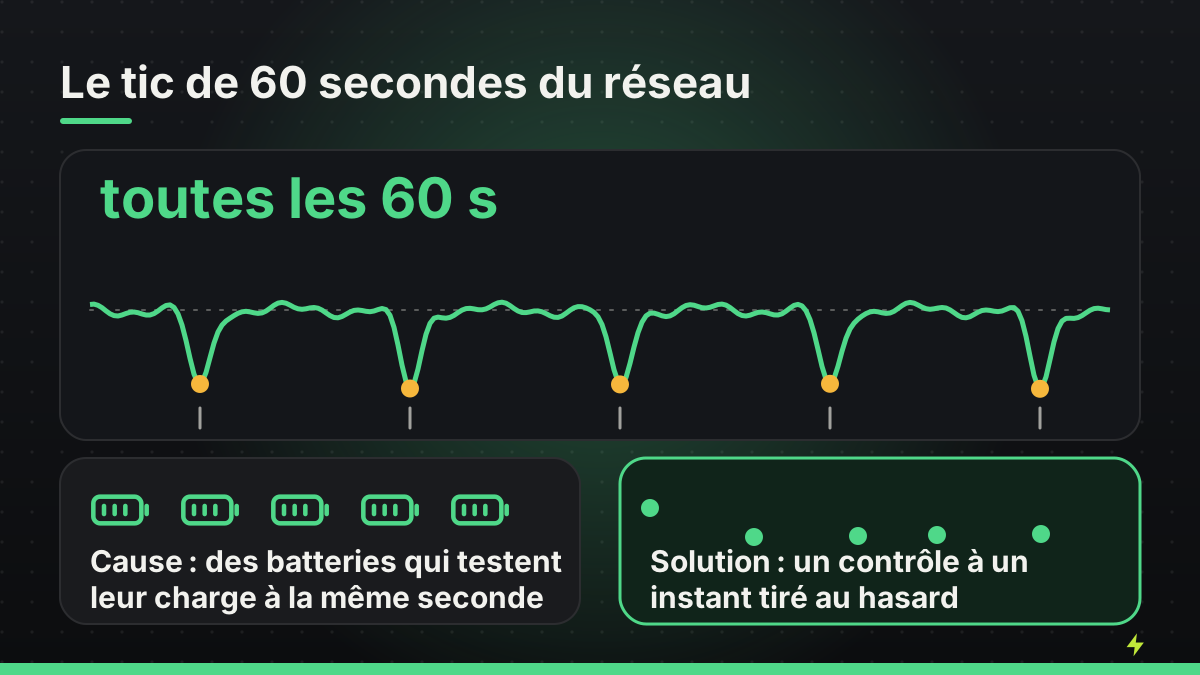
For years, the European power grid had a weird tic: every minute on the dot, it dipped just a tiny bit. Nobody knew why. A study published in the journal Nature Energy and reported on October 30, 2026 finally found the explanation. And the culprit isn't who you'd expect.
Key takeaways
- For several years, the German grid operator TenneT had noticed a small frequency drop on the European grid, every 60 seconds.
- German researchers found the cause: large storage batteries that all check their charge level at the start of every minute.
- It's not dangerous for now, but it wears out the turbines in hydroelectric dams.
- The phenomenon exists all over the world, and it grows with the number of batteries.
- The proposed fix is simple: have each device run its check at a random moment.
First: what is the grid's "frequency"?
In Europe, the current coming out of your outlet oscillates 50 times per second: that's what we call 50 hertz. That number is basically the grid's pulse.
This pulse depends on a constant balance. If power plants produce exactly what everyone is using, the frequency stays at 50 Hz. If demand suddenly jumps, the frequency drops a little. If demand falls, the frequency rises. Operators watch this number nonstop and correct it by adjusting production, often with hydroelectric dams that can react quickly.
Picture a tandem bike: if one rider stops pedaling for a second, the bike slows down, and the other has to push harder to make up for it. The grid works the same way, just with millions of riders.
An investigation worthy of a crime show
TenneT Germany, the country's largest high-voltage line operator, had been watching this regular dip keep coming back for several years. Not critical for grid safety, but too regular to be a coincidence.
A team from the Jülich research center, led by physicist Dirk Witthaut, working with the University of Cologne and the Karlsruhe Institute of Technology (KIT), took on the case. Their reasoning: if it always happens right on the minute, it has to be something that follows a clock. Not the weather, not humans.
To find the culprit, they used 80 measurement points installed on the Jülich campus. The regular pattern showed up exactly where the large storage batteries were. One of them showed a spike in power use at the start of every minute.
The culprit: a routine check
These big batteries regularly check their state of charge. To do that, they run a small test that briefly draws electricity. There's no official rule about when to run this test. According to Dirk Witthaut, manufacturers probably thought it made sense to do it every minute, at the start of the minute.
One battery on its own goes unnoticed. But thousands of batteries synced to the same clock, all drawing power at the exact same second zero, end up showing across an entire continent. It's like everyone in a stadium jumping at the same moment: one fan doesn't shake anything, 50,000 do.
And it's not just a European thing: the researchers found the same pattern elsewhere in the world.
Why it still matters
"Not critical" doesn't mean "no effect." Each dip forces the dams' turbines to correct course. These small, repeated jolts, once a minute, day and night, add to their wear and tear.
Ireland shows where this can lead. There, data centers, often equipped with batteries, account for about one fifth of the country's electricity use. The result: the strength of the one-minute signal quadrupled between 2016 and 2021. With the boom in data centers for AI and in batteries to store solar power, this kind of effect could grow elsewhere too.
The researchers suspect other computer-controlled devices behave the same way: air conditioners, heat pumps, connected washing machines. Keep in mind: that's a lead, not a proven result.
So, what changes?
For you, nothing you'd notice: no blackouts, no higher bill because of this.
But the study shows that times have really changed. The grid used to be run by big power plants and humans. Today, it's also shaped by millions of digital devices following their own clocks. A small programming choice, repeated at massive scale, can make a whole continent wobble.
The good news is that the fix costs almost nothing: each battery would just need to run its check at a random instant within the minute. Basically, a software update. Now manufacturers just have to do it, or a standard has to make them. Nothing has been announced along those lines so far, so think years rather than months.
Translated with the help of AI from our French article, which is prepared with AI from the sources, then reviewed and approved by Valentin Fouilloud before publication. How we work