Sodium-metal battery: a nonflammable electrolyte in the lab
Sodium is the element in table salt. It's everywhere, it's cheap, and it could one day replace some of the lithium in our batteries. The problem: the most powerful versions of these batteries tend to raise safety issues. South Korean researchers announced, in late October 2026, an electrolyte that resists flames and lasts 1,000 cycles. Let's see what it's really worth.
Key takeaways
- Researchers at Chonnam National University (South Korea) created a new electrolyte for sodium-metal batteries.
- It's solid, doesn't leak, and resists flames according to their tests.
- In the lab, the battery keeps more than 90% of its capacity after 1,000 charge cycles.
- This is a lab result on small cells: no commercial product has been announced.
- It could be most useful for storing electricity on the grid, rather than in your phone.
Sodium-ion vs. sodium-metal: don't mix them up
On TikTok, everything often gets lumped under the "sodium battery" label. In reality, there are two families.
Sodium-ion batteries already exist. Several manufacturers, mostly Chinese, mass-produce them. They work like classic lithium-ion batteries, with sodium instead of lithium. The upside: they're cheaper and less dependent on rare metals. The downside: they store less energy for the same weight.
Sodium-metal batteries, the ones this study is about, go further. One of their electrodes is made of pure sodium metal. In theory, that lets them store a lot more energy. But sodium metal reacts very strongly, especially with water, and the usual liquid electrolytes are flammable. On top of that, the metal tends to form tiny spikes as it recharges, which can pierce the battery and cause a short circuit. That's why you can't buy them yet.
What is an electrolyte?
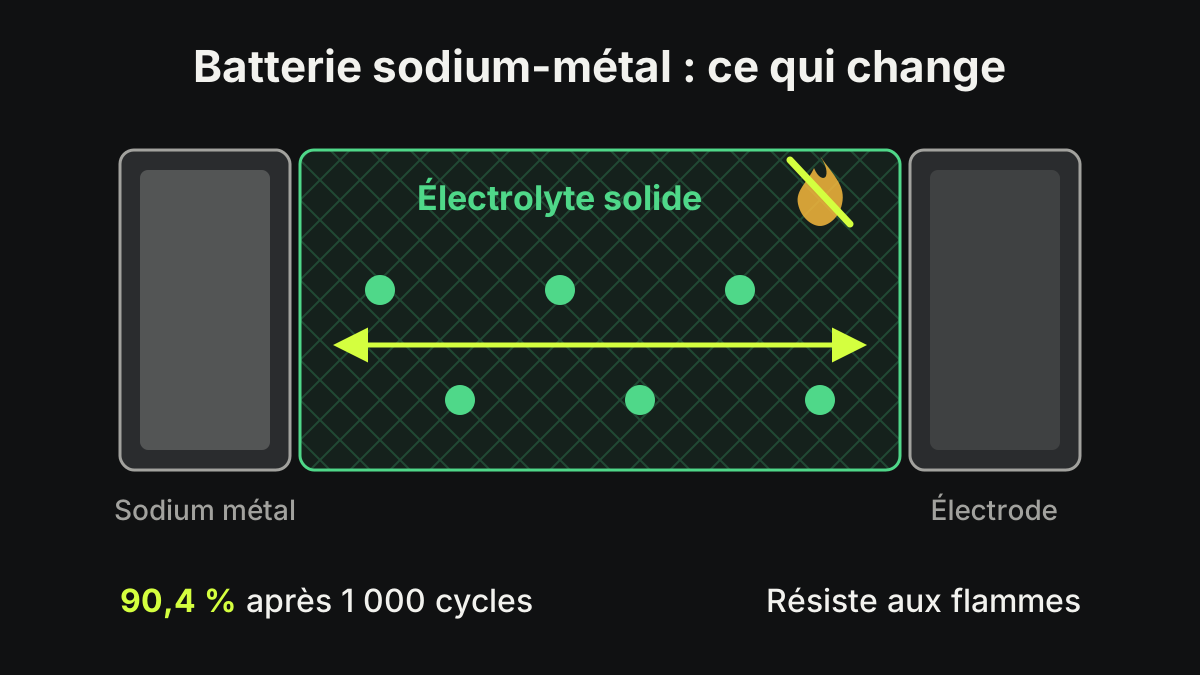
A battery is two electrodes separated by an electrolyte. The electrolyte works like a highway: it lets ions (here, sodium) travel from one electrode to the other during charging and discharging.
In most of today's batteries, this highway is a flammable liquid. If the battery gets damaged or overheats, that liquid is often what catches fire. That's behind many electric scooter and e-bike fires.
What the researchers did
Professor Chan-Jin Park's team mixed three ingredients: a sodium salt (which supplies the ions), a molecule that forms a plastic network, and another one that makes the whole thing more flexible and helps ions move. This mix is poured into the battery as a liquid, then turns solid right inside it. The result: a solid electrolyte that can't leak.
The figures reported in the journal Energy Storage Materials:
- Lifespan: 90.4% of capacity retained after 1,000 fast-charging cycles. If you charged a battery once a day, 1,000 cycles is almost three years.
- Efficiency: nearly 99% of the stored energy comes back out at each cycle.
- Safety: according to the researchers, the electrolyte holds up well when exposed directly to a flame.
- Toughness: a small flexible battery kept powering an LED after being folded and even cut.
What the announcement doesn't say
This is where you need to stay level-headed.
- The tests were done on lab cells, tiny compared with a car battery or a grid storage battery.
- The report doesn't detail the fire test protocol. "Resists flames" is a qualitative description, not a certification.
- No information on manufacturing cost, large-scale production, or how well the battery holds up over time when it sits in storage unused.
- 1,000 cycles is good in the lab. A grid storage battery often needs to aim for several thousand cycles.
- One of the components, sodium perchlorate, is a chemical that industry handles with care. That doesn't mean it's a problem here, but it will be one of the questions to settle before any industrial production.
So, what changes?
This study doesn't put a new battery in your pocket. It adds one more building block toward solving the main weakness of sodium-metal batteries: their safety.
If research keeps going in this direction, the first applications would more likely be large stationary storage systems, the kind that hold on to solar and wind power and release it in the evening. There, price and safety matter more than weight. The researchers themselves mention this use, as well as backup power supplies.
Realistic timeline: between a lab paper and a product on sale, it usually takes many years. If you want sodium today, look at sodium-ion instead, which is already in production. Sodium-metal remains a promise for the end of the decade at best, and only if manufacturers pick it up.
Translated with the help of AI from our French article, which is prepared with AI from the sources, then reviewed and approved by Valentin Fouilloud before publication. How we work