Sparxity: brain-inspired chips that only compute what matters
The data centers running AI are using more and more electricity. What if part of that power went into calculating... zeros? That's the bet of Sparxity, a startup from Dresden (Germany) formerly called SpiNNcloud. In late October 2026, it announced the installation of one of its machines at the Jülich Supercomputing Centre, one of the biggest in Europe. Its promise: only compute what really matters.
Key takeaways
- SpiNNcloud is changing its name to Sparxity and delivering a computing system called JUBIS to the Jülich Supercomputing Centre in Germany.
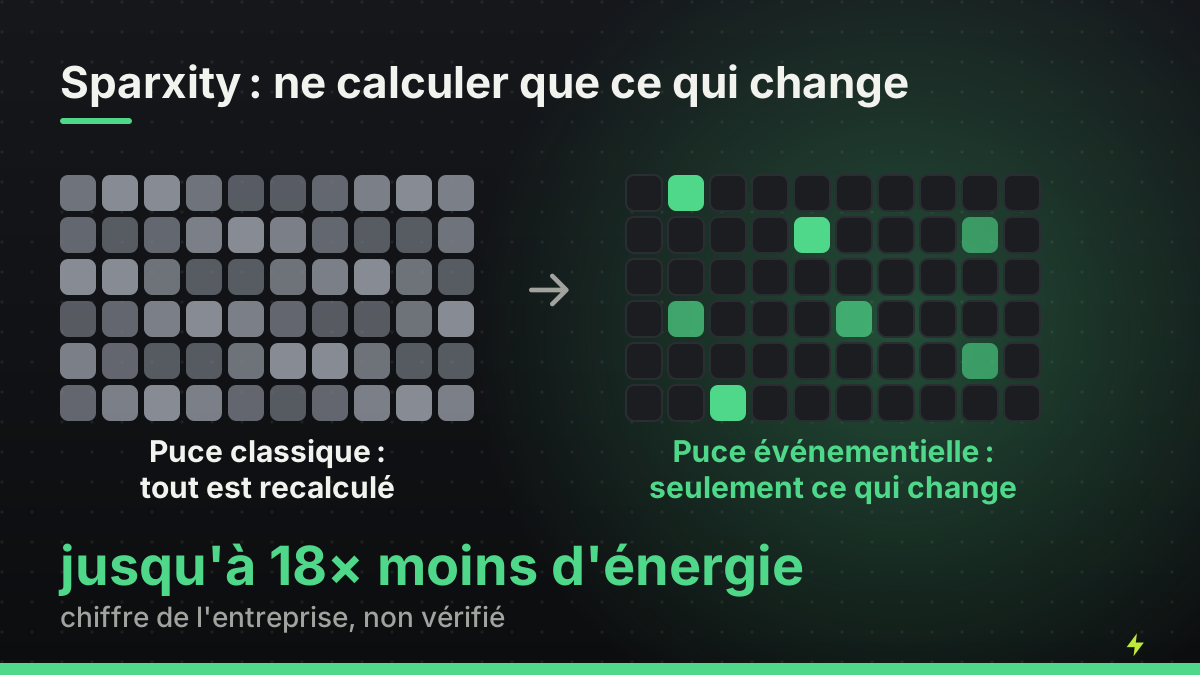
- Its chips are "event-based": they only work when a piece of data changes, instead of recalculating everything all the time.
- The company claims up to 18 times less energy than regular chips on some AI tasks.
- These numbers come from the company itself. They haven't been independently verified.
- The system is mainly for research: it's not about to replace ChatGPT's GPUs tomorrow.
The problem: AI spends a lot of power computing nothing
The graphics cards (GPUs) that run AI are computing monsters. They crunch mountains of numbers at the same time, whether those numbers are useful or not. Even when a big chunk of those numbers equal zero, the chip still processes them, and uses electricity to do it.
But recent AI models are increasingly "sparse," as specialists put it: full of gaps. For example, in "mixture of experts" models, only a small part of the model works on each word. The rest just waits. On a regular GPU, handling this setup takes extra work.
Sparxity's solution: only compute when something moves
Sparxity's chips, called SpiNNaker2, come from a long line of brain-inspired research. It was started by Steve Furber, one of the designers of the ARM architecture found today in almost every smartphone.
The idea comes from how neurons work. Your brain doesn't keep all its neurons working all the time: a neuron only "fires" when it receives a signal. That's one of the reasons the brain runs on about 20 watts, roughly the power of a small LED bulb.
Sparxity's chips copy this principle. Each computing unit stays on standby as long as nothing changes at its input. No change, no calculation, no data moved around, so no wasted energy.
In practice, one server board holds 48 SpiNNaker2 chips, each with 152 small ARM computing cores.
What's being installed at Jülich
The JUBIS system is a rack (a big server cabinet) with a price tag in the millions. It joins the machines at the Jülich Supercomputing Centre, which already hosts JUPITER, Europe's first "exascale" supercomputer (capable of a billion billion operations per second).
JUBIS is part of a three-year research project, launched in 2026 and funded by European money and by the German state of North Rhine-Westphalia. It's meant for "sparse" AI models, scientific simulations and optimization problems.
Truth vs. hype: what's "18 times less energy" really worth?
Sparxity puts forward three numbers: - scientific calculations 10 times faster on certain types of problems; - 18 times less energy for AI tasks suited to its architecture; - 20 times less time to find an acceptable solution to optimization problems.
A few caveats, though: - These are in-house numbers. The specialist site StorageReview points out that the company doesn't say which machine it compared against, which exact task, or which settings were used. - "Up to" and "on some tasks": these gains apply to carefully chosen calculations that suit the chip. On a typical AI task, the advantage could be much smaller, or even zero. - The scale is still modest. Sparxity claims more than 70,000 chips produced and about thirty customers. Nvidia, on the other hand, sells millions of GPUs.
What's solid: the technology exists, it works, and serious labs already use it. Sandia, a US lab, installed one of its systems in 2025, capable of simulating between 150 and 180 million neurons.
Why it matters for energy
Electricity has become one of the biggest bottlenecks for AI. The industry's giants are struggling to find enough power to plug in their new data centers. In that context, every efficiency gain counts.
But there are two ways to use less: produce more electricity, or waste less of it. Sparxity is betting on the second. If the "only compute what's useful" approach held up at large scale, it could lower the electricity bill for some AI calculations.
So, what changes?
For you, nothing right away: your next conversation with a chatbot will still run on regular GPUs.
What's real: a brain-inspired chip is leaving the lab and entering a major European computing center. What's still a promise: massive energy savings on real AI workloads, at large scale. The Jülich project lasts three years: that's the realistic horizon for getting independent measurements and finding out whether this approach can compete with GPUs, or whether it will stay a niche solution.
Translated with the help of AI from our French article, which is prepared with AI from the sources, then reviewed and approved by Valentin Fouilloud before publication. How we work