xAI gas turbine pollution lawsuit near Memphis heads to trial
To run Grok, Elon Musk's AI, the company xAI uses dozens of gas turbines near Memphis, in the United States. A civil rights group accuses those turbines of polluting the air without a permit. On October 30, 2026, a federal court refused to kill the case: the lawsuit is going ahead.
Key takeaways
- The NAACP, the major American civil rights organization, has been suing xAI (now a subsidiary of SpaceX) since April 2026.
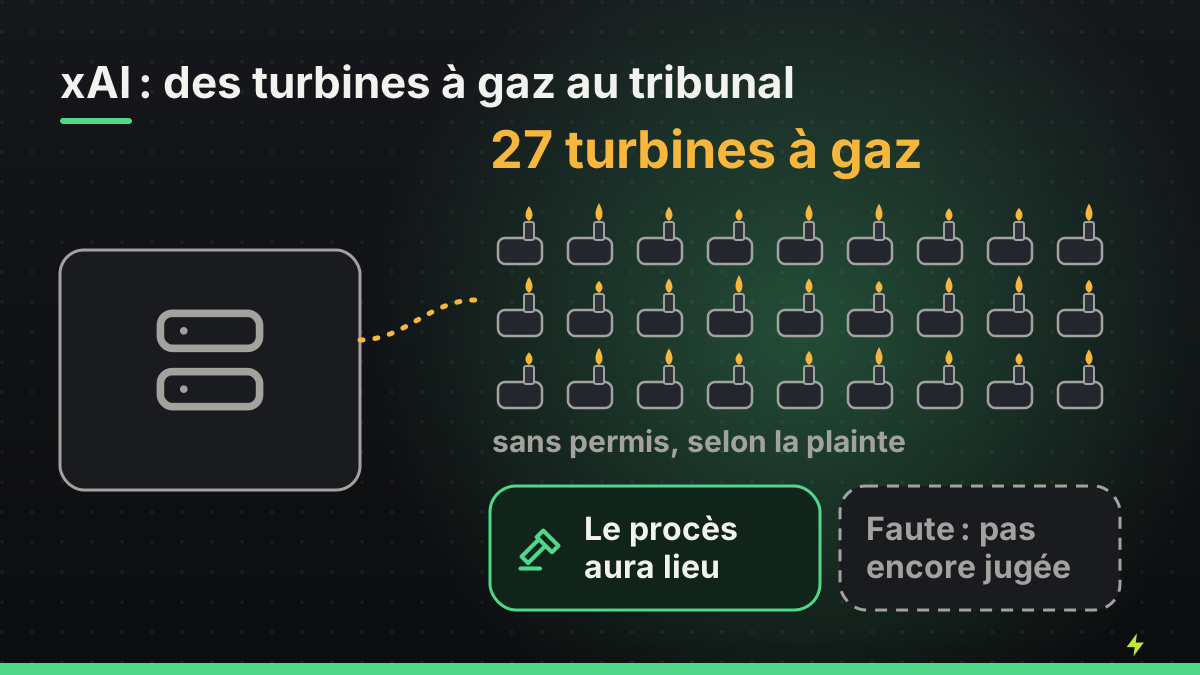
- The company is accused of running at least 27 gas turbines without a permit in Southaven, Mississippi, to power its Colossus 2 data center.
- xAI asked for the case to be dismissed. The court rejected all of its arguments, after already turning down a similar request from the Trump administration.
- Nothing has been decided on the merits: the court did not say xAI broke the law, only that the case can move forward.
- The case points to a bigger problem: AI needs so much electricity that some companies are building their own power plants, fast, running on gas.
What happened?
The Southaven site is in Mississippi, about one and a half kilometers from the Tennessee border. Right across the line, in south Memphis, sits Colossus 2, one of the giant data centers that run Grok.
To power that machine, xAI and its energy subsidiary, MZX Tech, installed gas turbines: think of jet engines sitting on the ground, burning gas to make electricity. According to the complaint, 27 turbines were installed and switched on between August and December 2025, without a permit under the Clean Air Act, the main US law on air quality. The fleet has grown since then: according to court documents, more turbines have arrived.
The NAACP, represented by two environmental law groups (the Southern Environmental Law Center and Earthjustice), filed suit on April 14, 2026. It is asking the court to: - declare that xAI violated the law; - shut down the unpermitted turbines; - require the best available pollution controls; - impose fines for every day of violation.
Why the court said no to xAI
In June, xAI asked for the case to be thrown out without a trial, making three arguments. The federal court for the Northern District of Mississippi rejected all of them in a ruling made public on October 30, CNBC reports: - "The turbines are mobile, so no permit is needed." The court found that under Mississippi's rules, they are not "mobile" sources. - "The NAACP has no right to sue us." Wrong, according to the court: the law lets citizens and organizations take action. - "This kind of lawsuit is unconstitutional." Rejected too.
About ten days earlier, on October 19, Judge Debra Brown, of the same court, had already turned down a request from the US Department of Justice. The Trump administration had sided with xAI in June, framing the turbines as a national security issue, since federal agencies use AI tools.
What's wrong with these turbines?
Burning gas releases CO₂, but also pollutants that people breathe in directly around the site. According to figures from the April complaint, shared by Earthjustice, potential emissions each year reach: - more than 1,700 tons of nitrogen oxides, which form smog (that haze of pollution that stings your eyes and irritates your lungs); - up to 180 tons of fine particles, small enough to get deep into your lungs; - up to 19 tons of formaldehyde, a substance classified as a carcinogen.
These are potential emissions, calculated by the plaintiffs, not measurements. They have been revised upward since, as the site expanded. The problem is that the Memphis area already exceeds national smog standards, and the site is close to homes, schools, and churches.
Mississippi's environmental regulators, for their part, concluded that these "portable" turbines did not need a permit. In March 2026, they authorized MZX Tech to build a permanent power plant with 41 turbines at the same location, scheduled for 2027. Until then, the temporary turbines keep running. SpaceX did not respond to CNBC. When the case began, xAI said its turbines complied with all applicable laws.
Not the first time
In Memphis itself, for its first data center, Colossus 1, xAI had already run up to 35 turbines that local groups called unauthorized. The company then removed 20 of them and got permits for the remaining 15. Same story, same local opposition: this has been going on for years.
Why AI burns gas
A giant AI data center uses as much electricity as a city. Plugging into the regular power grid can take years: you need power lines, substations, and approval from the grid operator. Gas turbines, on the other hand, can be set up in a few months. For a company that wants its model running before its competitors', that's tempting.
The catch: you save time, but you shift the cost onto the air the neighbors breathe and onto the climate. There are other options, slower ones: solar paired with batteries, nuclear, or simply chips that waste less, like Sparxity's chips that "only compute what matters".
So, what changes?
What's settled: the case will go to trial. Neither xAI nor the US government managed to get it thrown out.
What's still undecided: did xAI actually break the law? The court hasn't ruled on that yet. It also has to decide on a request the NAACP filed in May: shut down the turbines right away, without waiting for the end of the trial. A decision on that could come in the next few months. A ruling on the merits will probably take much longer, and an appeal is still possible.
For you: Grok isn't going dark tomorrow. But this case puts a concrete face on a question you're going to hear more and more: who pays AI's energy bill? Here, part of the answer is in the air of south Memphis neighborhoods.
Translated with the help of AI from our French article, which is prepared with AI from the sources, then reviewed and approved by Valentin Fouilloud before publication. How we work