Robot dog linked to human neurons: Cortical Labs fact vs. hype
Verdict: Half true
A robot dog whose movements are partly decided by living human neurons: it's the kind of news that sounds either terrifying or thrilling. Australian company Cortical Labs really did connect a robot to nerve cells grown on a chip. But this is nowhere near a "brain" piloting a robot.
Key takeaways
- Cortical Labs connected a robot dog to a chip carrying neurons grown in a lab from human stem cells.
- The neurons take part in choosing the movements: they aren't a brain, and they aren't conscious.
- A related study (a preprint, with Honda Research Institute Europe) tested about 1,300 settings over more than 4,000 hours, in a simulated world.
- The goal is adaptable, energy-efficient computing. That still has to be proven in real life.
How it works
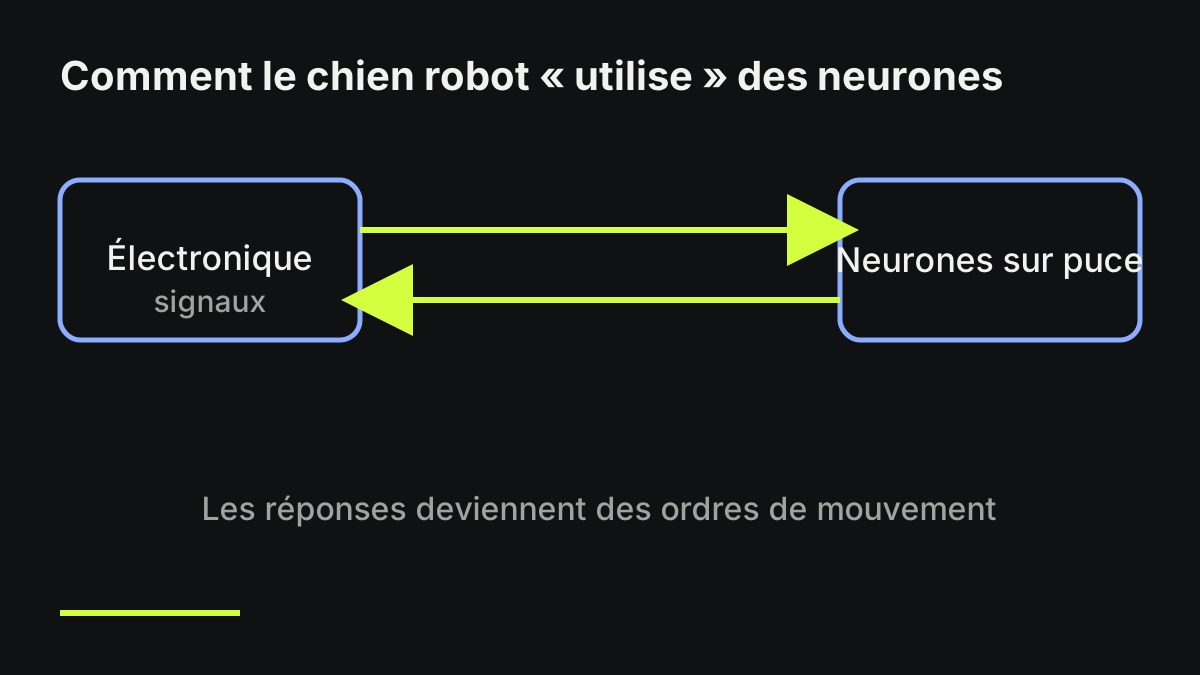
The chip contains many electrodes, small electrical contacts placed under the cells. The system works in a loop:
- The electronics turn a piece of information (for example, the position of a target) into electrical signals.
- These signals are sent to the neurons through the electrodes.
- The neurons respond with their own impulses.
- A program reads these responses and translates them into movement commands.
In the demonstration, the four-legged robot is steered toward a target in a simple situation. According to our source, there's no sign that this demo is part of the study described below.
What the study says
The preprint, posted in May 2026 and revised on October 2, is headed for the NeurIPS 2026 conference. So it hasn't been published in a journal yet: independent researchers can still challenge it.
The researchers were looking for the best way to send information to the neurons. They tested about 1,300 combinations of settings, for more than 4,000 hours of interaction with a virtual environment: a grid where you have to move toward a target by following a "scent gradient." Among these trials, 12 configurations learned consistently. They did better than standard baseline AI programs ("DQN" agents) given the same number of attempts. The abstract we were able to read doesn't give exact figures for that gain.
What it doesn't say
- The number of neurons isn't specified in our source.
- The neurons don't form a whole brain, and the system still relies heavily on conventional electronics.
- Beating a few comparison programs on a simple grid doesn't mean "better than today's AI" in general.
- The promised advantage (adapting to new situations while using little energy) hasn't been shown in real-world applications.
We already untangled a similar case with Mischief 1, the video AI "made from neurons": the word "neurons" in a headline often hides a much more modest project.
So, what changes?
Verdict: half true. The setup exists and the neurons play a real role in the loop, so it isn't pure hype. But "a robot piloted by a human brain" is an exaggeration. Today, this is research: it first needs to be verified in real conditions before anyone imagines products. A realistic timeline? None has been announced; we'll have to wait for review by the scientific community.
Translated with the help of AI from our French article, which is prepared with AI from the sources, then reviewed and approved by Valentin Fouilloud before publication. How we work