Dunkelflaute: when wind and solar power fail at the same time
In November 2024, a big mass of cold, cloudy, windless air stalled over northwestern Europe for about a week. Wind turbines barely turned, and solar panels produced almost nothing. Germans have a word for this scenario: Dunkelflaute. The United Kingdom had to look for extra electricity in early November 2026.
The word, and why it scares power grids
"Dunkel" means dark in German. "Flaute" means a dead calm, the kind you get at sea when the wind drops. The word describes a specific kind of weather: overcast skies, cold and still air. So it combines two failures at once, wind and sun.
The problem is how big a share renewables now have. In the UK, wind and solar provide more than a third of the electricity produced, according to the 2025 review by grid operator NESO cited in the article. Twenty years ago, that share was almost zero. The more you rely on wind and sun, the harder a week without either one hits the grid.
How a grid gets through a Dunkelflaute lull
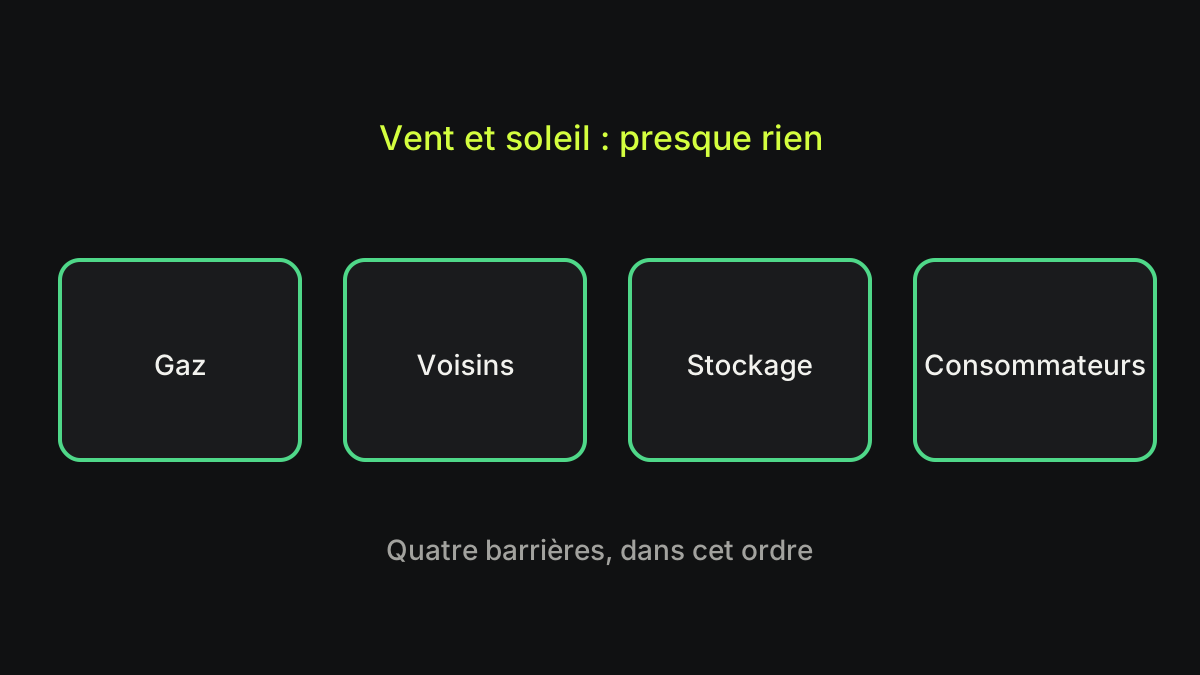
Electricity isn't easy to store in large amounts. So at every moment, the grid has to produce as much as it consumes. If production falls short, the grid's frequency drops, and someone has to act. When wind and sun disappear, several solutions take over, in this order:
- Gas plants fire up. They can ramp up quickly, but they're expensive to run when supply and demand are very tight.
- Neighboring countries send electricity. That works if the neighbors aren't going through the same outage. And that's exactly what happens in a Dunkelflaute, because the weather covers a large region.
- Storage steps in. Batteries and pumped hydro (water pumped uphill, then released to generate electricity) last a few hours. Over several days, they run dry.
- Consumers shift their usage. When there's wind or sun, lower prices can encourage people to run the washing machine or charge their car at that moment.
The cold makes everything worse. People had to use more electricity to heat their homes, which pushes demand up at the worst possible time.
How much gas needs to be kept in reserve?
The article cites a recommendation from NESO, the British grid operator, to keep about 35 gigawatts of gas capacity as backup by 2030. That's roughly the equivalent of thirty or so large nuclear reactors. So gas isn't only there for shortages: it acts as insurance, even in a grid that aims to be renewable.
What the article doesn't put numbers on
The piece is qualitative. It gives neither the amount of electricity that was missing during the November 2024 episode, nor its cost, nor the size of the batteries needed to get through a week without wind. The exact dates and the countries affected, beyond the UK and northwestern Europe, aren't specified either. Measuring the risk would take that data.
For storage over several days, read about the 148-meter tower that stores electricity with concrete blocks. On very fast swings in the grid, see the mystery of the 60-second dips, solved.
Key takeaways
- A Dunkelflaute combines overcast skies with calm, cold air, for about a week.
- In the UK, wind and solar provide more than a third of the electricity.
- The grid holds up thanks to four solutions: gas, neighboring countries, storage and lower consumption.
- Batteries last a few hours, not days, which is why a gas reserve is kept.
Translated with the help of AI from our French article, which is prepared with AI from the sources, then reviewed and approved by Valentin Fouilloud before publication. How we work