Data centers and electricity bills: who pays in the US?
A data center can use as much electricity as a mid-sized city. A Cornell study, published in the journal Nature Energy, looks at who pays for the grid upgrades needed to keep it running. It covers four large US regions, from 2020 to 2025. The answer: a big share of the bill lands on residents, especially low-income households.
Key takeaways
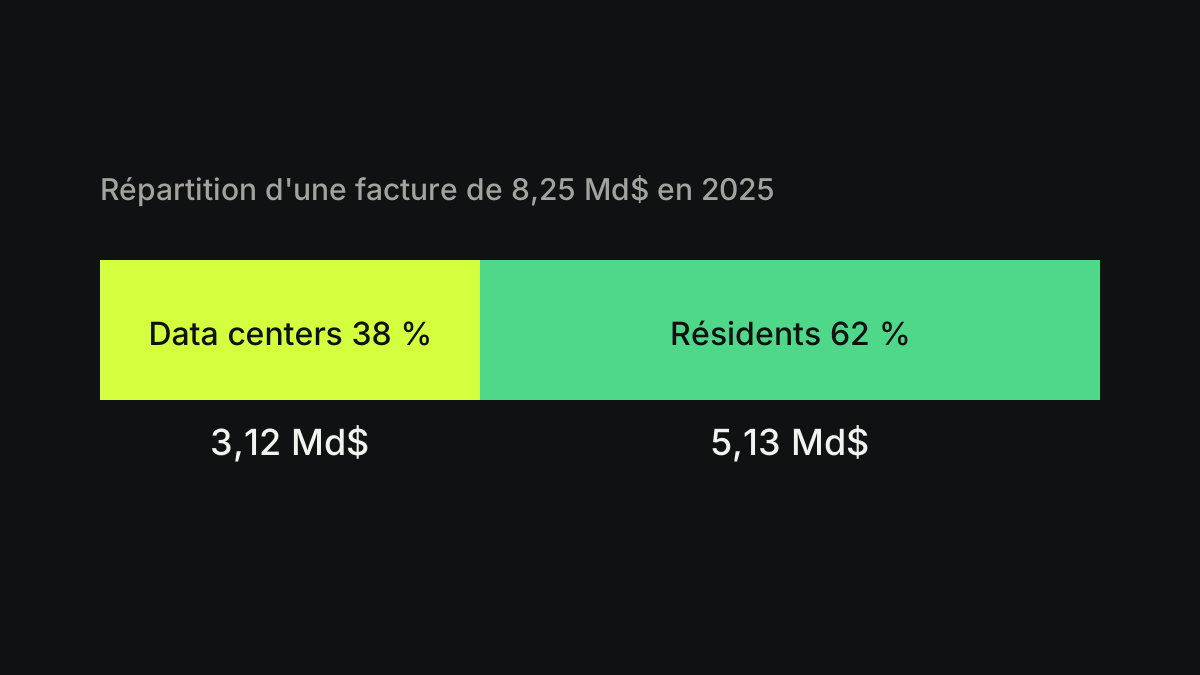
- In 2025, residents paid 62% of the $8.25 billion bill studied, data centers 38%.
- Investment in electricity transmission went from $2 billion to $34 billion between 2020 and 2025.
- In some regions, wholesale prices rose by about 10% or more in 2025.
- Low-income households are the most exposed. The 2030 projections are still models.
Why a data center drives up the bill
The mechanism comes down to four steps:
- A data center needs a lot of electricity, around the clock.
- The power grid then has to be upgraded: lines, transformers, substations. That work is expensive.
- These costs are split among the grid's customers according to rate rules, and those rules decide everyone's share.
- In the affected regions, wholesale prices go up, and bills follow.
The researchers give a specific example: residents of New Jersey, Pennsylvania and Ohio also pay for part of the upgrades made in Virginia, home to a lot of data centers.
What the numbers show
- Investment in electricity transmission went from $2 billion in 2020 to $34 billion in 2025.
- On a bill of $8.25 billion in 2025, data centers paid $3.12 billion, or 38%. Residents paid $5.13 billion, or 62%.
- Wholesale prices rose by about 15% in Virginia and 20% in the South Bay, the southern part of the San Francisco Bay Area.
- In the lowest-income households, extra energy costs can reach 28% of income.
- New York and New England show no clear increase linked to data centers.
The chart in the illustration shows how the 2025 bill was split.
Who benefits, and how many jobs?
The authors also note the upside. According to them, one gigawatt of capacity creates about 15,000 jobs across the economy, including 2,700 directly on site. These jobs don't necessarily make up for the higher bills paid by households in nearby areas, and the study doesn't measure that balance.
Projections, sample and method
- Several numbers are projections. The estimate that data centers will use 8 to 17% of US electricity in 2030, 70 to 80% of it for AI, comes from models.
- The number of households and counties analyzed isn't given in the TechXplore article.
- The link between rural areas and AI use relies on a national survey that's cited, not on the study's own data.
- The exact method for splitting costs isn't detailed.
These limits don't undermine the main finding: grid costs are split unevenly between regions and types of customers.
What could change
The authors suggest two options: asking data centers to cut their consumption during about 22 peak hours a year, and charging them for the grid based on the demand they add. Fengqi You, one of the authors, acknowledges that they still have to be put into practice.
On flexibility, you can compare this with France's off-peak hours changing on December 1. On the water side, data center water use, real or overblown controversy covers another part of their impact.
Translated with the help of AI from our French article, which is prepared with AI from the sources, then reviewed and approved by Valentin Fouilloud before publication. How we work