100,000 Times Faster Electronics? What the Study Really Says
Verdict: Hype
Physicists at the University of Regensburg, in Germany, have measured a quantum limit: you can't track an electron with infinite precision in both space and time at once. ScienceDaily's headline talks about electronics 100,000 times faster. The study itself describes a long-term goal, with no date.
Key takeaways
- The study, published in the journal Nature Photonics, describes a limit on an electron's position and timing taken together.
- The measurements cover a few atomic diameters, using calibrated laser pulses.
- The 100,000 times figure is a long-term goal, not a measurement.
- The first applications the team has in mind are chemical reactions, not chips.
What is the limit they found?
An electron has a position, and it moves through time. The researchers show that these two pieces of information share a common precision limit. This isn't the famous Heisenberg uncertainty principle, which links position and velocity. Here, the pair in question is position and time.
The trade-off is easy to sum up. To time the electron's motion very precisely, you have to give it more energy. The more energy it gets, the more its "wave packet," the zone where it can be found, spreads out in space.
How you measure an electron
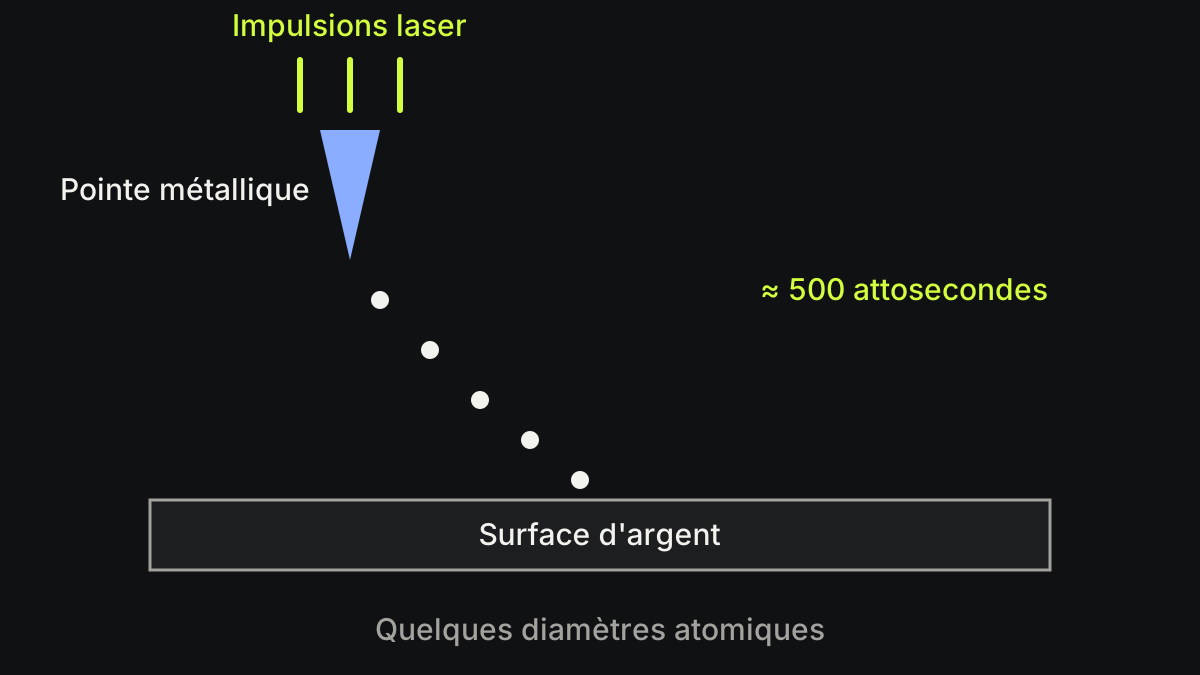
The setup comes down to three parts. A laser sends calibrated pulses that knock electrons out of an ultra-sharp metal tip. The electrons travel toward a silver surface, a few atomic diameters away. A single atom placed on the surface tightens the wave packet just before the pulse.
The electric current that results lets the team read the timing of the motion, using two pulses separated by a controlled interval. The time scale is the attosecond, or 10⁻¹⁸ second: a billionth of a billionth of a second.
The electrons react about 500 attoseconds after the light field. That result comes from simulations by Angel Rubio's team at the Max Planck Institute in Hamburg, which match the experiment. Locally, the current density can reach 1,000 billion amperes per square centimeter, when an electron's charge is packed into a very short slice of space-time.
Where does the 100,000 figure come from?
ScienceDaily's headline promises 100,000 times faster. The body of the article talks about "hundreds of thousands of times" faster than CMOS technology, the kind inside today's chips. That figure is a projection, not something that has been demonstrated.
The setup is nothing like a circuit. It studies electrons one at a time, in a very specific configuration: a tip, a surface, an atom. Getting from there to a processor means building an entire path from scratch.
The verdict: toc
The claim that "electronics could become 100,000 times faster" is heavily overstated. The physics is real and measured. The speed gain for chips, though, is only a goal, with no date and no prototype.
What the researchers want to do first
Jascha Repp, from the University of Regensburg, is considering using these wave packets to trigger chemical reactions and watch bonds break or change. Rupert Huber, from the same lab, talks about a longer-term goal: electronics and quantum information processing running at the speed limit of electron motion. No timeline is given for these applications.
A discovery of the same kind, altermagnetism, the third type of magnetism, is following the same path: a real measurement in the lab, with applications still far off.
Translated with the help of AI from our French article, which is prepared with AI from the sources, then reviewed and approved by Valentin Fouilloud before publication. How we work