October 31: Intel sinks, OpenAI trims its raise, xAI in court
A wild end to the week: the AI race is pushing up the price of your next PC, money is getting harder to raise, and data centers are ending up in court.
Intel crashes over memory prices
On Friday, October 30, Intel's stock lost about 28%, one of its worst days. The reason: Intel expects $15 to $16 billion in revenue at the end of the year, while analysts were expecting $17 billion. Its CEO says customers see a slowdown in PC sales coming, because memory has become expensive and hard to find: AI data centers are swallowing huge amounts of it. Why it matters: if you're planning to buy a laptop or build a gaming PC, expect to pay more for RAM, and so for the whole machine. Source: TechCrunch
OpenAI scales back its funding round
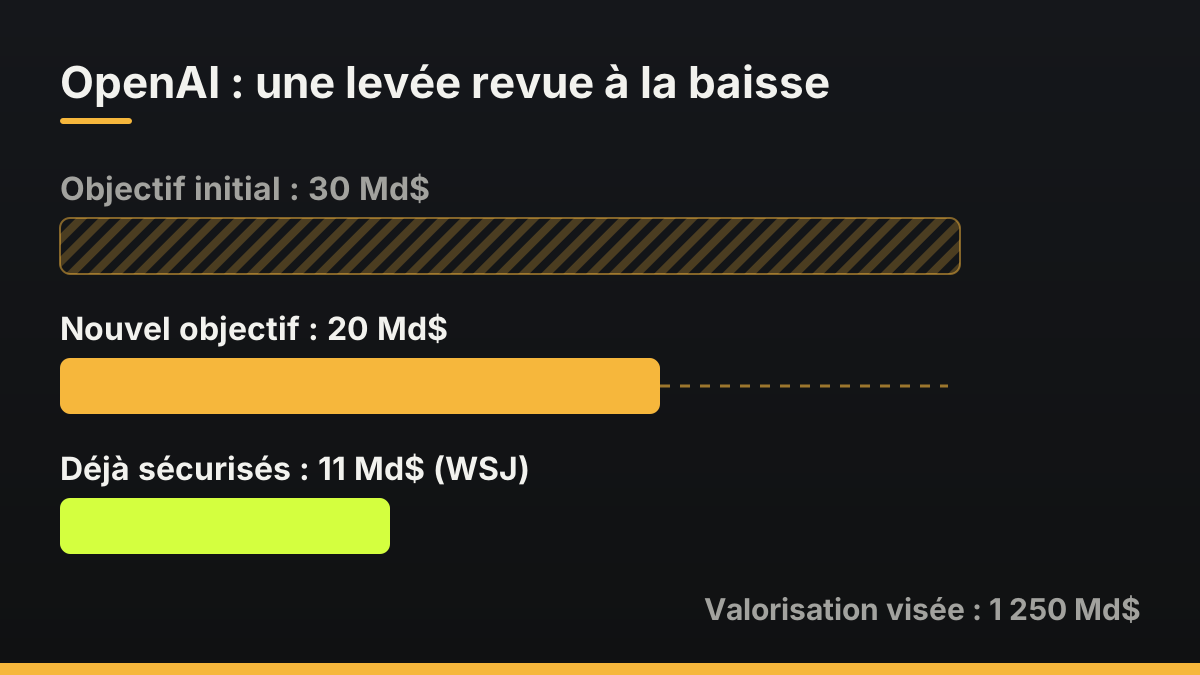
According to the Financial Times (October 30), OpenAI is no longer aiming for $30 billion but $20 billion in its new funding round, led by investors from the United Arab Emirates. The Wall Street Journal reports that $11 billion is already lined up, but some big investors are lukewarm. OpenAI didn't comment. Why it matters: the companies behind ChatGPT and Claude are spending fortunes on chips, and investors are starting to doubt it will all pay off. It's also a bad sign for Anthropic's IPO. Source: TechCrunch
xAI's gas turbines stay in court
On Friday, October 30, a federal court in Mississippi refused to throw out the lawsuit filed by the NAACP, a major civil rights organization, against xAI, Elon Musk's AI company, now part of SpaceX. The NAACP accuses it of running 27 gas turbines without permits in Southaven, between August and December 2025, to power its Colossus data centers in the Memphis area. xAI argued that these "mobile" turbines didn't need permits: the judge rejected that argument. Why it matters: AI needs so much electricity that some companies generate it on site with gas, and it's the people living nearby who breathe the pollution. Source: CNBC
Reddit plunges and wants you to log in
On October 30, Reddit's stock fell 29%, its worst day since going public in 2024. Its end-of-year forecast disappointed, and its CEO acknowledges that traffic from Google dropped noticeably this quarter, which the CEO blames on AI: the generated summaries at the top of search results answer your question without you clicking. So Reddit is going to test requiring users to log in to read its content. Why it matters: if you often land on Reddit when looking for an answer, you might soon need an account to read it. Source: CNBC
One line to stop AI from training on your site
On October 30, Google announced that it will respect a new signal placed in the robots.txt file, the small file that tells bots what they're allowed to read on a website. A single line will be enough to opt out of AI training with several companies at once, instead of blocking each bot one by one. Microsoft (Bing), OpenAI and Anthropic have announced similar moves. The standard is still just a proposal at the IETF, the body that sets the internet's technical rules, and Google is aiming for early 2027. Why it matters: if you have a blog or a portfolio, you'll have a simple way to keep your writing out of AI training. Source: Search Engine Roundtable
Google's AI satellite answered from orbit
Google announced on October 30 that the prototype for its Suncatcher project, launched this month and built by Planet, is working. It carries four AI chips (TPUs), only one of which runs at a time, for about twenty minutes straight. That chip ran the Gemma 4 model and sent a haiku about space back to Earth. The real test: checking that these chips can withstand radiation and temperature swings. Two more satellites are planned for 2027. Why it matters: the idea is to power data centers with sunlight in orbit, but Google isn't aiming for a profitable version until the 2030s. Source: TechCrunch
Behind some "AI agents," there are still humans
A CNBC investigation published on October 31 shows that AI agent startups such as Dazzle, Duckbill and Wajo hand some tasks to people: making calls, booking appointments, solving CAPTCHAs. Meta also ran internal tests where human contractors placed calls for its Muse assistant, which worried some employees about privacy. The startups are upfront about it: according to them, AI alone still fails too often. Why it matters: when an app promises you an AI that "does everything on its own," a human may actually be able to see your requests. Source: CNBC
Translated with the help of AI from our French article, which is prepared with AI from the sources, then reviewed and approved by Valentin Fouilloud before publication. How we work