Did OpenAI's Navier-Stokes proof emit 1,000 metric tons of CO2?
Verdict: Half true
In early September 2026, OpenAI announced that its AI had solved a math problem considered one of the hardest in the world, the Navier-Stokes equations. Ten thousand AI agents worked for 88 hours straight. Victor Charpenay, a professor and researcher at Mines Saint-Étienne, a French engineering school, estimated in The Conversation on November 12 that this computation emitted more than 1,000 metric tons of CO2 equivalent, the annual footprint of about 100 European researchers.
Key takeaways
- The estimate starts from the number of words the AI generated (130 billion tokens), since OpenAI hasn't released data on its energy use.
- It comes to about 500 metric tons of CO2 for the proof alone, and more than 1,000 metric tons counting the failed attempts.
- The author openly admits to "fragile assumptions": the figure could be far from the truth, in either direction.
- The proof itself is still being debated by mathematicians.
Navier-Stokes: what is this problem?
They're the equations that describe how fluids move: water in a pipe, air around an airplane wing, smoke from a candle. They've been used since the nineteenth century, but nobody had proven that they always have a "clean" solution, with no value shooting off to infinity. The Clay Mathematics Institute made it one of its seven Millennium Prize Problems, with a million-dollar prize attached.
OpenAI published its proof on September 8, with a version that can be checked by Lean, software that verifies proofs line by line. The company said it would not claim the prize. Mathematicians point out that the result covers a version of the equations with an external force, while the Clay Institute's problem targets the version without one. A researcher at New York University also accuses OpenAI of rushing to get ahead of a competing project. So what the result really proves is still up for debate, whatever its cost.
The 1,000-ton calculation, step by step
OpenAI hasn't said how much electricity its 10,000 agents used. So Victor Charpenay rebuilt an estimate from what the company did publish.
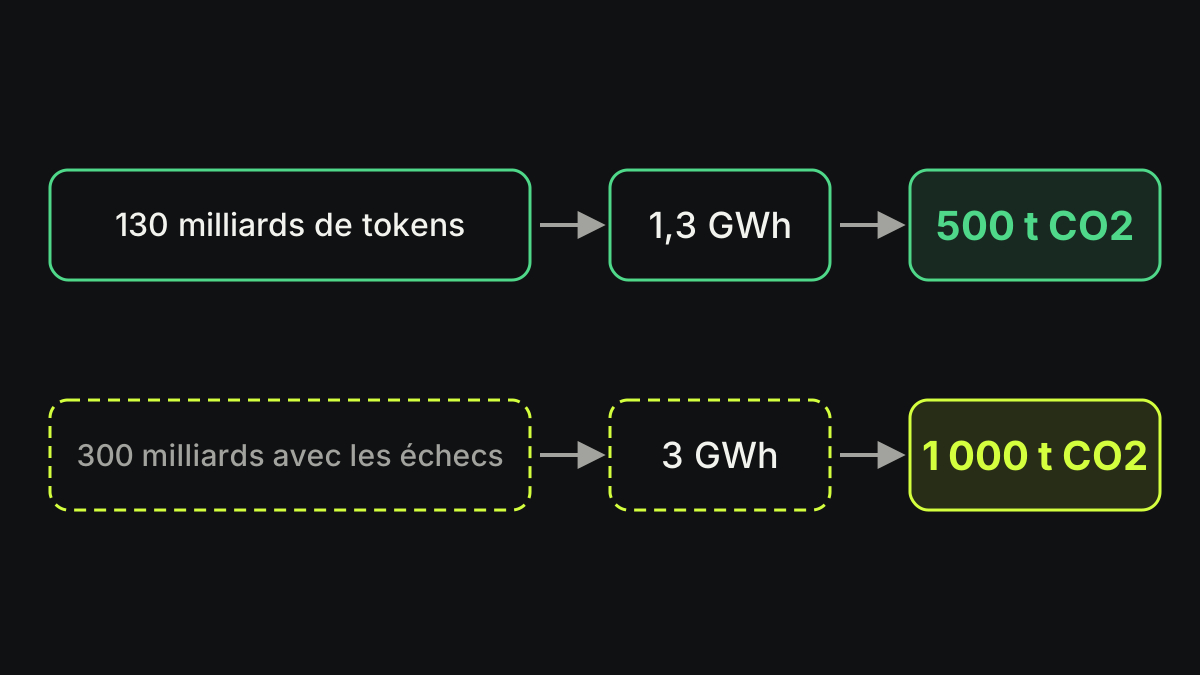
- Count what the AI wrote. According to OpenAI, the agents exchanged 2.7 million messages and produced about 130 billion tokens (pieces of words, the basic unit of a language model). For comparison, the entire Harry Potter series has about a million words: the AI wrote the equivalent of nearly 100,000 times that.
- Find the cost of one token. OpenAI's model is secret. So the author uses measurements by Neuralwatt on an open model, Kimi K3: 33.6 kilojoules per 1,000 tokens, or about 10 watt-hours. That's what an LED bulb uses when it's on for an hour.
- Multiply. 130 billion tokens at that rate come to about 1.3 gigawatt-hours.
- Convert to CO2. Using the average carbon intensity of US electricity in 2026, 388 grams per kilowatt-hour, you get about 500 metric tons of CO2 equivalent.
- Add the failed attempts. OpenAI ran its agents on other problems without saying whether they succeeded. The author puts the total at about 300 billion tokens, or 3 gigawatt-hours and more than 1,000 metric tons.
The 500 metric tons for the proof alone match the annual carbon footprint of about 50 Europeans. The 1,000 metric tons, that of about a hundred mathematicians over a year. The author adds a budget comparison: the cost of the computation would cover about forty PhD grants in France.
Why Kimi K3 might throw everything off
Step 2 carries almost the entire result. If OpenAI's model uses half as much energy per token as Kimi K3, the footprint is cut in half. If it's bigger, the footprint goes up. Nobody outside OpenAI can check.
The author flags another weakness: a model's energy use depends mostly on how long it computes, more than on the number of tokens it produces. A model that "thinks" for a long time before writing can burn a lot of energy for very little text. Yet the calculation doesn't account for that duration. Finally, the carbon intensity of 388 g/kWh is a national average; a data center running on gas would emit more, and one plugged into nuclear or hydro far less.
Google and OpenAI have already disputed academic estimates of their models' energy use in the past. The only way to settle it would be for OpenAI to publish its own numbers.
Is 1,000 metric tons a lot?
For a single scientific result, yes. The author compares it with physics: the GRAND radio antenna array accounts for 471 metric tons of CO2 equivalent, and a large Cherenkov telescope between 2,400 and 2,950 metric tons over its entire 30-year life. OpenAI's proof would weigh as much as ten to fifteen years of running such a telescope, in 88 hours.
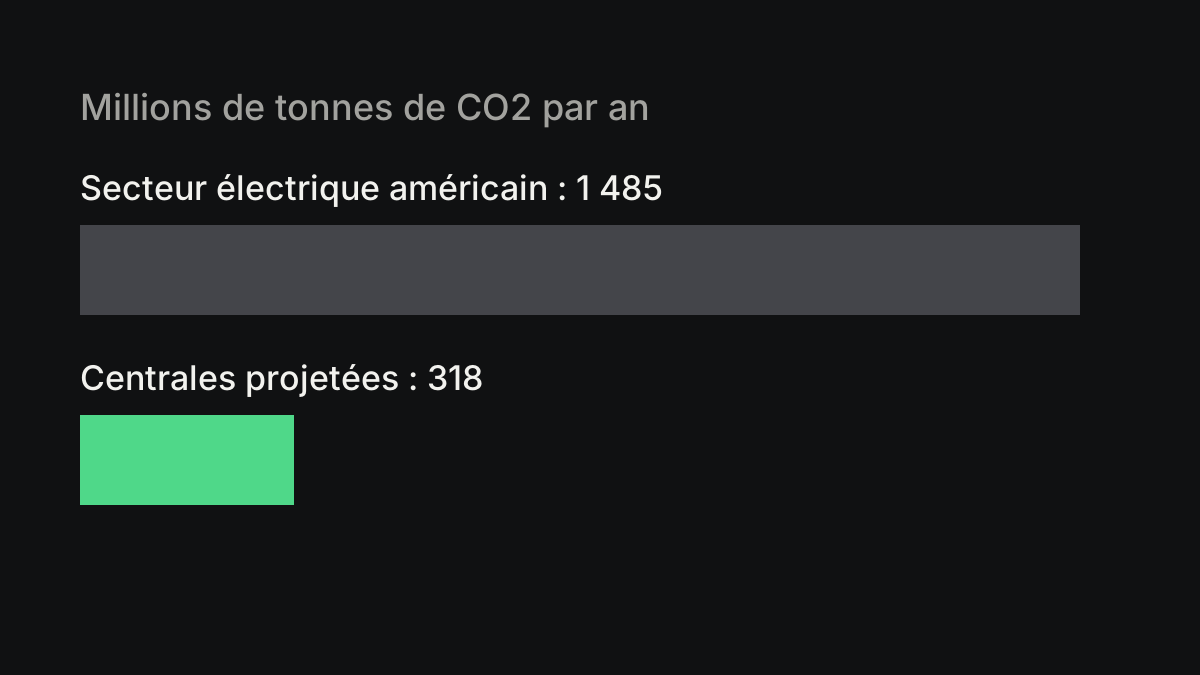
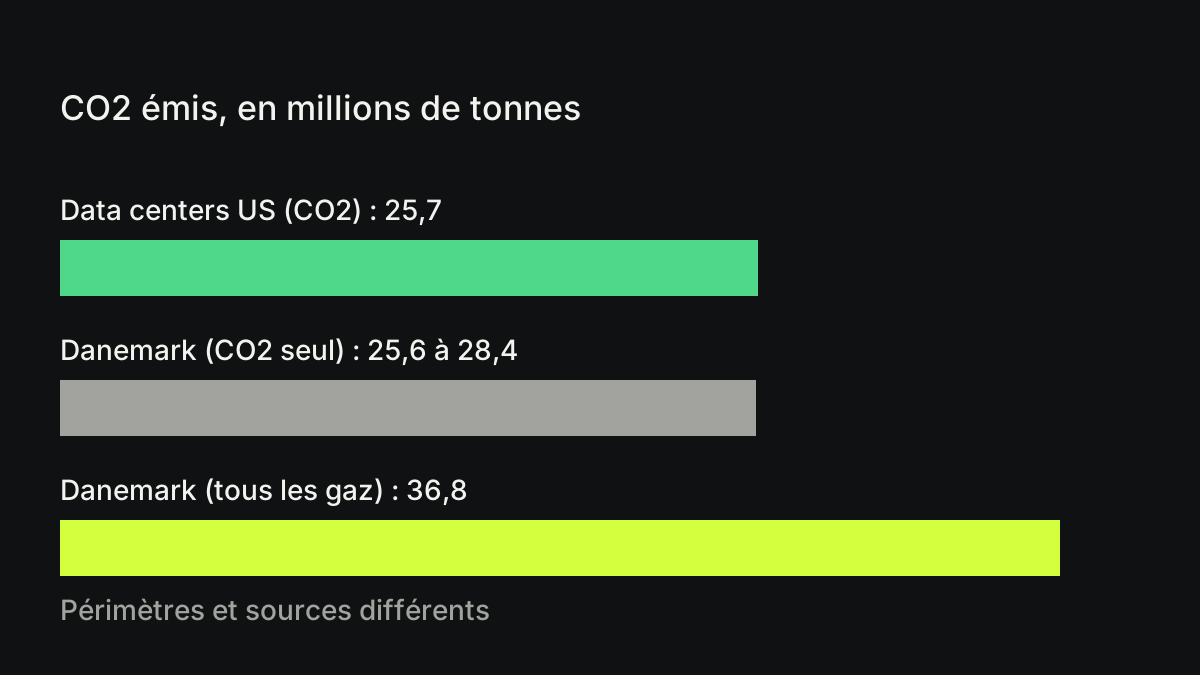
On the scale of AI, though, it's small. Big data centers are measured in hundreds of megawatts. A 1,000 MW site, the power OpenAI promises it can cut at its data center in Georgia, uses 3 GWh in three hours at full load.
So the word "astronomical" in The Conversation's headline is fair compared with a researcher's work, and exaggerated compared with the rest of the industry. The 1,000-ton figure is a plausible order of magnitude, built honestly, but it rests on a stand-in model that nothing can validate. We rate it half true until OpenAI publishes its real energy use.
Translated with the help of AI from our French article, which is prepared with AI from the sources, then reviewed and approved by Valentin Fouilloud before publication. How we work