AI agents booked only 4 Uber rides: what does it really mean?
Verdict: Half true
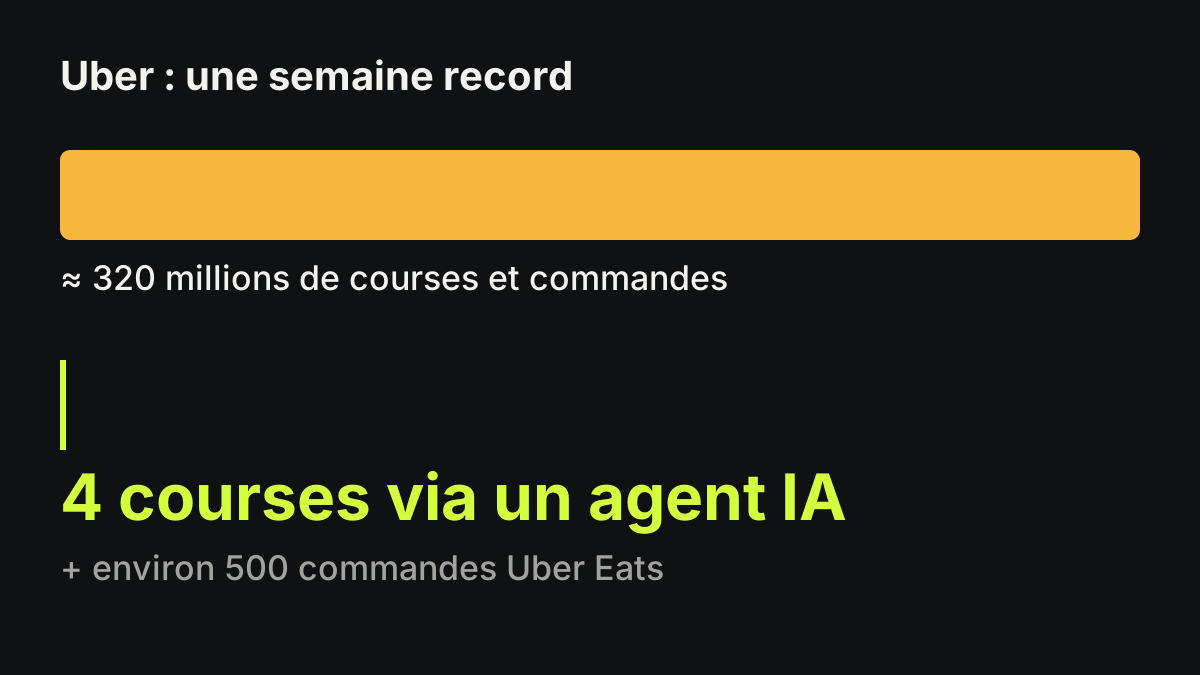
"Soon, your AI assistant will order everything for you." On November 4, 2026, Uber gave a first concrete number. During its busiest week of the quarter, only 4 rides were booked by AI agents. It's a tiny number. But above all, it's a useful one for understanding where these agents really stand.
Key takeaways
- Uber shared these numbers during its third-quarter earnings presentation on November 4, 2026.
- Its busiest week had about 320 million rides and orders. Only 4 rides and about 500 Uber Eats orders came from an AI agent.
- The CEO talks about "very, very low and limited traction."
- That doesn't prove agents have no future. It proves they aren't replacing apps yet.
The numbers, in perspective
Out of about 320 million transactions in one week, that's four ride-hailing trips and barely 500 meal orders placed through an agent. For rides, that's roughly one in 80 million (a calculation based on the numbers above, counting only rides, not meals). Agent meal orders are more common, but still tiny.
It's the same story at a competitor, DoorDash: only a few hundred orders through agents the week before, according to TechCrunch.
Why isn't it taking off?
Uber makes a simple argument: the app is already fast. Booking a ride takes about 50 seconds. Reordering your favorite dish, about 90 seconds. Asking an agent to do the same thing, by phrasing the request, waiting for its answer and checking it, doesn't necessarily save time. These are the company's explanations, and it has an interest in downplaying the threat. They're plausible, but they aren't proven.
What Uber is doing anyway
CEO Dara Khosrowshahi sees agents as a new channel to reach customers, not as a threat. He counts about eight major AI assistants today, and expects more than ten over time. According to him, "every AI company is talking to us." In other words: Uber is getting ready, just in case.
A contrast with the market's excitement
The same TechCrunch article notes that startup Instinct, which is building a personal agent, raised money at a $10 billion valuation. It also mentions Muse, Meta's agent: more than 10 million users, and number one on the US App Store. Meta says many people use it to buy things or get tasks done with businesses.
So millions of people are trying agents, but very few use them for actual purchases. Companies that already block some agents, as we explained in our article on Meta's Muse, don't make things easier either. And behind some agents, it's sometimes humans doing the work.
So, what changes?
Verdict: half true. The idea that "an AI agent replaces your apps" isn't true today, and Uber's numbers show it. But it isn't disproven either: we're at the very beginning, at a single company, over a single quarter.
For you, the practical takeaway is simple: for now, your usual app is still the fastest way to order. What to watch: Uber's and DoorDash's next earnings, which will show whether these numbers move.
Translated with the help of AI from our French article, which is prepared with AI from the sources, then reviewed and approved by Valentin Fouilloud before publication. How we work